Researchers develop ultra-simple method for creating nanoscale gold coatings (w/ Video)
June 16, 2010
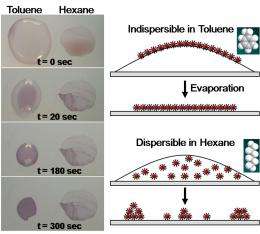
Researchers at Rensselaer Polytechnic Institute have developed a new, ultra-simple method for making layers of gold that measure only billionths of a meter thick. As seen in the research image, drops of gold-infused toluene applied to a surface evaporate within a few minutes and leave behind a uniform layer of nanoscale gold. The process requires no sophisticated equipment, works on nearly any surface, takes only 10 minutes, and could have important implications for nanoelectronics and semiconductor manufacturing. Credit: Rensselaer/Eah
Researchers at Rensselaer Polytechnic Institute have developed a new, ultra-simple method for making layers of gold that measure only billionths of a meter thick. The process, which requires no sophisticated equipment and works on nearly any surface including silicon wafers, could have important implications for nanoelectronics and semiconductor manufacturing.
Sang-Kee Eah, assistant professor in the Department of Physics, Applied Physics, and Astronomy at Rensselaer, and graduate student Matthew N. Martin infused liquid toluene - a common industrial solvent - with gold nanoparticles. The nanoparticles form a flat, closely packed layer of gold on the surface of the liquid where it meets air. By putting a droplet of this gold-infused liquid on a surface, and waiting for the toluene to evaporate, the researchers were able to successfully coat many different surfaces - including a 3-inch silicon wafer - with a monolayer of gold nanoparticles.
"There has been tremendous progress in recent years in the chemical syntheses of colloidal nanoparticles. However, fabricating a monolayer film of nanoparticles that is spatially uniform at all length scales - from nanometers to millimeters - still proves to be quite a challenge," Eah said. "We hope our new ultra-simple method for creating monolayers will inspire the imagination of other scientists and engineers for ever-widening applications of gold nanoparticles."
Watch a video demonstration of this new fabrication process at:
This video is not supported by your browser at this time.
Monolayer films of gold nanoparticles can be fabricated using a toluene droplet without using any sophisticated instruments. Synthesis of dodecanethiolate-protected gold nanoparticles is fast, reproducible, and 1 nm size-tunable without any post-synthesis cleaning.
Results of the study, titled "Charged gold nanoparticles in non-polar solvents: 10-min synthesis and 2-D self-assembly," were published recently in the journal Langmuir.Whereas other synthesis methods take several hours, this new method chemically synthesizes gold nanoparticles in only 10 minutes without the need for any post-synthesis cleaning, Eah said. In addition, gold nanoparticles created this way have the special property of being charged on non-polar solvents for 2-D self-assembly.
Previously, the 2-D self-assembly of gold nanoparticles in a toluene droplet was reported with excess ligands, which slows down and complicates the self-assembly process. This required the non-volatile excess ligands to be removed in a vacuum. In contrast, Eah's new method ensures that gold nanoparticles float to the surface of the toluene drop in less than one second, without the need for a vacuum. It then takes only a few minutes for the toluene droplet to evaporate and leave behind the gold monoloayer.
"The extension of this droplet 2-D self-assembly method to other kinds of nanoparticles, such as magnetic and semiconducting particles, is challenging but holds much potential," Eah said. "Monolayer films of magnetic nanoparticles, for instance, are important for magnetic data storage applications. Our new method may be able to help inform new and exciting applications."
More information: Read the journal paper at: http://dx.doi.org/10.1021/la100591h
-
In Brief: Gold nanoparticles might fight cancer
May 22, 2006 |
not rated yet |
0
-
Humidity sensor: hybrid nanoelectronics made from living bacteria and gold nanoparticles
Oct 07, 2005 |
not rated yet |
0
-
Gold nanoparticles enrich every day products
May 05, 2010 |
not rated yet |
0
-
Natural Gum Improves Gold Nanoparticles for Cancer Imaging
Feb 12, 2007 |
not rated yet |
0
-
'There's Gold In Them That Exhausts!'
Aug 30, 2007 |
not rated yet |
0
-
Engineers build first sub-10-nm carbon nanotube transistor
Feb 01, 2012 |
4.9 / 5 (31) |
30
-
Something old, something new: Evolution and the structural divergence of duplicate genes
Jan 31, 2012 |
4.6 / 5 (7) |
1
-
The hidden nanoworld of ice crystals: Revealing the dynamic behavior of quasi-liquid layers
Jan 30, 2012 |
5 / 5 (3) |
1
-
Stock market network reveals investor clustering
Jan 27, 2012 |
3.9 / 5 (23) |
8
-
Of microchemistry and molecules: Electronic microfluidic device synthesizes biocompatible probes
Jan 26, 2012 |
5 / 5 (1) |
0
-
polymer nanocomposites
Feb 10, 2012
-
Corrosion Tests on Magnesium
Feb 09, 2012
-
polyethylene copper nanocomposite
Feb 09, 2012
-
Output of xrd analysis
Feb 08, 2012
-
Transport phenomena problem based on problems 18.B11 and 19B.6 from Bird, stewart, lw
Feb 06, 2012
-
Help with material selection - Car Piston
Feb 05, 2012
- More from Physics Forums - Materials & Chemical Engineering
More news stories
What lies beneath: Mapping hidden nanostructures
The ability to diagnose and predict the properties of materials is vital, particularly in the expanding field of nanotechnology. Electron and atom-probe microscopy can categorize atoms in thin sheets of material, ...
18 hours ago |
5 / 5 (3) |
1
New kind of solar cell could capture significantly more energy than current cells
New solar cells could increase the maximum efficiency of solar panels by over 25%, according to scientists from the University of Cambridge.
Feb 08, 2012 |
4.5 / 5 (12) |
14
|
Nanoshell whispering galleries improve thin solar panels
Visitors to Statuary Hall in the U.S. Capitol Building may have experienced a curious acoustic feature that allows a person to whisper softly at one side of the cavernous, half-domed room and for another on ...
Nanotechnology / Nanomaterials
Feb 07, 2012 |
4.3 / 5 (6) |
6
|
'Dark plasmons' transmit energy
Microscopic channels of gold nanoparticles have the ability to transmit electromagnetic energy that starts as light and propagates via "dark plasmons," according to researchers at Rice University.
Feb 09, 2012 |
4.8 / 5 (9) |
1
|
Revealing how a battery material works
Since its discovery 15 years ago, lithium iron phosphate (LiFePO4) has become one of the most promising materials for rechargeable batteries because of its stability, durability, safety and ability to deliver ...
Nanotechnology / Nanomaterials
Feb 08, 2012 |
5 / 5 (5) |
0
|
Anonymous knocks CIA website offline (Update)
The website of the Central Intelligence Agency was inaccessible on Friday after the hacker group Anonymous claimed to have knocked it offline.
New error-correcting codes guarantee the fastest possible rate of data transmission
Error-correcting codes are one of the triumphs of the digital age. Theyre a way of encoding information so that it can be transmitted across a communication channel such as an optical fiber o ...
Humans may have helped the decline of African rainforests 3000 years ago
(PhysOrg.com) -- Large areas of rainforests in Central Africa mysteriously disappeared over three thousand years ago, to be replaced by savannas. The prevailing theory has been that the cause was a change ...
New power source discovered
(PhysOrg.com) -- Researchers at the Massachusetts Institute of Technology (MIT) and RMIT University have made a breakthrough in energy storage and power generation.
Small modular reactor design could be a 'SUPERSTAR'
(PhysOrg.com) -- Though most of today's nuclear reactors are cooled by water, we've long known that there are alternatives; in fact, the world's first nuclear-powered electricity in 1951 came from a reactor ...
Google users warned of threat to smartphone wallets
Users of Google smartphone wallets were being warned on Friday that there is a way to crack pass codes intended to thwart thieves from going on illicit shopping sprees.
Jun 16, 2010
Rank: not rated yet
Jun 16, 2010
Rank: not rated yet
Jun 16, 2010
Rank: not rated yet
Jun 17, 2010
Rank: not rated yet
From reading the abstract of the actual paper it seems that they first disperse charged gold nanoparticles in hexane. They then mix a small hexane droplet with a larger toluene droplet. The gold nanoparticles then float to the toluene/air interface and form a monolayer which is deposited on the surface after the hexane and toluene evaporate.
Pretty cool way of getting a uniform layer on the surface of the toluene.