Comet cause for climate change theory dealt blow by fungus
June 17, 2010
Comet cause for climate change theory dealt blow by fungus

Enlarge

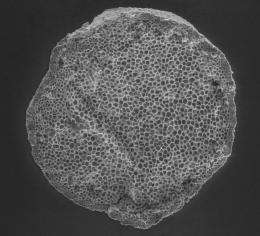
Specimen from Arlington Canyon, Santa Rosa Island, California, U.S.A.. (12,800-13,100 cal BP), section through spherule.

(PhysOrg.com) -- A team of scientists - led by Professor Andrew C Scott of the Department of Earth Sciences at Royal Holloway, University of London - have revealed that neither comet nor catastrophe were the cause for abrupt climate change some 12,900 years ago.

Theories of impacts and their influence on animal extinctions and are receiving increasing attention both in the scientific and popular literature. Despite increasing evidence to dispute the theory, the idea that onset of the Younger Dryas (‘Big Freeze’) climate interval, mega-faunal extinctions, including mammoths, the demise of the North American Clovis culture, and a range of other effects, is due to a airburst and/or impact event has remained alive both through written and television media despite growing negative scientific evidence.

One key aspect of this claim centers on the origin of ‘carbonaceous spherules’ that purportedly formed during intense, impact-ignited wildfires. Theorists have used these ‘carbonaceous spherules’ as evidence for their comet impact-theories, but this new study concludes that those supposed clues are nothing more than fossilized balls of fungus, charcoal, and fecal pellets. These naturally-occurring organic materials also date from a period thousands of years both before and after the Younger Dryas period began, further suggesting that there was no sudden impact event.

The research team examined organic residues from some of the proposed sites to investigate the nature of these organic spheres and ‘carbon elongates’ that ranged in size from 1/2 to 2mm (1/10 inch).

Samples from Pleistocene-Holocene sedimentary sequences in the California Channel Islands and other sites show that carbon spherules and elongate forms are common in samples dating to before, during, and well after the 12,900-year time horizon, including from modern samples. Professor Scott says, “Importantly, we were able demonstrate that these organic spheres were found commonly in both modern and ancient sediments and were not just restricted to any particular layer”.

The researchers undertook a series of microscopic studies, including using the advanced Swiss Light Source to probe their internal structure using Synchrotron Radiation X-ray Tomographic Microscopy (SRXTM) to show that carbon spherules have morphologies and internal structures identical to fungal sclerotia (such as Sclerotium and Cenococcum). In investigating these objects, Professor Scott commented: “These spherules had been commonly seen by researchers but little attention was paid to them and so few images existed in the literature. Perhaps it is not surprising that they have been misidentified. Some of the elongate forms described in other pa pers by the impact supporters are arthropod fecal pellets, some almost certainly from termites”.

Professor Scott points out that “we should always have a skeptical attitude to new theories and to test them thoroughly and if the evidence goes against them they should be abandoned”. Professor Pinter, one the report’s authors, from Southern Illinois University, adds, “I think we have reached that stage with the Younger Dryas impact theory”.

The paper, entitled ‘Fungus, not comet or catastrophe, accounts for carbonaceous spherules in the Younger Dryas ‘impact layer’, is published in the journal ‘Geophysical Research Letters’.

Provided by Royal Holloway, University of London

4.7 /5 (13 votes)  

Filter


Move the slider to adjust rank threshold, so that you can hide some of the comments.


Display comments: newest first

dobermanmacleod
Jun 18, 2010

Rank: 5 / 5 (1)
I thought the most popular theory was a glacial lake emptying into the Atlantic, stifling the Gulf Stream (the current conveyor belt that transports something like a million billion watts of heat north). Sure would be nice if we knew why such a gigantic abrupt climate change event took place - although now it is more likely the earth will abruptly change into the hot state, not the cold one.
Gene_H
Jun 18, 2010

Rank: 1 / 5 (1)
As far I know, fungi are killing bees, bats, lizards, frogs and snakes by now, too...
Rank 4.7 /5 (13 votes)
Relevant PhysicsForums posts
  • Discrepancy between oxygen and carbon-dioxide levels
    created8 hours ago
  • where gems are found in the world
    created12 hours ago
  • Wind Waves in Reservoir ~ Wind run-up and Wind set-up
    createdFeb 08, 2012
  • Balance of oxygen in the atmosphere
    createdFeb 01, 2012
  • The case for a methanol-based economy
    createdJan 30, 2012
  • Weather in a rotating cylinder
    createdJan 25, 2012
  • More from Physics Forums - Earth

More news stories

NASA budget will axe Mars deal with Europe: scientists

US President Barack Obama's budget proposal to be submitted next week for 2013 will cut NASA's budget by 20 percent and eliminate a major partnership with Europe on Mars exploration, scientists said Thursday.

Space & Earth / Space Exploration

created 57 minutes ago | popularity not rated yet | comments 0

Humans may have helped the decline of African rainforests 3000 years ago

(PhysOrg.com) -- Large areas of rainforests in Central Africa mysteriously disappeared over three thousand years ago, to be replaced by savannas. The prevailing theory has been that the cause was a change ...

Space & Earth / Environment

created 1 hour ago | popularity 5 / 5 (1) | comments 0 | with audio podcast report

New views show old NASA Mars landers

(PhysOrg.com) -- The High Resolution Imaging Science Experiment (HiRISE) camera on NASA's Mars Reconnaissance Orbiter recorded a scene on Jan. 29, 2012, that includes the first color image from orbit showing ...

Space & Earth / Space Exploration

created 23 hours ago | popularity 4.9 / 5 (7) | comments 9 | with audio podcast

Black holes and star formation

(PhysOrg.com) -- It has long been recognized that galaxy mergers or even close interactions can play a vital role in shaping the morphology of galaxies. One way they can do so, it is thought, is by triggering ...

Space & Earth / Astronomy

created 22 hours ago | popularity 4.1 / 5 (7) | comments 5 | with audio podcast

Deconstructing a mystery: What caused Snowmaggedon?

In the quiet after the storms, streets and cars had all but disappeared under piles of snow. The U.S. Postal Service suspended service for the first time in 30 years. Snow plows struggled to push the evidence ...

Space & Earth / Earth Sciences

created 15 hours ago | popularity 4.7 / 5 (3) | comments 1 | with audio podcast


Protein libraries in a snap

(PhysOrg.com) -- A Rice University undergraduate will depart with not only a degree but also a possible patent for his invention of an efficient way to create protein libraries, an important component of biomolecular ...

Neurologic improvement detected in rats receiving stem cell transplant

In a study to be presented today at the Society for Maternal-Fetal Medicine's annual meeting, The Pregnancy Meeting, in Dallas, Texas, researchers will report that early transplantation of human placenta-derived mesenchymal ...

Breastfeeding protects against asthma up to six years of age

(Medical Xpress) -- Research by the University of Otago in Christchurch and Wellington has shown that breastfeeding of infants has a clear protective effect against children developing asthma or wheezing up to six years of ...

Study finds stress hormones fluctuate with mood during pregnancy

(Medical Xpress) -- While pregnant, women pay particular attention to factors such as diet and exercise to ensure their babies are born healthy and develop normally. New research from the University of Calgary’s Faculty ...

Clinical trial teaches binge eaters to toss away cravings

Of 190 million obese Americans, approximately 10-15 percent engage in harmful binge eating. During single sittings, these over-eaters consume large servings of high-caloric foods. Sufferers contend with weight gain and depression ...

Japan scientist makes 'Avatar' robot

A Japanese-developed robot that mimics the movements of its human controller is bringing the Hollywood blockbuster "Avatar" one step closer to reality.