Australian amber is treasure trove of ancient life
June 17, 2010
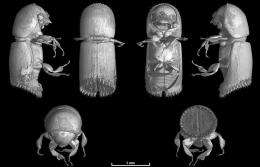
Beetle found in amber

Enlarge

Beetle found in amber

(PhysOrg.com) -- A study led by University of New South Wales scientists has confirmed the discovery of Australia's most northerly fossil site - deposits of the precious mineral amber that contain a treasure trove of trapped animal and plant remains and even bubbles of air from millions of years ago.

The was found during a hazardous expedition last September to remote beaches on eastern Cape York, in far north Queensland, where the researchers braved crocodiles and sharks to find the source of amber pieces first seen washed up on nearby beaches in 2003 by alert beachcombers Beth Norris and Dale Wicks.

The amber itself is of many colours, from greens, reds and yellows to an almost psychedelic blue, says lead investigator Dr Suzanne Hand, of the UNSW School of Biological, Earth and Environmental Sciences (BEES). Its age is still uncertain but it has formed over millions of years from what was once tree resin in ancient rainforests.

"More importantly, many of the pieces we've looked at have inclusions of beautifully preserved plant and animal remains that were trapped in the resin before it hardened," Dr Hand says.

"There's a strange new species of beetle that looks like something from a science-fiction movie, a millipede, two species of ants, butterflies, spiders, many different kinds of flies, wasps, pseudo-scorpions, termites and even a tuft of hair from what I suspect is an ancient marsupial.

"This is a fabulous find. Not only are these are the most significant amounts of amber ever found in Australia but they occur where Australia and were once joined by a land bridge and until now we had almost no information about what was living there at the time. Now we can study some of the actual animals."

Team members have taken more than 100 opaque pieces of the Cape York amber to Grenoble for analysis at the European Synchrotron Radiation Facility. "We knew they had inclusions but we were amazed at the variety of things that emerged on the screen," says Hand. The facility was able to use those scanned images to make almost perfect three-dimensional giant models of some of the creatures, including the strange beetle and a prehistoric spider.

Provided by University of New South Wales (news : web)

Filter


Move the slider to adjust rank threshold, so that you can hide some of the comments.


Display comments: newest first

RobertKarlStonjek
Jun 18, 2010

Rank: not rated yet
Looks like an ancient nostril beetle...
Wayfarer
Jun 18, 2010

Rank: not rated yet
Fascinated by a "beetle" with only four legs. More
pictures please!
TJ_alberta
Jun 18, 2010

Rank: not rated yet
Wayfarer: yes -- good observation! more photos are in order. Do the front legs look like two pair at the same position (segment?) And there may be some vestigial limbs anterior to those (like a double chin).
Wayfarer
Jun 18, 2010

Rank: not rated yet
TJ alberta, what we need is electron close ups,the old eyes aint what they used to be!
Rank 5 /5 (10 votes)
Related Stories
Relevant PhysicsForums posts
  • Homo Sapien vs. Chimpanzee - Divergence Timeline
    created4 hours ago
  • a single mRNA strand is attached to sevaral ribosomes?
    createdFeb 08, 2012
  • Oestrogen and FSH
    createdFeb 07, 2012
  • Linear Blood Vessel Network Examples in Animals or Plants
    createdFeb 07, 2012
  • Neuroscientists: What is a Principal Cell Layer?
    createdFeb 06, 2012
  • How does slime mould grow?
    createdFeb 04, 2012
  • More from Physics Forums - Biology

More news stories

Mexican experts excited to find ancient home ruins

(AP) -- The ruins aren't particularly impressive, just some stone and clay footings for houses that probably supported walls of wood or clay wattle. And it's that very ordinariness that has experts excited.

Other Sciences / Archaeology & Fossils

created 1 hour ago | popularity not rated yet | comments 0

Tackling financial exploitation of elderly people

Professionals who are in close contact with elderly people could soon be in a better position to spot if they are being financially exploited, for example through a lottery scam or by a deceitful relative draining the bank ...

Other Sciences / Social Sciences

created 1 hour ago | popularity not rated yet | comments 0

Researchers probe 200-year-old shipwreck off RI

(AP) -- For two centuries it rested a mile from shore, shrouded by a treacherous reef from the pleasure boaters and beachgoers who haunt New England's southern coast.

Other Sciences / Archaeology & Fossils

created 1 hour ago | popularity not rated yet | comments 0

Mexico road project sets up fight over ruins

(AP) -- When neighbors in the hills east of Mexico City saw backhoes ripping up pre-Hispanic relics for a highway, they did something unexpected in a country where building projects often bulldoze through ...

Other Sciences / Archaeology & Fossils

created 12 hours ago | popularity 5 / 5 (1) | comments 0

Champagne gases different out of a flute versus coupe

Champagne just isn't champagne without its bubbles, and a study highlights the effects that champagne glass shape and temperature can have on carbonation upon serving and the drinking experience. The full report is published ...

Other Sciences / Other

created 12 hours ago | popularity 4 / 5 (2) | comments 0


Study shows calories drive earlier puberty

(Medical Xpress) -- Environmental pollutants, eating habits, lack of exercise and genetic traits have all been raised as possible causes of earlier puberty onset in girls in recent years.

Bonding out: Making companies pay up front for potential environmental disasters

Whether it’s building an oil pipeline, drilling for fuel in the ocean or “fracking” to flush natural gas out of the Earth, we’re often asked to believe the process is safe, when companies want to do something ...

Soraa LED light may dim 50-watt halogen rivals

(PhysOrg.com) -- Soraa, a Fremont, California company founded in 2008, this week launched its first product, a light that uses LEDS (light emitting diodes). The "Soraa LED MR16 lamp" is the "perfect" replacement for traditional ...

Life in Antarctic lake? It's everywhere else

If scientists find microbes in a frigid lake two miles beneath the thick ice of Antarctica, it will illustrate once again that somehow life finds a way to survive in the strangest and harshest places.

Fruit flies drawn to the sweet smell of youth

Aging takes its toll on sex appeal and now an international team of researchers led by Baylor College of Medicine and the University of Michigan find that in fruit flies, at least, it even diminishes the come-hither ...

Amazing skin gives sharks a push

Shark skin has long been known to improve the fish's swimming performance by reducing drag, but now George Lauder and Johannes Oeffner from Harvard University show that in addition, the skin generates thrust, ...