Highly efficient solar cells could result from quantum dot research
June 17, 2010
Highly efficient solar cells could result from quantum dot research

Enlarge

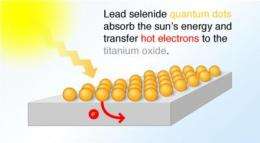
Xiaoyang Zhu and colleagues discovered that hot electrons can be transferred from photo-excited lead selenide nanocrystals to an electron conductor made of titanium dioxide. Their discovery points the way toward more efficient solar cells. Credit: The University of Texas at Austin

Conventional solar cell efficiency could be increased from the current limit of 30 percent to more than 60 percent, suggests new research on semiconductor nanocrystals, or quantum dots, led by chemist Xiaoyang Zhu at The University of Texas at Austin.

Zhu and his colleagues report their results in this week's Science.

The scientists have discovered a method to capture the higher energy sunlight that is lost as heat in conventional .

The maximum efficiency of the silicon solar cell in use today is about 31 percent. That's because much of the energy from sunlight hitting a solar cell is too high to be turned into usable electricity. That energy, in the form of so-called "hot ," is lost as heat.

If the higher energy sunlight, or more specifically the hot electrons, could be captured, solar-to-electric power conversion efficiency could be increased theoretically to as high as 66 percent.

"There are a few steps needed to create what I call this 'ultimate solar cell,'" says Zhu, professor of chemistry and director of the Center for Materials Chemistry. "First, the cooling rate of hot electrons needs to be slowed down. Second, we need to be able to grab those hot electrons and use them quickly before they lose all of their energy."

Zhu says that semiconductor nanocrystals, or , are promising for these purposes.

As for the first problem, a number of research groups have suggested that cooling of hot electrons can be slowed down in semiconductor nanocrystals. In a 2008 paper in Science, a research group from the University of Chicago showed this to be true unambiguously for colloidal .

Zhu's team has now figured out the next critical step: how to take those electrons out.

They discovered that hot electrons can be transferred from photo-excited lead selenide nanocrystals to an electron conductor made of widely used .

"If we take the out, we can do work with them," says Zhu. "The demonstration of this hot electron transfer establishes that a highly efficient hot carrier solar cell is not just a theoretical concept, but an experimental possibility."

The researchers used quantum dots made of lead selenide, but Zhu says that their methods will work for quantum dots made of other materials, too.

He cautions that this is just one scientific step, and that more science and a lot of engineering need to be done before the world sees a 66 percent efficient solar cell.

In particular, there's a third piece of the science puzzle that Zhu is working on: connecting to an electrical conducting wire.

"If we take out electrons from the solar cell that are this fast, or hot, we also lose energy in the wire as heat," says Zhu. "Our next goal is to adjust the chemistry at the interface to the conducting wire so that we can minimize this additional energy loss. We want to capture most of the energy of sunlight. That's the ultimate solar cell.

"Fossil fuels come at a great environmental cost," says Zhu. "There is no reason that we cannot be using solar 100 percent within 50 years."

Provided by University of Texas at Austin (news : web)

4.5 /5 (30 votes)  

Filter


Move the slider to adjust rank threshold, so that you can hide some of the comments.


Display comments: newest first

HaveYouConsidered
Jun 18, 2010

Rank: 3 / 5 (2)
Oh for heaven's sake. Yet another wildly premature article about solar cell technology. Wait until the additional science and tech work is DONE, then tell us about it, once it's reality.
antialias_physorg
Jun 18, 2010

Rank: 5 / 5 (2)
This site is not only about tech, but also about science - and theoretical physics is part of that.
Anynomouse
Jun 18, 2010

Rank: 5 / 5 (2)
I've been testing lead selenide nanocrystals for night vision device uses - striking them with UV causes them to radiate near IR.

This "quantum gearbox" effect can be useful in many ways, such as color correcting LEDs.

The first obstacle is a low cost production method. My project would already be fielded if this had been accomplished.

Stellarparadox
Jun 20, 2010

Rank: not rated yet
This is the first time I have heard about this technology, sounds like an interesting idea. The idea of totally using solar would be great, but I would bet that in 100 years from now there will be a very high percentage of fusion powered generating plants along with many square miles of solar collectors. Fusion will be much cheaper, low fuel costs.
Rank 4.5 /5 (30 votes)
Related Stories
Relevant PhysicsForums posts
  • polymer nanocomposites
    created23 hours ago
  • Corrosion Tests on Magnesium
    createdFeb 09, 2012
  • polyethylene copper nanocomposite
    createdFeb 09, 2012
  • Output of xrd analysis
    createdFeb 08, 2012
  • Transport phenomena problem based on problems 18.B11 and 19B.6 from Bird, stewart, lw
    createdFeb 06, 2012
  • Help with material selection - Car Piston
    createdFeb 05, 2012
  • More from Physics Forums - Materials & Chemical Engineering

More news stories

What lies beneath: Mapping hidden nanostructures

The ability to diagnose and predict the properties of materials is vital, particularly in the expanding field of nanotechnology. Electron and atom-probe microscopy can categorize atoms in thin sheets of material, ...

Nanotechnology / Nanophysics

created 15 hours ago | popularity 5 / 5 (3) | comments 1

New kind of solar cell could capture significantly more energy than current cells

New solar cells could increase the maximum efficiency of solar panels by over 25%, according to scientists from the University of Cambridge.

Nanotechnology / Nanophysics

created Feb 08, 2012 | popularity 4.5 / 5 (12) | comments 14 | with audio podcast

Nanoshell whispering galleries improve thin solar panels

Visitors to Statuary Hall in the U.S. Capitol Building may have experienced a curious acoustic feature that allows a person to whisper softly at one side of the cavernous, half-domed room and for another on ...

Nanotechnology / Nanomaterials

created Feb 07, 2012 | popularity 4.3 / 5 (6) | comments 6 | with audio podcast

'Dark plasmons' transmit energy

Microscopic channels of gold nanoparticles have the ability to transmit electromagnetic energy that starts as light and propagates via "dark plasmons," according to researchers at Rice University.

Nanotechnology / Nanophysics

created Feb 09, 2012 | popularity 4.8 / 5 (8) | comments 1 | with audio podcast

Revealing how a battery material works

Since its discovery 15 years ago, lithium iron phosphate (LiFePO4) has become one of the most promising materials for rechargeable batteries because of its stability, durability, safety and ability to deliver ...

Nanotechnology / Nanomaterials

created Feb 08, 2012 | popularity 5 / 5 (5) | comments 0 | with audio podcast


Google users warned of threat to smartphone wallets

Users of Google smartphone wallets were being warned on Friday that there is a way to crack pass codes intended to thwart thieves from going on illicit shopping sprees.

Anonymous knocks CIA website offline (Update)

The website of the Central Intelligence Agency was inaccessible on Friday after the hacker group Anonymous claimed to have knocked it offline.

New error-correcting codes guarantee the fastest possible rate of data transmission

Error-correcting codes are one of the triumphs of the digital age. They’re a way of encoding information so that it can be transmitted across a communication channel — such as an optical fiber o ...

Humans may have helped the decline of African rainforests 3000 years ago

(PhysOrg.com) -- Large areas of rainforests in Central Africa mysteriously disappeared over three thousand years ago, to be replaced by savannas. The prevailing theory has been that the cause was a change ...

New power source discovered

(PhysOrg.com) -- Researchers at the Massachusetts Institute of Technology (MIT) and RMIT University have made a breakthrough in energy storage and power generation.

Complex wiring of the nervous system may rely on a just a handful of genes and proteins

Researchers at the Salk Institute have discovered a startling feature of early brain development that helps to explain how complex neuron wiring patterns are programmed using just a handful of critical genes. ...