Carbon dioxide is the missing link to past global climate changes
June 17, 2010
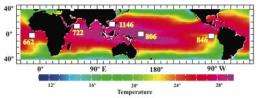
Sedimentary cores taken from the ocean floor in four locations show that climate patterns in the tropics have mirrored Ice Age cycles for the last 2.7 million years and that carbon dioxide has played the leading role in determining global climate patterns. Cores from site 806 were used as controls. Credit: Timothy Herbert, Brown University
Increasingly, the Earth's climate appears to be more connected than anyone would have imagined. El Nino, the weather pattern that originates in a patch of the equatorial Pacific, can spawn heat waves and droughts as far away as Africa.
Now, a research team led by Brown University has established that the climate in the tropics over at least the last 2.7 million years changed in lockstep with the cyclical spread and retreat of ice sheets thousands of miles away in the Northern Hemisphere. The findings appear to cement the link between the recent Ice Ages and temperature changes in tropical oceans. Based on that new link, the scientists conclude that carbon dioxide has played the lead role in dictating global climate patterns, beginning with the Ice Ages and continuing today.
"We think we have the simplest explanation for the link between the Ice Ages and the tropics over that time and the apparent role of carbon dioxide in the intensification of Ice Ages and corresponding changes in the tropics," said Timothy Herbert, professor of geological sciences at Brown and the lead author of the paper in Science.
"It certainly supports the idea of global sensitivity of climate to carbon dioxide as the first order of control on global temperature patterns," Herbert added, "but we don't know why. The answer lies in the ocean, we're pretty sure."
The research team, including scientists from Luther College in Iowa, Lafayette College in Pennsylvania, and the University of Hong Kong, analyzed cores taken from the seabed at four locations in the tropical oceans: the Arabian Sea, the South China Sea, the eastern Pacific and the equatorial Atlantic Ocean.
They decided to zero in on tropical ocean surface temperatures because these vast bodies, which make up roughly half of the world's oceans, in large measure orchestrate the amount of water in the atmosphere and thus rainfall patterns worldwide, as well as the concentration of water vapor, the most prevalent greenhouse gas.
Looking at the chemical remains of tiny marine organisms that lived in the sunlit zone of the ocean, the scientists were able to extract the surface temperature for the oceans for the last 3.5 million years, well before the beginning of the Ice Ages. Beginning about 2.7 million years ago, the geologists found that tropical ocean surface temperatures dropped by 1 to 3 degrees Celsius (1.8 to 5.4 degrees Fahrenheit) during each Ice Age, when ice sheets spread in the Northern Hemisphere and significantly cooled oceans in the northern latitudes. Even more compelling, the tropics also changed when Ice Age cycles switched from roughly 41,000-year to 100,000-year intervals.
"The tropics are reproducing this pattern both in the cooling that accompanies the glaciation in the Northern Hemisphere and the timing of those changes," Herbert said. "The biggest surprise to us was how similar the patterns looked all across the tropics since about 2.7 million years ago. We didn't expect such similarity."
Climate scientists have a record of carbon dioxide levels for the last 800,000 years — spanning the last seven Ice Ages — from ice cores taken in Antarctica. They have deduced that carbon dioxide levels in the atmosphere fell by about 30 percent during each cycle, and that most of that carbon dioxide was absorbed by high-latitude oceans such as the North Atlantic and the Southern Ocean. According to the new findings, this pattern began 2.7 million years ago, and the amount of atmospheric carbon dioxide absorbed by the oceans has intensified with each successive Ice Age. Geologists know the Ice Ages have gotten progressively colder — leading to larger ice sheets — because they have found debris on the seabed of the North Atlantic and North Pacific left by icebergs that broke from the land-bound sheets.
"It seems likely that changes in carbon dioxide were the most important reason why tropical temperatures changed, along with the water vapor feedback," Herbert said.
Herbert acknowledges that the team's findings leave important questions. One is why carbon dioxide began to play a major role when the Ice Ages began 2.7 million years ago. Also left unanswered is why carbon dioxide appears to have magnified the intensity of successive Ice Ages from the beginning of the cycles to the present. The researchers do not understand why the timing of the Ice Age cycles shifted from roughly 41,000-year to 100,000-year intervals.
-
Ice core studies confirm accuracy of climate models
Sep 11, 2008 |
not rated yet |
0
-
3.2-Million-Year Temperature History from Tiny Fossils
Aug 05, 2009 |
not rated yet |
0
-
New Ice Age maps point to climate change patterns
Jan 19, 2009 |
not rated yet |
0
-
Global warming likely to be amplified by slow changes to Earth systems
Dec 20, 2009 |
not rated yet |
0
-
Scientists detect huge carbon 'burp' that helped end last ice age
May 27, 2010 |
not rated yet |
0
-
Engineers build first sub-10-nm carbon nanotube transistor
Feb 01, 2012 |
4.9 / 5 (31) |
30
-
Something old, something new: Evolution and the structural divergence of duplicate genes
Jan 31, 2012 |
4.6 / 5 (7) |
1
-
The hidden nanoworld of ice crystals: Revealing the dynamic behavior of quasi-liquid layers
Jan 30, 2012 |
5 / 5 (3) |
1
-
Stock market network reveals investor clustering
Jan 27, 2012 |
3.9 / 5 (23) |
8
-
Of microchemistry and molecules: Electronic microfluidic device synthesizes biocompatible probes
Jan 26, 2012 |
5 / 5 (1) |
0
-
Discrepancy between oxygen and carbon-dioxide levels
Feb 09, 2012
-
where gems are found in the world
Feb 09, 2012
-
Wind Waves in Reservoir ~ Wind run-up and Wind set-up
Feb 08, 2012
-
Balance of oxygen in the atmosphere
Feb 01, 2012
-
The case for a methanol-based economy
Jan 30, 2012
-
Weather in a rotating cylinder
Jan 25, 2012
- More from Physics Forums - Earth
More news stories
Humans may have helped the decline of African rainforests 3000 years ago
(PhysOrg.com) -- Large areas of rainforests in Central Africa mysteriously disappeared over three thousand years ago, to be replaced by savannas. The prevailing theory has been that the cause was a change ...
Could Venus be shifting gear?
(PhysOrg.com) -- ESAs Venus Express spacecraft has discovered that our cloud-covered neighbour spins a little slower than previously measured. Peering through the dense atmosphere in the infrared, the ...
Space & Earth / Space Exploration
19 hours ago |
5 / 5 (7) |
8
|
NASA budget will axe Mars deal with Europe: scientists
US President Barack Obama's budget proposal to be submitted next week for 2013 will cut NASA's budget by 20 percent and eliminate a major partnership with Europe on Mars exploration, scientists said Thursday.
Space & Earth / Space Exploration
22 hours ago |
5 / 5 (2) |
19
Mars Science Laboratory computer issue resolved
(PhysOrg.com) -- Engineers have found the root cause of a computer reset that occurred two months ago on NASA's Mars Science Laboratory and have determined how to correct it.
Space & Earth / Space Exploration
20 hours ago |
4.7 / 5 (6) |
4
|
Two new moons for Jupiter
Advances in technology have lead to the discovery of new planets outside of our Solar System, and now even new moons in our own backyard.
Space & Earth / Space Exploration
19 hours ago |
4 / 5 (1) |
7
Anonymous knocks CIA website offline (Update)
The website of the Central Intelligence Agency was inaccessible on Friday after the hacker group Anonymous claimed to have knocked it offline.
New error-correcting codes guarantee the fastest possible rate of data transmission
Error-correcting codes are one of the triumphs of the digital age. Theyre a way of encoding information so that it can be transmitted across a communication channel such as an optical fiber o ...
Small modular reactor design could be a 'SUPERSTAR'
(PhysOrg.com) -- Though most of today's nuclear reactors are cooled by water, we've long known that there are alternatives; in fact, the world's first nuclear-powered electricity in 1951 came from a reactor ...
New power source discovered
(PhysOrg.com) -- Researchers at the Massachusetts Institute of Technology (MIT) and RMIT University have made a breakthrough in energy storage and power generation.
The power of estrogen -- male snakes attract other males
A new study has shown that boosting the estrogen levels of male garter snakes causes them to secrete the same pheromones that females use to attract suitors, and turned the males into just about the sexiest ...
Google users warned of threat to smartphone wallets
Users of Google smartphone wallets were being warned on Friday that there is a way to crack pass codes intended to thwart thieves from going on illicit shopping sprees.
Jun 17, 2010
Rank: 3 / 5 (4)
Jun 17, 2010
Rank: 2.8 / 5 (5)
-What do fibonacci numbers have to do with this?
-We are not looking for static cycles, but we are looking for dynamic cycles.
-yes, solar orbit plays a roll; so do flares, solar rotation, proximity to other bodies, geothermal activity, atmospheric content, radiation from other stars and infinitely more.
-Just because there are an infinite number of variables in the universe doesn't mean we can't learn anything about it. We have learnt a lot already.
-You don't think man can affect the environment? Or is it that we shouldn't put effort into anything because it's hard?
-The evidence has been collected, there is agreement.
Jun 17, 2010
Rank: 2.6 / 5 (5)
Jun 17, 2010
Rank: 3.3 / 5 (7)
Thanks, but it doesn't really matter anymore what these people think about global warming. They absolutely cannot deny the fact any longer that we should have switched our fuel source 50 years ago, there are just to many disadvantages to fossil in comparison to other more modern technologies.
I have my reasons for wanting to switch our fuel source (primarily because I don't want to be responsible for fowling the planet), they MUST have theirs by now. If they don't, they are simply ignorant, incompetent or a stooge of the fossil industry.
The fuel switch is all I care about, I don't care if I'm right about global warming or not, to many lives are being lost to cancer and that is reason enough, not to mention my beautiful state of florida is going to be destroyed, worse than a hydrogen bomb this oil spill is. There are plenty more reasons they can latch onto.
Jun 17, 2010
Rank: 2.3 / 5 (6)
Right!
The fact is, the w/ poor the resolution ability of this authors work cannot determine whether or not CO2 change led or trailed warming and cooling (nor, it appears, do they care). So this report resolves nothing other than defining what the authors think.
Extensive studies w/ higher resolution have consistently shown that CO2 changes invariably trail temperature changes, not lead them.
Jun 18, 2010
Rank: 3.4 / 5 (5)
Jun 18, 2010
Rank: 2 / 5 (4)
First, the flip from the 41,000 to 110,000 year cycles in Ice ages is a simple reflection of the fact that the mechanism driving Earh's ice-ages flipped from being the change in the tilt of the Earth's axis (i.e. the obliquity which varies on a cycle of 41,000 years) to the change in the ellipticity of the Earth's orbit (which varies on a cycle of ~ 100,000 years). It is these changes that cause the onset of the Earth's Ice Ages.
Second, The levels of CO2 follow temperature changes by ~ 700 - 1,000 years and so they are a response to the temperature changes in the oceans and NOT a driver. And no they do not amplify these changes.
These are basic facts that even a novice to climate science would be aware of. You are absolute fools if you are hood-winked by this pseudo-science.
CO2 has little or no effect on driving the world's Ice ages - no reputable scientist would make such a stupid claim.
Jun 18, 2010
Rank: 2.6 / 5 (5)
Empirical analysis of direct measurements of the opacity of the atmosphere in the infra-red over the last 61 years shows that there has been NO significant change, yes that is NO significant change, in the ability of the atmosphere to trap incoming solar radiation.
This means that the increase in infra-red opacity caused by CO2 is being compensated for by a corresponding decrease in infra-red opacity caused by H2O. The decrease in H2O opacity is being driven by a drying of the atmosphere (i.e. an observed decrease in the absolute humidity) in the upper troposphere.
What is causing this decease in absolute humdity in the upper atmosphere. It is simply the pumping of large amounts of dry dehumidified air into the upper troposhere by large equatorial thunderstorms.
In laymens terms, what these observations show is that CO2 plays little or no role in heating the Earth's atmosphere.
Jun 18, 2010
Rank: 2.6 / 5 (5)
I have direct scietific evidence, which will soon be published in a peer reviewed journal, which shows that the main factor determining the timing of the onset of El Nino events in the Eastern Pacific Ocean are solar/lunar tidal forces influencing the the up welling of cool deep ocean water.
But don't let scientific facts get in the way of your faith in AGW!
Jun 18, 2010
Rank: 4 / 5 (4)
It's odd, Ninder doesn't think AGCC is valid but has a hypothesis that addresses the oceans, most actual natural world scientists who don't agree with AGCC also have an oceanic hypothesis.
The AGCC proponents always get back to the oceans as a first order driver, how about we stop talking AGCC and AGW and instead focus ont he ocean's role in climate?
Jun 18, 2010
Rank: 1 / 5 (2)
I'm not a scientist, but data is my job. If I tried to submit a capital expense request for the facility I work at, and I only had four data points showing that the expense would pay off, I would be fired.
Jun 18, 2010
Rank: 5 / 5 (2)
Jun 18, 2010
Rank: 5 / 5 (3)
I realize that AGW is a big attention driver, but I wish there were more interest and attention here in the nuts and bolts of science than in the politicized stuff. Some of us are actually interested in the former.
I'm glad I read this article, but I almost didn't get past the hyperbolic attention-grabbing boldfaced paragraph at the top. No one ever imagined that weather or climate in one place might be connected to weather or climate a long ways away? Nonsense. Scientists have been exploring such theories for more than a hundred years. See "Butterfly Effect". Frankly, it never occurred to me that the tropics might NOT have been affected by ice ages
Jun 18, 2010
Rank: 4.2 / 5 (5)
But to address the main points:
- A data core is actually a LOT of data, its just at a single location.
- The climate is warming. If not CO2, then what is driving it?
- None of this matters anyway because using fossil fuels has unacceptable ecological costs and they can't last forever.
So we all better start the switch out of fossil fuel dependence.
Jun 18, 2010
Rank: 4.2 / 5 (5)
We do know the oceans are key, we know that fossil fuels really screw up everything from the environment to the geopolitical conversation. It's past time to just do the science and ignore the main stream media. After all, what the hell has the main stream media ever done for us, in the modern age, other than bring greater and greater divide. We have the greatest tool ever developed for rational conversation and ideological debate, let's use it and come up with solutions rather than engaging in endless pissing contests.
Jun 19, 2010
Rank: 1 / 5 (2)
Jun 19, 2010
Rank: 1 / 5 (3)
Jun 20, 2010
Rank: not rated yet
Well . . . duh.
Jun 20, 2010
Rank: 3.7 / 5 (3)
Continental drift greatly affects weather patterns.
Jun 20, 2010
Rank: 1 / 5 (3)
Carbon dioxide isn't the main reason for climate change; it amplifies changes. What would cause carbon dioxide and heat levels to cycle? The Milankovitch cycle. Soon (which is relative, it could be thousands of years from now), temperature levels should decrease in spite of relatively high CO2 levels. Rise in temperature also generally preceded the natural rise in CO2 levels (although the latter amplified the former).
Also, water vapour is much more important in the greenhouse effect than CO2 (evidenced even in the studies that support anthropogenic global warming).
So far, I obviously agree that global warming is happening, but I cannot conclude that CO2 emissions are a significant factor, even in the short term, because the Earth should be warming now, anyway.
I still support hybrid or fully electric vehicles, though, because of pollution and possible economic savings (although Canada largely depends on Alberta's oil).
Jun 21, 2010
Rank: 3.7 / 5 (3)
If you look a little more closely at the graph you link to, you will perceive two things:
1. Milankovitch cycle is into coolong phase-not warming;
2. Temperature and CO2 change in lockstep- there is no lead/lag.
Just the fact that we are continuing to warm, when solar irradiance is decreasing due to expression of Milankovitch Cycle, should be a clue that something anomalous is affecting climate.
Jun 21, 2010
Rank: 5 / 5 (1)