Seventh Graders Find a Cave on Mars
June 17, 2010
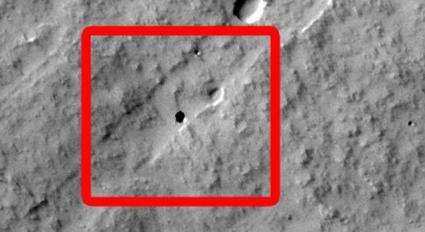
Sixteen seventh-grade students at Evergreen Middle School in Cottonwood, Calif., found the Martian pit feature at the center of the superimposed red square in this image while participating in a program that enables students to use the camera on NASA's Mars Odyssey orbiter. Image Credit: NASA/JPL-Caltech/ASU
(PhysOrg.com) -- California middle school students using the camera on NASA's Mars Odyssey orbiter have found lava tubes with one pit that appears to be a skylight to a cave.
They went looking for lava tubes on Mars -- and found what may be a hole in the roof of a Martian cave.
The 16 students in Dennis Mitchell's 7th-grade science class at Evergreen Middle School in Cottonwood, California, chose to study lava tubes, a common volcanic feature on Earth and Mars. It was their class project for the Mars Student Imaging Program (MSIP), a component of ASU's Mars Education Program, which is run out of the Mars Space Flight Facility on the Tempe campus.
The imaging program involves upper elementary to college students in Mars research by having them develop a geological question about Mars to answer. Then the students actually command a Mars-orbiting camera to take an image to answer their question. Since MSIP began in 2004, more than 50,000 students have participated to varying extents.
"The students developed a research project focused on finding the most common locations of lava tubes on Mars," says Mitchell. "Do they occur most often near the summit of a volcano, on its flanks, or the plains surrounding it?"
To answer the question, the students examined more than 200 images of Mars taken with the Thermal Emission Imaging System (THEMIS), an instrument on NASA's Mars Odyssey orbiter. Philip Christensen, a Regents' Professor of geological sciences in the School of Earth and Space Exploration, is the instrument's designer and principal investigator. The students chose for their targeted THEMIS image (plus a secondary backup image) areas on Pavonis Mons volcano that had yet to be photographed by THEMIS at highest resolution (18 meters, or 59 feet, per pixel).
On their two targeted images the students found lava tubes, as they had hoped. And on the backup image, they also found a small, round black spot. Many Martian lava tubes are marked by aligned chains of collapse pits, which typically have flat floors and sloping sides. The spot they students found, however, appears to have vertical sides.
Such features made a stir in the news in 2007, when Glen Cushing, a U.S. Geological Survey scientist, published a paper showing several Martian examples, which had been located using the heat-sensing capability of THEMIS. He argued that these holes were anomalous as compared to the usual chain pit crater, being smaller and resembling a relatively straight-sided shaft going down into the ground.
Cushing proposed that these anomalous pit craters are "skylights" — places where a small part of the roof of a cave or a lava tube has collapsed, opening the subsurface to the sky. They typically appear cooler than the ground surface by day, but warmer than it by night. This is exactly what would be expected, given that Martian surface temperatures have a large diurnal range, while subsurface temperatures hold fairly even.
"This pit is certainly new to us," Cushing told the students. "And it is only the second one known to be associated with Pavonis Mons." He estimated it to be approximately 190 by 160 meters (620 x 520 feet) wide and 115 meters (380 feet) deep at least.
In addition, he said, the spot appears clear against the background surface of Pavonis Mons. "It sticks out like a sore thumb in THEMIS predawn thermal observations."
The students have submitted their site as a candidate for imaging by the High Resolution Imaging Science Experiment (HiRISE) camera on NASA's Mars Reconnaissance Orbiter. HiRISE can image the surface at about 30 centimeters (12 inches) per pixel, which may allow a look inside the hole in the ground.
"The Mars Student Imaging Program is certainly one of the greatest educational programs ever developed," says Mitchell. "It gives the students a good understanding of the way research is conducted and how that research can be important for the scientific community. This has been a wonderful experience."
-
Lava tubes on Pavonis Mons
May 23, 2006 |
not rated yet |
0
-
Mars image marks THEMIS milestone
May 14, 2007 |
not rated yet |
0
-
Odyssey Finds Possible Cave Skylights on Mars
Sep 21, 2007 |
not rated yet |
0
-
Dark Pit on Mars' Arsia Mons, with Sunlit Wall
Aug 31, 2007 |
not rated yet |
0
-
Better looks at Mars minerals for ASU instrument on NASA's Mars Odyssey orbiter
Jun 22, 2009 |
not rated yet |
0
-
Engineers build first sub-10-nm carbon nanotube transistor
Feb 01, 2012 |
4.9 / 5 (31) |
30
-
Something old, something new: Evolution and the structural divergence of duplicate genes
Jan 31, 2012 |
4.6 / 5 (7) |
1
-
The hidden nanoworld of ice crystals: Revealing the dynamic behavior of quasi-liquid layers
Jan 30, 2012 |
5 / 5 (3) |
1
-
Stock market network reveals investor clustering
Jan 27, 2012 |
3.9 / 5 (23) |
8
-
Of microchemistry and molecules: Electronic microfluidic device synthesizes biocompatible probes
Jan 26, 2012 |
5 / 5 (1) |
0
-
Titan's lack of impact craters
Feb 09, 2012
-
Real pictures of black hole eating a star?
Feb 08, 2012
-
Hypothetical way to travel faster than light, but not technically exceed lightspeed
Feb 06, 2012
-
How do scientists monitor the Sun's activity?
Feb 05, 2012
-
Search patterns in observational studies
Feb 05, 2012
-
Derivation of Pogson's law
Feb 03, 2012
- More from Physics Forums - General Astronomy
More news stories
Humans may have helped the decline of African rainforests 3000 years ago
(PhysOrg.com) -- Large areas of rainforests in Central Africa mysteriously disappeared over three thousand years ago, to be replaced by savannas. The prevailing theory has been that the cause was a change ...
Could Venus be shifting gear?
(PhysOrg.com) -- ESAs Venus Express spacecraft has discovered that our cloud-covered neighbour spins a little slower than previously measured. Peering through the dense atmosphere in the infrared, the ...
Space & Earth / Space Exploration
5 hours ago |
5 / 5 (5) |
7
|
Mars Science Laboratory computer issue resolved
(PhysOrg.com) -- Engineers have found the root cause of a computer reset that occurred two months ago on NASA's Mars Science Laboratory and have determined how to correct it.
Space & Earth / Space Exploration
6 hours ago |
5 / 5 (5) |
3
|
Clam fields found at deep, low-temperature Mariana vents
(PhysOrg.com) -- Scientists have marveled at the unusual life forms thriving at high temperature hydrothermal vents of the deep ocean.
Space & Earth / Earth Sciences
6 hours ago |
not rated yet |
0
|
Two new moons for Jupiter
Advances in technology have lead to the discovery of new planets outside of our Solar System, and now even new moons in our own backyard.
Space & Earth / Space Exploration
5 hours ago |
not rated yet |
2
Human cognitive performance suffers following natural disasters, researchers find
Not surprisingly, victims of a natural disaster can experience stress and anxiety, but a new study indicates that it might also cause them to make more errors - some serious - in their daily lives. In their upcoming Human Fa ...
"Twisted Metal" gamers get shot at real gunplay
Fans of "Twisted Metal" will get to welcome a long-awaited sequel of the car-battle videogame with a real-world bang by blasting an ice cream truck to bits with a machine gun.
Putting the squeeze on planets outside our solar system
(PhysOrg.com) -- Using high-powered lasers, scientists at Lawrence Livermore National Laboratory and collaborators discovered that molten magnesium silicate undergoes a phase change in the liquid state, abruptly ...
The power of estrogen -- male snakes attract other males
A new study has shown that boosting the estrogen levels of male garter snakes causes them to secrete the same pheromones that females use to attract suitors, and turned the males into just about the sexiest ...
Both maternal and paternal age linked to autism
Older maternal and paternal age are jointly associated with having a child with autism, according to a recently published study led by researchers at The University of Texas Health Science Center at Houston (UTHealth).
New error-correcting codes guarantee the fastest possible rate of data transmission
Error-correcting codes are one of the triumphs of the digital age. Theyre a way of encoding information so that it can be transmitted across a communication channel such as an optical fiber o ...
Jun 17, 2010
Rank: 5 / 5 (6)
Jun 17, 2010
Rank: 4.8 / 5 (9)
Jun 17, 2010
Rank: 5 / 5 (1)
Jun 18, 2010
Rank: 4.5 / 5 (4)
Jun 18, 2010
Rank: 4 / 5 (6)
Jun 18, 2010
Rank: not rated yet
Jun 18, 2010
Rank: 3.8 / 5 (4)
There is an amazing amount of usable data from NASA and others. My son did a science fair experiment using SOHO data, it's really easy to perform basic CME calculations and build a rather good dataset to analyze.
Jun 18, 2010
Rank: 3 / 5 (2)
Jun 18, 2010
Rank: 4 / 5 (4)
Its a sad state of affairs when you ask an average high school student "who is Galileo?" and "who is Lady Gaga?" and they think they are both famous musicians.
If people wonder why we are falling behind is so many fields, they need look no further than the lack of access to resources, technology, and expertise at the public educational level. This article is a positive example of just what can be accomplished given the opportunity.
Jun 19, 2010
Rank: 4 / 5 (4)
http://www.abovet...4267/pg1
It's not new, it has been found before.
Jun 19, 2010
Rank: 1.5 / 5 (2)
Uhh....I can't seem to find one that matches. Which image again?
Jun 20, 2010
Rank: 5 / 5 (1)
I'm glad they noted that the square was superimposed, I was beginning to wonder why everyone was freaking out about a hole in the ground when there was a gigantic red square carved out on Mars.
Jun 20, 2010
Rank: 5 / 5 (2)
You gave a link to a 2007 blog announcing the discovery of seven 'pits' on the surface of Mars( http://www.planet...0000984/ ). Six images are shown (one contains two pits) labeled A-F. None seem to match the pit shown in this post. So...which image again (A-F)?
(Hint: check the coordinates of the 2007 finds against the current find.)
Jun 21, 2010
Rank: 5 / 5 (2)