Halfway to Pluto, New Horizons Wakes Up in 'Exotic Territory'

June 18, 2010 by Dauna Coulter
An artist's concept of New Horizons.
Zipping through space at nearly a million miles per day, NASA's New Horizons probe is halfway to Pluto and just woke up for the first time in months to look around.
"Our spacecraft is way out in exotic territory, in the middle of nowhere," says Hal Weaver, New Horizons project scientist at Johns Hopkins University. "And we have a lot to do."
It's the perfect opportunity to test New Horizon's instruments before the probe reaches Pluto in 2015. "We don't want to miss a single breathtaking moment during the Pluto encounter," he says. "So we're checking everything out now to make sure we're ship-shape and ready to go."
The 9 weeks of testing commenced on May 25th. Mission controllers plan a thorough checkout and recalibration of all seven science instruments onboard.
First up is LORRI, the Long-Range Reconnaissance Imager, one of the largest interplanetary telescopes ever flown.
"On July 14, 2015, the date of closest approach, we'll be able to distinguish objects on Pluto as small as a football field," says Weaver. "That's about 300 times better resolution than anything we have now."
LORRI will be working together with "Ralph," a spectrometer designed to probe the surface of Pluto at visible and infrared wavelengths. Ralph will reveal Pluto's temperature, color, and chemical composition.
"During the current tests, we'll point both LORRI and Ralph at something in the sky to make sure they can be operated together with full sensitivity. Since New Horizons is far from any large bodies right now, we'll aim the cameras at a star field to test them."

Space artist Ron Miller's concept of hypothetical geysers and sundogs on Pluto.
Just after New Horizons passes Pluto in 2015, Pluto will appear as a waning crescent to the spacecraft looking back at it. Weaver speculates that during this phase LORRI might be able to spot hazes high in Pluto's atmosphere or perhaps evidence for cryo-volcanism (i.e., volcanoes that spew icy cold material rather than hot magma) on Pluto's surface."During a flyby of Neptune in 1989, Voyager 2 spotted dark streaks on Neptune's moon Triton that appear to have been produced by geysers spewing dirty, frozen nitrogen particles. We could see something similar on Pluto."
As New Horizons passes into Pluto's shadow in 2015, a UV imaging spectrometer named "Alice" will look back toward the sun through Pluto's atmosphere. This should reveal how molecules in Pluto's atmosphere absorb sunlight, and thus what the atmosphere is made of.
"We know the sun's extreme brightness can make these activities difficult for our instruments. So we'll set up the same angles during the current testing to determine what we'll really be able to see and what kinds of information can be pulled out."
Cameras and spectrometers won't be the only busy instruments. REX, New Horizon's Radio Science EXperiment, will detect and observe radio signals coming all the way from NASA's Deep Space Network on Earth.
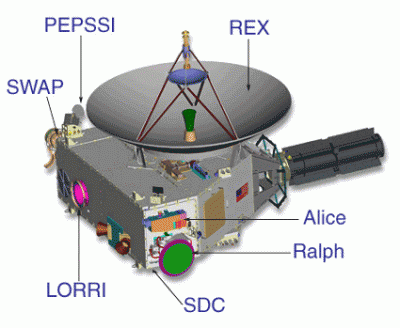
New Horizons baseline spacecraft design. Image Credit: The Boeing Company
"The way those signals bend as they pass through Pluto's atmosphere will tell us a lot about the atmosphere's pressure and thickness."The team is counting on test results to be "all systems go." If everything checks out, there's a lot to look forward to.
"We have high hopes for this mission," concludes Weaver. "Pluto awaits. The most exciting thing is that we don't know what we're going to see when we get there."
Stay tuned for 2015.
More information: Click here for information about New Horizon's seven main science instruments: http://pluto.jhuap … verview.html
Provided by Science@NASA
-
New Horizons Gets First Glimpse of Pluto
Nov 30, 2006 |
not rated yet |
0
-
New Hubble images show similar colors for Pluto's moons
Mar 10, 2006 |
not rated yet |
0
-
Spacecraft to Pluto Prepares for Jupiter Encounter
Jan 18, 2007 |
not rated yet |
0
-
To Pluto And Beyond
Mar 10, 2006 |
not rated yet |
0
-
The lower atmosphere of Pluto revealed
Mar 02, 2009 |
not rated yet |
0
-
Engineers build first sub-10-nm carbon nanotube transistor
Feb 01, 2012 |
4.9 / 5 (30) |
30
-
Something old, something new: Evolution and the structural divergence of duplicate genes
Jan 31, 2012 |
4.6 / 5 (7) |
1
-
The hidden nanoworld of ice crystals: Revealing the dynamic behavior of quasi-liquid layers
Jan 30, 2012 |
5 / 5 (3) |
1
-
Stock market network reveals investor clustering
Jan 27, 2012 |
3.9 / 5 (23) |
8
-
Of microchemistry and molecules: Electronic microfluidic device synthesizes biocompatible probes
Jan 26, 2012 |
5 / 5 (1) |
0
-
Titan's lack of impact craters
21 hours ago
-
Real pictures of black hole eating a star?
Feb 08, 2012
-
Hypothetical way to travel faster than light, but not technically exceed lightspeed
Feb 06, 2012
-
How do scientists monitor the Sun's activity?
Feb 05, 2012
-
Search patterns in observational studies
Feb 05, 2012
-
Derivation of Pogson's law
Feb 03, 2012
- More from Physics Forums - General Astronomy
More news stories
Mars Science Laboratory computer issue resolved
(PhysOrg.com) -- Engineers have found the root cause of a computer reset that occurred two months ago on NASA's Mars Science Laboratory and have determined how to correct it.
Space & Earth / Space Exploration
43 minutes ago |
5 / 5 (1) |
1
|
Clam fields found at deep, low-temperature Mariana vents
(PhysOrg.com) -- Scientists have marveled at the unusual life forms thriving at high temperature hydrothermal vents of the deep ocean.
Space & Earth / Earth Sciences
18 minutes ago |
not rated yet |
0
|
Streams need trees to withstand climate change
(PhysOrg.com) -- More than twenty years of biological monitoring have confirmed the importance of vegetation for protecting Australia's freshwater streams and rivers against the ravages of drought and climate ...
27 minutes ago |
not rated yet |
0
The turbulent birth of super star clusters in galaxy mergers
By combining two of the most advanced telescopes in the world -- the new Atacama Large Millimeter Array (ALMA) and the Very Large Telescope (VLT) of ESO -- a team of French astronomers from the Institut d'astrophysique ...
9 minutes ago |
not rated yet |
0
Putin receives 'prehistoric' water from Antarctic lake
Prime Minister Vladimir Putin was given a water sample Friday taken from a pristine lake hidden under Antarctic ice for over a million years, after Russian scientists drilled down to its surface.
Space & Earth / Earth Sciences
49 minutes ago |
5 / 5 (1) |
0
A frank discussion of the power law and linking correlation to causation
(PhysOrg.com) -- Michael Stumpf a mathematics professor at Imperial College in London, and Mason Porter a lecturer at Oxford have teamed together to write and publish a perspective piece in Science regarding the in ...
Advanced power-grid model finds low-cost, low-carbon future in West
(PhysOrg.com) -- The least expensive way for the Western U.S. to reduce greenhouse gas emissions enough to help prevent the worst consequences of global warming is to replace coal with renewable and other ...
Small modular reactor design could be a 'SUPERSTAR'
(PhysOrg.com) -- Though most of today's nuclear reactors are cooled by water, we've long known that there are alternatives; in fact, the world's first nuclear-powered electricity in 1951 came from a reactor ...
Seeing colors in music, tasting flavors in shapes may happen in life's early months
Famed violinist Itzhak Perlman sees a deep forest green whenever he plays a B-flat on his Stradivarius' G string. The A on the E string is red.
The question of life in the ancient world
Theres a general feeling that we dont get the Greeks ancient or modern. Many, including heads of state like Angela Merkel, visibly shake their head in exasperation, rightly or wrongly, at ...
Study suggests girls can 'rewire' brains to ward off depression
(Medical Xpress) -- What if you could teach your brain to respond differently to things that make you feel sad, down or stressed out? What if doing that helped ward off depression?


Jun 18, 2010
Rank: 5 / 5 (5)
Of course it makes sense to search for potential signs of cryovolcanism on Pluto, but known occurrences in our solar system involve tidal heating of a *moon* by a much more massive planet (Jupiter, Saturn, Neptune).
After the encounter with Pluto, flybys of several Kuiper Belt objects are also planned. Can't wait!
Jun 18, 2010
Rank: 5 / 5 (2)
I'm with you, I can't wait for visual confirmation of the Kuiper belt. I'm hoping we'll see a far more robust set of deep solar objects than we anticipate. Regardless, anything that will lead us back into the area of the "Voyager anomaly" always intrigues me.
Jun 18, 2010
Rank: 4.5 / 5 (2)
Jun 18, 2010
Rank: 5 / 5 (2)
Jun 19, 2010
Rank: 5 / 5 (1)
This is going to be a show not to miss.
Jun 19, 2010
Rank: 5 / 5 (1)
I assume they will do the same check again about 4 years from now.
Jun 19, 2010
Rank: 5 / 5 (1)
Kedas, Over the next four years, New Horizons will periodically be checked out to ensure all systems are functional for the flyby. Imaging will also be obtained to help determine if any course corrections need to be made.
Skeptic_Heretic, Should be interesting to see what KBOs are chosen for flyby opportunities. At this time, the search is on (from Earth) for undiscovered KBOs that might be proper candidates for the extended mission. The New Horizons website mentions that this search is complicated because the search area is heavily contaminated by background stars in the Milky Way.
Jun 19, 2010
Rank: not rated yet
Jun 19, 2010
Rank: 5 / 5 (2)
Nope, 17 degrees tilted.