FCC asks: Do media ownership limits make sense?
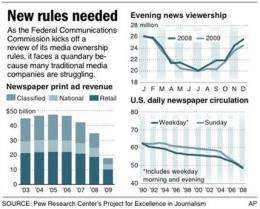
(AP) -- Even the news industry's free fall probably will not be enough to wipe out complicated federal rules designed to restrain the power of media companies.
For decades, the Federal Communications Commission has imposed strict limits preventing any company from controlling too many media properties in the same market. These limits were established to ensure that communities have choices of newspapers and local TV and radio stations.
Congress requires the FCC to take a hard look at the rules every four years to determine whether they still serve the public interest. If they don't, the FCC has to rewrite them.
Now, as the FCC kicks off its latest review, it faces calls to pare the limits because traditional media companies are no longer the almighty players that they were when the ownership rules were first enacted.
Newspaper readers and advertisers have migrated to the Internet, where a lot of content is free and advertising costs less. As a result, newsrooms have shrunk and newspapers have sought bankruptcy protection or shut down. Television broadcasters are suffering too as cable, satellite TV and the Internet splinter audiences and siphon ad dollars - forcing stations to seek new revenue streams and even raising questions about the future of free, over-the-air TV.
Against this backdrop, media companies argue that the FCC's ownership limits no longer make sense and should be relaxed, or even scrapped, so that the companies can get bigger in order to better compete and survive.
"These rules need to fall away," says Jerry Fritz, general counsel for Allbritton Communications, an Arlington, Va., company that owns eight TV stations in seven markets, a cable station in Washington, D.C., and Politico, a successful online and print publication that covers politics. Allbritton is also launching a local news website to cover the Washington region. "The FCC rules make no sense anymore," Fritz says.
But the FCC is unlikely to toss out media ownership restrictions entirely. The agency is also under pressure from public interest groups that support strong limits. Andrew Schwartzman, head of the group Media Access Project, argues that such rules remain critical because democracy relies on a vibrant press with many voices.
These groups have a key ally in Michael Copps, one of the three Democrats on the five-member FCC. FCC Chairman Julius Genachowski has said little publicly about his views on the existing rules, and his staff has promised a fresh look at the entire media ownership framework. But Genachowski was an architect of the Obama campaign's technology platform, which included a pledge to encourage diversity in media ownership.
Complicating the situation: Even as the FCC launches the 2010 review, the agency still is tied up in a legal battle in the Third Circuit Court of Appeals over the media ownership reviews of Genachowski's Republican predecessors.
The case goes back to the 2002 review under then-FCC chairman Michael Powell. Powell tried to raise the caps on TV and radio station ownership and relax the so-called "cross-ownership" ban, a rule adopted in 1975 that prohibits common ownership of a broadcast station and a newspaper in the same market. (Holdings in some markets, such as Chicago, where Tribune Co. owns WGN radio and TV and the Chicago Tribune, were grandfathered in.)
But Powell's plan drew legal challenges from public interest groups that said he had gone too far and media companies that said he had not gone far enough. So the Third Circuit sent the matter back to FCC, telling it to rewrite the rules. And that led Powell's successor, Kevin Martin, to try to ease the cross-ownership ban in the 20 largest media markets. That drew more challenges from both sides.
After Genachowski came to the FCC last year, the agency urged the Third Circuit to hold off on considering the case because Martin's rules would soon be superseded by the 2010 review. For a time, the court complied and prevented those rules from going into effect. But in March, the court got tired of waiting for the agency to act and allowed Martin's rules to take force, which could pave the way for cross-ownership deals in the biggest markets. So now, the FCC must decide how to respond in court to the challenges to Martin's actions - even as it launches its own media ownership review.
On both fronts, public interest groups are pushing to roll back Martin's cross-ownership rules and leave the rest of the restrictions in place. Meanwhile, media companies are fighting to lift the cross-ownership ban entirely. They also want some relief from rules that prohibit one company from owning more than one TV station in smaller markets and more than two TV stations in larger markets, including only one of the top four.
Such rules, opponents say, reflect a time when the news business was dominated by just three TV networks and local newspapers - before cable, satellite and the Internet transformed the media, providing outlets for all sorts of viewpoints and voices. Indeed, some of the current ownership rules date in some form to as early as the 1940s. So why, critics ask, should the FCC continue to measure competition by counting broadcast stations and newspapers in individual markets?
"I don't think the average consumer sees the market the way we regulate it," Powell says. "This isn't the way Americans consume media."
Critics also say the rules do more harm than good by artificially inflating the number of media outlets fighting for a limited pool of readers, viewers and advertisers in individual markets. Allowing consolidation, says Harold Furchtgott-Roth, a former Republican FCC commissioner, would let media companies build larger audiences to attract advertisers and spread hefty newsgathering costs by repurposing content across more platforms.
"If we want robust local news, we need to give media companies the opportunity to achieve scale, since producing local news is not cheap," says Rebecca Duke, vice president of distribution for LIN Media, a company based in Providence, R.I., that owns 29 TV stations.
Lifting the rules could help save struggling newspapers or TV stations looking for a buyer, Furchtgott-Roth adds, because often the only potential suitor might be the other major media outlet in town.
One irony not lost on media executives is that the FCC and the Justice Department are expected to approve Comcast Corp.'s proposal to buy a majority stake in NBC Universal from General Electric Co. That deal, which would give the nation's largest cable TV operator control of NBC's media empire, would dwarf the types of local media mergers prohibited by the FCC's current rules.
Still, Corie Wright, policy counsel for the public interest group Free Press, insists there is not enough competition in most markets to permit consolidation. Even as cable and the Internet offer many more choices for general news and commentary, most local reporting is still done by newspapers and TV stations, she notes.
Georgetown Law professor Angela Campbell, who represents several public interest groups defending strong ownership limits, fears more consolidation would lead to newsroom layoffs as media companies combine operations and feed the same content to different outlets.
"Every time you have one of these deals, at the end of the day it means one newsroom closes, another lost voice, less local coverage and less diversity of perspective," says FCC Commissioner Copps.
Schwartzman, head of Media Access Project, is also skeptical of the argument that the industry's troubles justify deregulation. After all, he noted, the economy is still emerging from a deep recession that has hit major advertisers in the auto, real estate and retailing sectors particularly hard. As those sectors recover, he says, media companies may recover too.
"I am concerned about enacting policy changes based on temporary economic conditions," Schwartzman says. "We don't know what the new normal is."
But whatever the new normal turns out to be, it figures to look very different from the traditional media landscape. That's why some observers are asking whether all the debate over media consolidation may be beside the point, given the huge problems facing the industry.
"Media companies are struggling and the government is standing in their way," says Kenneth Ferree, a former FCC official who pushed to relax the ownership limits under Powell and is now a senior fellow with The Progress & Freedom Foundation, a free-market think tank. "But even if the FCC got rid of the rules, would it matter anyway? That's the $64,000 question."
©2010 The Associated Press. All rights reserved. This material may not be published, broadcast, rewritten or redistributed.


