Experts discover heavenly solar music (w/ Video)
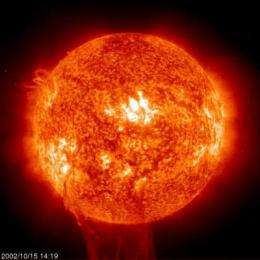
Musical sounds created by longitudinal vibrations within the Sun's atmosphere, have been recorded and accurately studied for the first time by experts at the University of Sheffield, shedding light on the Sun's magnetic atmosphere.
Using state-of-the-art mathematical theory combined with satellite observations, a team of solar physicists from the University have captured the music on tape and revealed the harmonious sounds are caused by the movement of giant magnetic loops in the solar corona -the outermost, mysterious, and least understood layer of the Suns atmosphere. Most importantly, the team studied how this sound is decaying, giving an unprecedented insight into the physics of the solar corona.
High-resolution images taken by a number of satellites show that the solar corona is filled with large banana-shaped magnetic structures known as coronal loops. It is thought that these giant magnetic loops, some of them over a few 100,000 km long, play a fundamental role in governing the physics of the corona and are responsible for huge atmospheric explosions that occur in the atmosphere, known as solar flares.
These giant coronal loops have also been observed to undergo periodic (oscillatory) motion, which can be thought of as someone plucking a guitar string (transversal oscillations) or blowing the wind-pipe instrument (longitudinal oscillations). With the length and thickness of the string fixed, the pitch of the note is determined by the tension of the string and the tone is made up of the harmonics of the modes of oscillation.
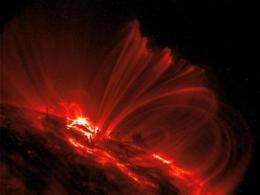
In this sense, the solar atmosphere is constantly pervaded by the music of the coronal loops. The coronal music also provides scientists with a unique and unprecedented tool to study the magnetic solar atmosphere, as the motion of these loops is determined by their local surroundings. This technique is known as solar magneto-seismology and is very similar to the seismology methods used by geologists studying earthquakes.
Studying this magnetic solar atmosphere will help the team, which is headed-up by Professor Robertus von Fáy-Siebenbürgen and includes postgraduate student Richard Morton and postdoctoral research associate Dr Youra Taroyan, all from the Dept of Applied Mathematics, make further breakthroughs into understanding one of the key and central unresolved problems of modern astrophysics, i.e. the heating of solar and tellar coronal plasmas, and reveal the underlying physical processes: Are there millions of localised magnetic explosions releasing the energy necessary to maintain the corona at millions of degrees or is the physics related to the numerous waves propagating from the internal regions of the Sun toward its outer regions, reaching even space around the Earth's atmosphere.
The discovery was presented by the University experts to an audience of MPs both from the House of Commons and the House of Lords at the House of Commons Marquee, as well as and senior scientists representing prestigious institutions such as the Royal Society, after being selected by the Parliamentary and Scientific Committee.
The next step for the team will be to develop cutting edge numerical modelling that will be able to give further insight into the sub-resolution properties of coronal loops, i.e. on spatial scales that are not even observable with the latest high-resolution satellites available to scientist.
This is the second solar related breakthrough made by experts at the University. The way in which the solar corona is heated to temperatures of over a million degrees had, until recently, remained a long-standing puzzle of solar and space physics, as this region of the sun is even further away from the centre of energy production than the underlying solar surface. However Professor von Fáy-Siebenbürgen and his team last month solved this enigma and revealed that Transition Region Quakes - described by the experts as 'mega-tsunamis' - power the lower base of the solar corona.
The news comes as the University of Sheffield launches a unique venture entitled Project Sunshine, led by the Faculty of Science. The Project aims to unite scientists across the traditional boundaries in both the pure and applied sciences to harness the power of the sun and tackle the biggest challenge facing the world today: meeting the increasing food and energy needs of the world's population in the context of an uncertain climate and global environment change. It is hoped that Project Sunshine will change the way scientists think and work and become the inspiration for a new generation of scientists focused on solving the world's problems.
Professor Robertus von Fáy-Siebenbürgen from the University of Sheffield's Department of Applied Mathematics and Head of SP2RC, said: "The results of our latest coronal research, presented in the Parliament at Westminster, allow us to gain a fundamentally new insight into the fascinating but at the same time very mysterious solar atmosphere. I'm most proud to have such talented young scientists within my research group and department. The invitation by SET for Britain and our collaborative research efforts clearly demonstrate our international leadership position in the field of solar physics."
Provided by University of Sheffield


