Brain signs of schizophrenia found in babies
June 21, 2010
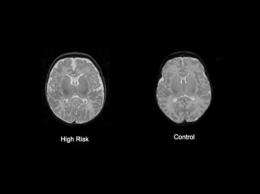
The infant's brain image on left shows the larger lateral ventricles and a generally larger brain overall. Credit: Image provided by John Gilmore, MD.
Schizophrenia is a debilitating mental disorder affecting one in 100 people worldwide. Most cases aren't detected until a person starts experiencing symptoms like delusions and hallucinations as a teenager or adult. By that time, the disease has often progressed so far that it can be difficult to treat.
In a paper published recently online by the American Journal of Psychiatry, researchers at the University of North Carolina at Chapel Hill and Columbia University provide the first evidence that brain abnormalities associated with schizophrenia risk are detectable in babies only a few weeks old.
"It allows us to start thinking about how we can identify kids at risk for schizophrenia very early and whether there things that we can do very early on to lessen the risk," said lead study author John H. Gilmore, MD, professor of psychiatry and director of the UNC Schizophrenia Research Center.
The scientists used ultrasound and MRI to examine brain development in 26 babies born to mothers with schizophrenia. Having a first-degree relative with the disease raises a person's risk of schizophrenia to one in 10. Among boys, the high-risk babies had larger brains and larger lateral ventricles—fluid-filled spaces in the brain—than babies of mothers with no psychiatric illness.
"Could it be that enlargement is an early marker of a brain that's going to be different?" Gilmore speculated. Larger brain size in infants is also associated with autism.
The researchers found no difference in brain size among girls in the study. This fits the overall pattern of schizophrenia, which is more common, and often more severe, in males.
The findings do not necessarily mean the boys with larger brains will develop schizophrenia. Relatives of people with schizophrenia sometimes have subtle brain abnormalities but exhibit few or no symptoms.
"This is just the very beginning," said Gilmore. "We're following these children through childhood." The team will continue to measure the children's brains and will also track their language skills, motor skills and memory development. They will also continue to recruit women to the study to increase the sample size.
This research provides the first indication that brain abnormalities associated with schizophrenia can be detected early in life. Improving early detection could allow doctors to develop new approaches to prevent high-risk children from developing the disease. "The research will give us a better sense of when brain development becomes different," said Gilmore. "And that will help us target interventions."
More information: The paper is available now online and will be published in the September issue of the journal.
Provided by University of North Carolina School of Medicine (news : web)
-
Mother's flu during pregnancy may increase baby's risk of schizophrenia
Mar 11, 2010 |
not rated yet |
0
-
Stopping schizophrenia before it starts?
Jan 28, 2010 |
not rated yet |
0
-
Hallucinations in schizophrenia linked to brain area that processes voices
Jul 31, 2007 |
not rated yet |
0
-
Siblings of schizophrenia patients display subtle shape abnormalities in brain
Feb 19, 2008 |
not rated yet |
0
-
MRI may help predict schizophrenia
Dec 08, 2006 |
not rated yet |
0
-
Engineers build first sub-10-nm carbon nanotube transistor
Feb 01, 2012 |
4.9 / 5 (31) |
30
-
Something old, something new: Evolution and the structural divergence of duplicate genes
Jan 31, 2012 |
4.6 / 5 (7) |
1
-
The hidden nanoworld of ice crystals: Revealing the dynamic behavior of quasi-liquid layers
Jan 30, 2012 |
5 / 5 (3) |
1
-
Stock market network reveals investor clustering
Jan 27, 2012 |
3.9 / 5 (23) |
8
-
Of microchemistry and molecules: Electronic microfluidic device synthesizes biocompatible probes
Jan 26, 2012 |
5 / 5 (1) |
0
-
Is Everyday Technology Killing Us?
Feb 08, 2012
-
Exercise and weight loss
Feb 08, 2012
-
Why do we have head aches? Our brains can't feel anything.
Feb 07, 2012
-
"The end of diseases" by David Agus, interview from Daily Show with Jon Stewart
Feb 04, 2012
-
Oncolytic adenovirus
Feb 04, 2012
-
Nutrition label stuffs and diets
Feb 02, 2012
- More from Physics Forums - Medical Sciences
More news stories
Human cognitive performance suffers following natural disasters, researchers find
Not surprisingly, victims of a natural disaster can experience stress and anxiety, but a new study indicates that it might also cause them to make more errors - some serious - in their daily lives. In their upcoming Human Fa ...
Medicine & Health / Psychology & Psychiatry
1 hour ago |
not rated yet |
0
Both maternal and paternal age linked to autism
Older maternal and paternal age are jointly associated with having a child with autism, according to a recently published study led by researchers at The University of Texas Health Science Center at Houston (UTHealth).
Medicine & Health / Psychology & Psychiatry
4 hours ago |
not rated yet |
0
|
Curry spice component may help slow prostate tumor growth
Curcumin, an active component of the Indian curry spice turmeric, may help slow down tumor growth in castration-resistant prostate cancer patients on androgen deprivation therapy (ADT), a study from researchers ...
5 hours ago |
5 / 5 (3) |
0
|
Team isolates nerve cells involved in storing long term memory and gene proteins associated with them
(Medical Xpress) -- A research team in Taiwan has succeeded in isolating two nerve cells in fruit fly brains that are believed to be the major players in allowing for the formation of long term memories. Furthermore, ...
Seeing colors in music, tasting flavors in shapes may happen in life's early months
Famed violinist Itzhak Perlman sees a deep forest green whenever he plays a B-flat on his Stradivarius' G string. The A on the E string is red.
Medicine & Health / Psychology & Psychiatry
7 hours ago |
4.5 / 5 (2) |
1
|
The power of estrogen -- male snakes attract other males
A new study has shown that boosting the estrogen levels of male garter snakes causes them to secrete the same pheromones that females use to attract suitors, and turned the males into just about the sexiest ...
New error-correcting codes guarantee the fastest possible rate of data transmission
Error-correcting codes are one of the triumphs of the digital age. Theyre a way of encoding information so that it can be transmitted across a communication channel such as an optical fiber o ...
Putting the squeeze on planets outside our solar system
(PhysOrg.com) -- Using high-powered lasers, scientists at Lawrence Livermore National Laboratory and collaborators discovered that molten magnesium silicate undergoes a phase change in the liquid state, abruptly ...
Humans may have helped the decline of African rainforests 3000 years ago
(PhysOrg.com) -- Large areas of rainforests in Central Africa mysteriously disappeared over three thousand years ago, to be replaced by savannas. The prevailing theory has been that the cause was a change ...
Fool's gold may prove an unlikely alternative to overexploited catalytic materials
Catalytic materials, which lower the energy barriers for chemical reactions, are used in everything from the commercial production of chemicals to catalytic converters in car engines. However, with current catalytic materials ...
Could Venus be shifting gear?
(PhysOrg.com) -- ESAs Venus Express spacecraft has discovered that our cloud-covered neighbour spins a little slower than previously measured. Peering through the dense atmosphere in the infrared, the ...
Jun 21, 2010
Rank: 1 / 5 (2)
Also, a general rule of thumb: When you don't know the cause of an illness, any anatomical variant, you will consider an abnormality.
The same thing that anthropologists declare with pride to be a hallmark of human evolutionary advantage, is - when it serves the purpose of a psychiatric or epidemiological study - the possible hallmark of disease.
Jun 21, 2010
Rank: 1 / 5 (1)
Jun 21, 2010
Rank: 4.5 / 5 (2)
That's true, in general, although in the case of Kim Peek, his brain was larger than average and missing the corpus callossum. Einstein's brain was also missing the parietal operculum (which is linked with speech) and the sylvian fissure; "to compensate, the inferior parietal lobe was 15 percent wider than normal. The inferior parietal region is responsible for mathematical thought, visuospatial cognition, and imagery of movement." John Nash is/was schizophrenic.
http://en.wikiped...'s_brain
http://www.ncbi.n...19794194
"Individuals with youth-onset schizophrenia have severe cognitive deficits, whereas those with late-onset schizophrenia have some relatively preserved cognitive functions."
Jun 22, 2010
Rank: 5 / 5 (1)
You're right, it's obviously a negative correlation.
Joking aside, there is research showing a causal relationship between larger brains and greater intellect, take a look on pubmed or sciencedirect.
Also, with regard to schizophrenics displaying statistically lower performance on IQ tests, well so do people who frequent the internet, but that doesn't mean they are less intelligent. In the latter case the 10 point average IQ drop is attributed to information overload, why could it not be a similar (but magnified) "disturbance" for schizophrenics? Some of the smartest people in history had DSM-IV classifiable bipolar or schizo.
The point is that when one leads with the assumption that schizophrenics are cognitively deficient due to biological abnormalities, they'll interpret all structural differences to fit that premise. That isn't science.