World Cup Security Uses Physics To Thwart Hackers
June 21, 2010 By Devin Powell
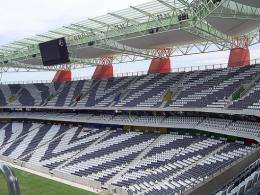
South African physicists working to protect data networks at the World Cup hope to provide something that no goalkeeper can promise: perfect defense. They're tapping the laws of physics to prevent hackers from monitoring videos, emails and phone calls relayed between Durban's Moses Mabhida Stadium and a nearby operations center for police, firefighters, and military personnel.
The stadium's quantum cryptography system, installed by researchers at the University of KwaZulu-Natal in Durban, is an emerging technology thought to be in regular use by military and intelligence organizations but rarely showcased on such a public stage.
"The goal is to ensure not only the confidentially but also the integrity of this information," said Gregoire Ribordy, CEO of ID Quantique in Geneva, which developed the system with Senetas Corporation in Australia. ID Quantique, whose clients are primarily military and financial organizations, used similar technology to secure ballot information in the 2007 Swiss elections.
Data -- whether ballots or stadium security footage -- flows over fiber optic cables as a series of ones and zeros that can be stolen by hackers, who can tap into and monitor a line. To protect the information, it is often encoded in a way that can only be unlocked with a key. This key is often a second string of ones and zeros transmitted over the same line as the data.
Traditional means of encrypting such a key use mathematical functions that are difficult -- but not impossible -- to undo.
Quantum cryptography, on the other hand, uses the principles of quantum mechanics to provide theoretically uncrackable security. It sends the key as a series of particles of light, or photons. Because the act of observing one of these "quantum bits" fundamentally changes it, eavesdroppers can't help but reveal themselves -- in theory.
In practice, the equipment developed to send photons back and forth is not perfect -- some of the photons are lost, some are transmitted incorrectly -- so anyone receiving a quantum key must expect a certain level of error. A clever hacker might be able to figure out a way to disguise eavesdropping as error, said Hoi Kwong Lo of the University of Toronto. Last month his team was the first to hack an ID Quantique system in a laboratory -- albeit a less secure version than the one in use at the World Cup.
"I think it's premature to say whether commercial systems are secure or not," said Lo. "It's much easier to hack a system than to make a system secure."
First proposed more than three decades ago, quantum cryptography has only been developed into commercial systems in recent years. The World Cup system, installed in April by researchers at the University of KwaZulu-Natal's Centre for Quantum Technology, is part of a larger plan to deploy quantum security systems throughout Durban.
Provided by Inside Science News Service
-
Cryptic messages boost data security
Nov 29, 2007 |
not rated yet |
0
-
Quantum cryptography: No Signaling and quantum key distribution
Jul 05, 2005 |
not rated yet |
0
-
JST, NEC Realize Secure Quantum Key Distribution with Quantitative Assurance
Mar 06, 2007 |
not rated yet |
0
-
Mitsubishi, NEC, Tokyo University Realize Successful Interconnection of Quantum Encryption Networks
May 12, 2006 |
not rated yet |
0
-
Laser security for the Internet
Mar 23, 2010 |
not rated yet |
0
-
Engineers build first sub-10-nm carbon nanotube transistor
Feb 01, 2012 |
4.9 / 5 (30) |
30
-
Something old, something new: Evolution and the structural divergence of duplicate genes
Jan 31, 2012 |
4.6 / 5 (7) |
1
-
The hidden nanoworld of ice crystals: Revealing the dynamic behavior of quasi-liquid layers
Jan 30, 2012 |
5 / 5 (3) |
1
-
Stock market network reveals investor clustering
Jan 27, 2012 |
3.9 / 5 (23) |
8
-
Of microchemistry and molecules: Electronic microfluidic device synthesizes biocompatible probes
Jan 26, 2012 |
5 / 5 (1) |
0
-
feed hold button on CNC lathe
9 hours ago
-
Mechanics of Solids ( Final exam question) plz help!
11 hours ago
-
RFAC in Fortran
14 hours ago
-
dynamics 2/32
19 hours ago
-
dynamics
20 hours ago
-
Vibration Absorbtion Problem
Feb 08, 2012
- More from Physics Forums - General Engineering
More news stories
Pa. symphony seeks soloist via YouTube contest
(AP) -- Pittsburgh Symphony Orchestra officials insist it's not "American Idol" meets Mozart.
1 hour ago |
not rated yet |
0
Thomson Reuters posts loss on $3 bn writedown
Thomson Reuters posted a fourth-quarter loss on Thursday as the financial news and information provider took a $3 billion writedown on its financial services business.
1 hour ago |
not rated yet |
0
Petitions protest Apple working conditions in China
Petitions denouncing working conditions at Chinese factories making Apple gadgets were delivered to the California firm's new Grand Central Station store on Thursday.
1 hour ago |
not rated yet |
0
Model analyzes shape-memory alloys for use in earthquake-resistant structures
Recent earthquake damage has exposed the vulnerability of existing structures to strong ground movement. At the Georgia Institute of Technology, researchers are analyzing shape-memory alloys for their potential ...
4 hours ago |
not rated yet |
0
|
Soraa LED light may dim 50-watt halogen rivals
(PhysOrg.com) -- Soraa, a Fremont, California company founded in 2008, this week launched its first product, a light that uses LEDS (light emitting diodes). The "Soraa LED MR16 lamp" is the "perfect" replacement ...
Hydrogen from acidic water: Researchers develop potential low cost alternative to platinum for splitting water
A technique for creating a new molecule that structurally and chemically replicates the active part of the widely used industrial catalyst molybdenite has been developed by researchers with the Lawrence Berkeley ...
Ultraviolet protection molecule in plants yields its secrets
Lying around in the sun all day is hazardous not just for humans but also for plants, which have no means of escape. Ultraviolet (UV) radiation from the sun can damage proteins and DNA inside cells, leading ...
To perform with less effort, practice beyond perfection
Whether you are an athlete, a musician or a stroke patient learning to walk again, practice can make perfect, but more practice may make you more efficient, according to a surprising new University of Colorado Boulder study.
Scientists identify most lethal known species of prion protein
Scientists from the Florida campus of The Scripps Research Institute have identified a single prion protein that causes neuronal death similar to that seen in "mad cow" disease, but is at least 10 times more ...
Researchers weigh in on ethics of H5N1 research
(Medical Xpress) -- In a commentary on the biosecurity controversy surrounding publication of bird flu research details, a bioethicist and a vaccine expert at Johns Hopkins reaffirm that "all scientists have an affirmativ ...
US workers are 'giving away the store,' costing firms billions
Nearly 70 percent of the nation's service employees give away free goods and services from hamburgers to cable TV costing companies billions of dollars a year, according to a groundbreaking study.
Jun 22, 2010
Rank: 5 / 5 (2)
Jun 22, 2010
Rank: 3 / 5 (1)
Unless someone hacks into your computer and steals the pad-file such systems are 100% secure.