Botanical Garden braces for blooming corpse plant
June 21, 2010
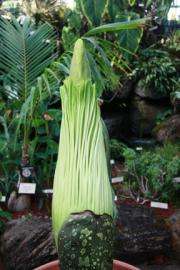
June 21: Tip with spathe at 33.5in. Image: The University of California Botanical Garden at Berkeley
The University of California Botanical Garden at Berkeley, nestled in Strawberry Canyon just above the central campus, features a mind-boggling 12,000 kinds of plants and breathtaking views of the Bay Area. The term breathtaking soon will describe the rotten flesh-like stench of the garden's about-to-blossom Titan Arum, also known as the corpse plant.
This will be the sixth Titan Arum flower to fascinate visitors to the garden's Tropical House since 2005. But the still rare event, a plant world equivalent of a gasp-inducing car wreck, always draws crowds.
"I've been watching this plant for the past week, but just got the final confirmation that it will be a bloom," Paul Licht, director of the UC Botanical Garden and a professor emeritus of integrative biology, said Wednesday. "We expect it to start growing quite quickly now, and it can easily grow up four inches a day."
This particular corpse plant has grown four inches, to about 25 inches, since Sunday and is expected to continue at a rapid pace until it reaches an exceptionally stinky and spectacular crescendo - in the form of a bright green and deep maroon flower - probably around July 1. The powerful odor is at its peak for about 24 hours and attracts insects to pollinate it. Then the stink can come and go for several days.
The Botanical Garden is using its website, Facebook page and Twitter to update the stinky plant's progress and to solicit suggestions for names until early Monday (June 21). The winner will receive a young Amorphophallus titanum plant, a family membership or a one-year extension of a current membership. The garden's previous blooms included Trudy (2005), Titania (2007), Odora and Odorado (2008) and Tiny (2009).
This Titan Arum is from the garden's original collection that arrived from Sumatra as seeds 15 years ago, and its brothers and sisters are on display alongside it at the garden.
"We will have 'babies' for sale from our earlier bloom by Titania for anyone wanting to impress their neighbors," said Licht. "The titans make nice house plants, except perhaps during the one night they bloom."
The garden is open from 9 a.m. to 5 p.m. daily, and is closed the first Tuesday of each month. When the latest bloom occurs, the garden will be opening after hours to members, and memberships will be sold at the gate.
The Titan Arum, or Amorphophallus titanum, is the largest flowering structure in the plant world. Discovered in Sumatra in 1878 by Italian botanist Odoardo Boccari, the plant's swollen underground stem - or corm - needs to weigh around 30 pounds or more before blooming. That typically takes at least seven years, but it can obviously take longer.
The flowering structure is not really a single flower, but a stalk of tiny male and female flowers that are kept from sight at the base of the central phallus-like structure called the spadix, which heats up to human body temperature. It is surrounded by a pleated skirt-like covering, the spathe, which is bright green on the outside and deep maroon inside when it opens. The flower bud is open for a day or two before it starts to collapse.
Provided by University of California - Berkeley (news : web)
-
Hold your nose and head for the hills: Titania is opening
Aug 07, 2007 |
not rated yet |
0
-
Professor on the scent of the world's smelliest flower
Feb 02, 2007 |
not rated yet |
0
-
New orchid species is discovered in the UC Botanical Garden collection
Apr 27, 2010 |
not rated yet |
0
-
Molecule tells flower to flower
Aug 12, 2005 |
not rated yet |
0
-
Flowering lantana draws butterflies -- but little water
Sep 11, 2009 |
not rated yet |
0
-
Stars containing dark matter should look different from other stars
Feb 20, 2012 |
4.5 / 5 (17) |
11
-
Physicists discover evidence of rare hypernucleus, a component of strange matter
Feb 17, 2012 |
4.7 / 5 (38) |
22
-
Fast photon control brings quantum photonic technologies closer
Feb 13, 2012 |
5 / 5 (8) |
1
-
Engineers build first sub-10-nm carbon nanotube transistor
Feb 01, 2012 |
4.9 / 5 (36) |
32
-
Something old, something new: Evolution and the structural divergence of duplicate genes
Jan 31, 2012 |
4.6 / 5 (7) |
1
-
Flowering Plant Revived After 30,000 Years in Permafrost
Feb 21, 2012
-
Toba volcano eruptions - 1.000 - 10,000 breeding pairsunb
Feb 20, 2012
-
How is a specific gene removed from DNA
Feb 20, 2012
-
Reproduction and Human evolution
Feb 19, 2012
-
Viruses: Living or Non-living organisms
Feb 19, 2012
-
Would you eat brainless animals?
Feb 16, 2012
- More from Physics Forums - Biology
More news stories
Surprising diversity at a synapse hints at complex diversity of neural circuitry
A new study reveals a dazzling degree of biological diversity in an unexpected place a single neural connection in the body wall of flies.
7 hours ago |
5 / 5 (4) |
0
|
Men might not 'become extinct' after all: Theory of the 'rotting' Y chromosome dealt a fatal blow
If you were to discover that a fundamental component of human biology has survived virtually intact for the past 25 million years, you'd be quite confident in saying that it is here to stay.
10 hours ago |
5 / 5 (6) |
1
|
Climate change affects bird migration timing in North America
Bird migration timing across North America has been affected by climate change, according to a study published Feb. 22 in the open access journal PLoS ONE.
6 hours ago |
4.5 / 5 (2) |
2
New family of legless amphibians found in India
Since before the age of dinosaurs it has burrowed unbothered beneath the monsoon-soaked soils of remote northeast India - unknown to science and mistaken by villagers as a deadly, miniature snake.
17 hours ago |
5 / 5 (8) |
3
New iridescent lizard species found in Cambodia
A new species of lizard with striking iridescent rainbow skin, a long tail and very short legs has been discovered in the rainforest in northeast Cambodia, conservationists announced Wednesday.
6 hours ago |
not rated yet |
0
Researchers build first physical 'metatronic' circuit
(PhysOrg.com) -- The technological world of the 21st century owes a tremendous amount to advances in electrical engineering, specifically, the ability to finely control the flow of electrical charges using ...
Faster than light neutrinos? More like faulty wiring
You can shelf your designs for a warp drive engine (for now) and put the DeLorean back in the garage; it turns out neutrinos may not have broken any cosmic speed limits after all.
Spitzer finds solid buckyballs in space
(PhysOrg.com) -- Astronomers using data from NASA's Spitzer Space Telescope have, for the first time, discovered buckyballs in a solid form in space. Prior to this discovery, the microscopic carbon spheres ...
Physicists surprised by disappearing and reappearing superconductivity in iron selenium chalcogenides
Superconductivity is a rare physical state in which matter is able to conduct electricity -- maintain a flow of electrons -- without any resistance. This phenomenon can only be found in certain materials at low temperatures, ...
Scientists create potent molecules aimed at treating muscular dystrophy
While RNA is an appealing drug target, small molecules that can actually affect its function have rarely been found. But now scientists from the Florida campus of The Scripps Research Institute have for the first time designed ...
Stanford research team cracks animated NuCaptcha
(PhysOrg.com) -- The research team from Stanford University, led by Elie Bursztein, that previously had cracked regular CAPTCHAs and then audio CAPTCHAs, now has also successfully cracked the animated version called NuCapt ...
Jun 22, 2010
Rank: not rated yet
"... the plant's swollen underground stem - or corm - needs to weigh around 30 pounds or more before blooming. "
Well, that sounds like a real practical house plant.