Humans have a mighty bite: Size matters, but efficiency matters more
June 22, 2010
Humans have a mighty bite: Size matters, but efficiency matters more

Enlarge

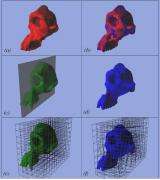
Reconstruction of fossil material - meshes of the left cranium (and see Materials and Methods). (a) P. boisei (cast and fossil combined). (b) Undeformed Pan. (c) Pan skull and 3D grid prior to deformation. (d) P. boisei mesh with deformed Pan mesh (blue) superimposed. (e) Deformed Pan mesh. (f) Pan mesh and 3D grid after at end of deformation process. Image: Dr Stephen Wroe et al. Proceedings of the Royal Society B.

The robust jaws and formidable teeth of some of our ancestors and ape cousins may suggest that humans are wimps when it comes to producing a powerful bite: but a new study has found the opposite is true, with major implications for our understanding of diet in ancestral humans.

The surprise findings suggest that early modern humans did not necessarily need to use tools and cooking to process high-nutrient hard foods, such as nuts - and perhaps less tough foods such as meat - but may have lost an ability to eat very tough items, such as tubers or leaves.

In the first comparison of its kind, Australian researchers have found that the lightly built human skull has a far more efficient bite than those of the chimp, gorilla and orang-utan, and of two prehistoric members of our family, Australopithecus africanus and Paranthropus boisei.

They found that modern humans can achieve relatively high bite forces using less-powerful . In short, the human skull does not have to be as robust because, for any given bite force, the sum of forces acting on the human skull is much less.

These results also explain the apparent inconsistency of very thick in modern humans - a feature typically associated with high bite forces in other species. Thick enamel and large human tooth roots are well adapted to take high loads when biting.

The study appears in a paper in the journal by a team led by Dr Stephen Wroe, of the Computational Biomechanics Research Group in the UNSW's School of Biological, Earth and Environmental Sciences. They used sophisticated three-dimensional (3D) finite element analysis to compare digital models of actual skulls that had been CAT-scanned.

The technique, adapted from engineering, provides a highly detailed view of where stresses occur in materials under loads designed to mimic actual scenarios. Wroe's team has previously used this approach to study the jaw mechanics of living and as varied as the great white shark and the sabre-toothed tiger.

These result calls into question previous suggestions that the evolution of a less robust skull in involved a trade-off for a weaker bite or was necessarily a response to behavioural changes, such as switching to softer foods or more processing of foods with tools and cooking. It has also been suggested that human jaw muscles were reduced to make way for a larger brain.

"However plausible those ideas may seem they have been based on very little by way of comparative data: for example, there are no actual records of bite force collected from living members of any other ape species, " says Dr Wroe. "It turns out that we don't have a wimpish bite at all - it is very efficient and powerful.

"When we're biting down in vertical plane, at the back of the jaw our bite is about 40-50% more efficient than it is for all great apes. It's even more efficient when biting at the front of the jaw.

"We've only looked at two extinct hominins in this study, but, for our size, we humans are comparable in terms of maximum bite force to these fossil species, which include 'nutcracker man', renowned for its particularly massive skull and jaw muscles. Size matters, but efficiency matters more - and humans are very efficient biters.

"Importantly though, our study focuses on the generation of peak forces over short time spans. The jaws of other species may be better adapted to maintain chewing over long periods. This means that although humans are up there with great apes in their ability to quickly crack open a hard item, such as a large nut, or process less tough foods, such as meat, they may be less well adapted to process tough material, such as leaves or bamboo, which requires sustained chewing over a long period."

More information: Paper: http://rspb.royals … ull.pdf+html

Provided by University of New South Wales (news : web)

4.8 /5 (6 votes)  

Rank 4.8 /5 (6 votes)
Related Stories
Relevant PhysicsForums posts
  • Mitosis
    created6 hours ago
  • Stem cell question.
    created7 hours ago
  • Protease cleavage
    created13 hours ago
  • Pertubance in a model
    created20 hours ago
  • Cancer drugs and Alzheimer's, Oh my!
    createdFeb 09, 2012
  • Squishing cells
    createdFeb 09, 2012
  • More from Physics Forums - Biology

More news stories

A frank discussion of the power law and linking correlation to causation

(PhysOrg.com) -- Michael Stumpf a mathematics professor at Imperial College in London, and Mason Porter a lecturer at Oxford have teamed together to write and publish a perspective piece in Science regarding the in ...

Other Sciences / Mathematics

created 20 hours ago | popularity 5 / 5 (3) | comments 8 | with audio podcast report

Employers feel no love for unscrupulous practice of 'service sweethearting'

A new study led by two Florida State University marketing professors finds that some frontline service employees who are rewarded for hikes in customer loyalty and satisfaction also may engage in "service ...

Other Sciences / Economics & Business

created 14 hours ago | popularity 4 / 5 (1) | comments 7

The question of life in the ancient world

There’s a general feeling that we don’t get the Greeks – ancient or modern. Many, including heads of state like Angela Merkel, visibly shake their head in exasperation, rightly or wrongly, at ...

Other Sciences / Archaeology & Fossils

created 19 hours ago | popularity 1.3 / 5 (3) | comments 4

Sonic Cradle lands spot in TED exhibition

A Simon Fraser University graduate student project that melds music, meditation and modern technology has landed a rare spot as an exhibit at TEDActive 2012 in Palm Springs, California this month.

Other Sciences / Other

created 16 hours ago | popularity not rated yet | comments 0

Do we no longer care about the collective good?

The Transformation of Solidarity, a book co-edited by University of Queensland sociologist Dr Mara Yerkes, tackles the subject of globalisation of national economies and societies where we put a high value ...

Other Sciences / Social Sciences

created Feb 06, 2012 | popularity 3.9 / 5 (8) | comments 39


Anonymous knocks CIA website offline (Update)

The website of the Central Intelligence Agency was inaccessible on Friday after the hacker group Anonymous claimed to have knocked it offline.

New error-correcting codes guarantee the fastest possible rate of data transmission

Error-correcting codes are one of the triumphs of the digital age. They’re a way of encoding information so that it can be transmitted across a communication channel — such as an optical fiber o ...

Humans may have helped the decline of African rainforests 3000 years ago

(PhysOrg.com) -- Large areas of rainforests in Central Africa mysteriously disappeared over three thousand years ago, to be replaced by savannas. The prevailing theory has been that the cause was a change ...

New power source discovered

(PhysOrg.com) -- Researchers at the Massachusetts Institute of Technology (MIT) and RMIT University have made a breakthrough in energy storage and power generation.

Small modular reactor design could be a 'SUPERSTAR'

(PhysOrg.com) -- Though most of today's nuclear reactors are cooled by water, we've long known that there are alternatives; in fact, the world's first nuclear-powered electricity in 1951 came from a reactor ...

Google users warned of threat to smartphone wallets

Users of Google smartphone wallets were being warned on Friday that there is a way to crack pass codes intended to thwart thieves from going on illicit shopping sprees.