Defective signaling pathway leads to vascular malformations in the brain
June 22, 2010
Defective signaling pathway leads to vascular malformations in the brain

Enlarge

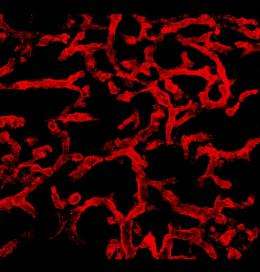
Human blood vessel in an experimental mouse model: Turning off the CCM1 gene leads to the typical, disorganized appearance.

A disrupted signaling pathway in endothelial cells, which line the insides of blood vessels, leads to cavernomas, vascular malformations in the brain which are often dangerous. This has been published by a research team of the Medical Faculty Mannheim of Heidelberg University and the German Cancer Research Center. The investigators have found the cause of one of the most common human malformations and point out that cavernomas might be treated by drugs which inhibit vascular growth.

Benign vascular malformations known as cavernomas can occur in many tissues of the body. These abnormalities are characterized by enlarged, instable and unstructured blood vessels. Cavernomas of medical relevance are primarily those of the brain, which develop approximately in one out of two hundred people. In the brain, such growths often remain unnoticed and are typically found by chance in MRI scans. If they grow larger, they often cause unspecific symptoms such as headaches or dizziness. There is a growing danger of cerebral hemorrhage from these vascular growths, which can lead to seizures, neurological failures and even stroke. Therefore, cavernomas causing symptoms are surgically removed from the brain, if possible.

In the joint department of Vascular Biology and Tumor Metastasis of Mannheim Medical Faculty of Heidelberg University and DKFZ, researchers are investigating how blood vessels and lymphatic vessels are newly formed in tumor diseases. "Our latest findings suggest that - like in tumors - excessive and uncontrolled vascular growth leads to the development of cavernomas," said Dr. Andreas Fischer, who leads the current study.

It was already known that the disease develops when the CCM1 gene is inactive in endothelial cells, which line all blood vessels. However, it was still unclear why this leads to the characteristic malformations. The research team has now identified, jointly with colleagues from Essen and Greifswald, the central signaling pathways in endothelial cells which are affected if the CCM1 gene is missing. For best possible simulation of the disease occurring in humans, the investigators transplanted human with disabled CCM1 gene into mice. The transplanted cells subsequently grew into the typical vascular malformations. Thus, it was possible to perform experiments with human vascular malformations in the mouse model. Therefore, the results obtained can well be transferred to the human disease situation so that it was even possible, for example, to perform drug tests.

In their first approach, the researchers tested the anticancer drug sorafenib, which inhibits the formation of new (angiogenesis). In the transplanted mice, the substance led to massive reduction of the vascular growth. "We will now investigate whether we can treat brain cavernomas without surgery using a drug from cancer medicine," said Dr. Andreas Fischer describing the project's future goals.

More information: Wüstehube J, Bartol A, Liebler SS, Brütsch R, Zhu Y, Felbor U, Sure U, Augustin HG, Fischer A: Cerebral cavernous malformation protein CCM1 inhibits sprouting angiogenesis by activating DELTA-NOTCH signaling. Proc. Natl. Acad. Sci. USA; early online edition, June 21, 2010 DOI: 10.1073/pnas.1000132107

Provided by Helmholtz Association of German Research Centres (news : web)


Rank not rated yet
Related Stories
Relevant PhysicsForums posts
  • Is Everyday Technology Killing Us?
    createdFeb 08, 2012
  • Exercise and weight loss
    createdFeb 08, 2012
  • Why do we have head aches? Our brains can't feel anything.
    createdFeb 07, 2012
  • "The end of diseases" by David Agus, interview from Daily Show with Jon Stewart
    createdFeb 04, 2012
  • Oncolytic adenovirus
    createdFeb 04, 2012
  • Nutrition label stuffs and diets
    createdFeb 02, 2012
  • More from Physics Forums - Medical Sciences

More news stories

Complex wiring of the nervous system may rely on a just a handful of genes and proteins

Researchers at the Salk Institute have discovered a startling feature of early brain development that helps to explain how complex neuron wiring patterns are programmed using just a handful of critical genes. ...

Medicine & Health / Research

created 11 hours ago | popularity 4.9 / 5 (9) | comments 1 | with audio podcast

Team isolates nerve cells involved in storing long term memory and gene proteins associated with them

(Medical Xpress) -- A research team in Taiwan has succeeded in isolating two nerve cells in fruit fly brains that are believed to be the major players in allowing for the formation of long term memories. Furthermore, ...

Medicine & Health / Neuroscience

created 17 hours ago | popularity 5 / 5 (4) | comments 2 | with audio podcast report

Seeing colors in music, tasting flavors in shapes may happen in life's early months

Famed violinist Itzhak Perlman sees a deep forest green whenever he plays a B-flat on his Stradivarius' G string. The A on the E string is red.

Medicine & Health / Psychology & Psychiatry

created 18 hours ago | popularity 4.5 / 5 (2) | comments 2 | with audio podcast

Both maternal and paternal age linked to autism

Older maternal and paternal age are jointly associated with having a child with autism, according to a recently published study led by researchers at The University of Texas Health Science Center at Houston (UTHealth).

Medicine & Health / Psychology & Psychiatry

created 15 hours ago | popularity 4.3 / 5 (3) | comments 0 | with audio podcast

New understanding of DNA repair could eventually lead to cancer therapy

A research group in the Faculty of Medicine & Dentistry at the University of Alberta is hoping its latest discovery could one day be used to develop new therapies that target certain types of cancers.

Medicine & Health / Cancer

created 15 hours ago | popularity 4.8 / 5 (6) | comments 0 | with audio podcast


Anonymous knocks CIA website offline (Update)

The website of the Central Intelligence Agency was inaccessible on Friday after the hacker group Anonymous claimed to have knocked it offline.

New error-correcting codes guarantee the fastest possible rate of data transmission

Error-correcting codes are one of the triumphs of the digital age. They’re a way of encoding information so that it can be transmitted across a communication channel — such as an optical fiber o ...

Humans may have helped the decline of African rainforests 3000 years ago

(PhysOrg.com) -- Large areas of rainforests in Central Africa mysteriously disappeared over three thousand years ago, to be replaced by savannas. The prevailing theory has been that the cause was a change ...

Google users warned of threat to smartphone wallets

Users of Google smartphone wallets were being warned on Friday that there is a way to crack pass codes intended to thwart thieves from going on illicit shopping sprees.

New power source discovered

(PhysOrg.com) -- Researchers at the Massachusetts Institute of Technology (MIT) and RMIT University have made a breakthrough in energy storage and power generation.

The power of estrogen -- male snakes attract other males

A new study has shown that boosting the estrogen levels of male garter snakes causes them to secrete the same pheromones that females use to attract suitors, and turned the males into just about the sexiest ...