Turning off the air conditioning helps save fuel: Swiss study
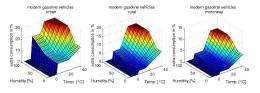
Automobile air conditioning systems do not run "free of charge". In fact in the hot parts of the world they can account for up to thirty per cent of fuel consumption. Even in Switzerland, with its temperate climate, the use of air conditioning systems is responsible for about five per cent of total fuel usage, rising to around ten per cent in urban traffic, as shown by a new study undertaken by Empa on behalf of the Swiss Federal Office for the Environment (FOEN). Furthermore, two thirds of the additional fuel usage could be saved if air conditioning systems were simply turned off when the air temperature falls below 18 degrees Celsius.
Car air conditioning systems require energy to compress the cooling agent, and the greater the degree of cooling required the more energy (i.e. fuel) they use. Little known, however, is the fact that these systems also used fuel when the outside air temperature is cooler than in the vehicle. For this reason the Federal Office for the Environment (FOEN) gave Empa the task of investigating in detail the fuel consumption of six modern cars - both diesel and petrol models - with their air conditioning systems switched on and off under varying ambient temperatures and humidities.
The study, the results of which have just been published in the scientific journal Environmental Science and Technology, shows that the fuel consumption of the test vehicles with air conditioning systems in operation increases with rising ambient air temperature and humidity (Figure 1), reaching a value of some 18 per cent on a typical Swiss summer day with an air temperature of 27 degrees and relative humidity of 60 per cent. In addition, the researchers noted that the air conditioning systems in cars with automatic transmissions (which today are the most widely sold models) only turn themselves off when the external temperature drops below 5 degrees, when the cooling system could ice-up. This occurs because air conditioning systems not only cool the air before blowing it into the vehicle interior but also dry it, so as to avoid causing condensation on the front windscreen when it rains, among other reasons. This is of course perfectly sensible and important for safe driving, but only when the air humidity is high, and not all the time - as is currently the case.
Using the standard climate model defined by the Swiss Society of Engineers and Architects (SIA, Bern) and allowing for the measured increase in consumption (plus the use of the vehicle during the day), the average annual extra consumption of a petrol-engined car works out to 5.4 per cent (Figure 2, orange bar). Differentiating between urban, suburban and motorway driving gives additional fuel usage values of 10, 2.8 and 1.3 per cent respectively.
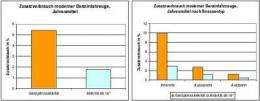
It is known from physiological studies that the average driver feels comfortably warm when the air temperature around the head is 23 degrees. This means that if the outside temperature is below 18°C the car's air conditioning system could be turned off without any loss of comfort. For the petrol-engined vehicles investigated this would represent a saving of some two-thirds of the additional fuel usage (Figure 2, blue bar), which is after all 3.6 per cent of the total consumption. When the outside temperature is higher, it is advisable to keep the air conditioning switched on since otherwise the heat may affect the driver's concentration and reduce safety.
With the diesel fuelled vehicles tested, the additional consumption due to the use of air conditioning, particularly for urban driving, is somewhat lower (2.7 per cent in total). The individual values for urban, suburban and motorway driving in this case are 4.5, 2.3 and 1.2 per cent respectively. The potential saving possible through switching off the air conditioning unit when the outside temperature falls below 18 degrees remains, however, two thirds of the additional consumption for the diesel vehicles tested.
If the entire Swiss automobile fleet is evaluated - that is, including vehicles without air conditioning systems as well as older models with inefficient compressor units - then a figure of 3.1 per cent of additional consumption is arrived at, assuming all air conditioning units are in use over the whole year. This drops to 1 per cent if air conditioning units are switched off when the ambient air temperature falls below 18 degrees. This simple measure could therefore result in a reduction in total fuel consumption of some two per cent across the whole country.
More information: Martin F. Weilenmann, Robert Alvarez, Mario Keller, Fuel consumption and CO2/pollutant emissions of mobile air conditioning at fleet level - new data and model comparison, Environmental Science & Technology, published online June 8, 2010: pubs.acs.org/doi/abs/10.1021/es903654t
Provided by EMPA


