New Air Conditioner Conquers All Climates, Saves Up To 90% Energy
June 22, 2010 by Bill Scanlon
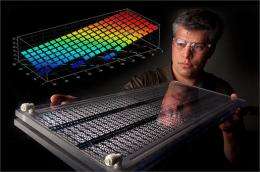
NREL senior engineer Eric Kozubal examines a prototype air flow channel of the DEVap air conditioner, which he co-invented. DEVap, which stands for desiccant-enhanced evaporative air conditioner, is a novel concept that uses membrane technology to combine the efficiency of evaporative cooling and the drying potential of liquid desiccant salt solutions. The graph superimposed on the photo shows shows how hot humid air, in red, changes to cool dry air, in blue, as the air passes through the DEVap core. Credit: Pat Corkery
Ah, the cool, refreshing feel of air conditioning on a sweltering summer day. Ugh, the discomfort when those energy bills in July, August and September come due $200, $400, $600 or more.
Feel miserable, or dig deep into your wallet not much of a choice for the 250 million Americans who live in climates where heat, humidity or both are a Catch-22 for three to 12 months a year.
A soothing solution may be on its way, thanks to a melding of technologies in filters, coolers and drying agents.
The U.S. Department of Energy's National Renewable Energy Laboratory has invented a new air conditioning process with the potential of using 50 percent to 90 percent less energy than today's top-of-the-line units. It uses membranes, evaporative cooling and liquid desiccants in a way that has never been done before in the centuries-old science of removing heat from the air.
"The idea is to revolutionize cooling, while removing millions of metric tons of carbon from the air," NREL mechanical engineer Eric Kozubal, co-inventor of the Desiccant-Enhanced eVaporative air conditioner (DEVap), said.
"We'd been working with membranes, evaporative coolers and desiccants. We saw an opportunity to combine them into a single device for a product with unique capabilities."
Hot and Humid Climates are Tricky
Evaporative coolers are a lower-cost alternative to A/C in dry climates that don't get too hot or humid say, Denver, but not Phoenix or Miami. Water flows over a mesh, and a fan blows air through the wet mesh to create humid, cool air.
In humid climes, adding water to the air creates a hot and sticky building environment. Furthermore, the air cannot absorb enough water to become cold.
In Phoenix or Tucson, the evaporative cooler can bring down the temperature, but not enough to make it pleasant inside on a 100-degree day or during the four to eight week moist period known as monsoon season. The cooling bumps up against the wet bulb temperature, the lowest temperature to which air can be cooled by evaporating without changing the pressure. The wet bulb temperature could be 75 or 80 degrees on a mid-summer Tucson day. Typically, evaporative coolers only can bring the temperatures about 85 percent of the way to the wet bulb level.
So, for most of the country, refrigeration-based air conditioning is the preferred way of keeping cool.
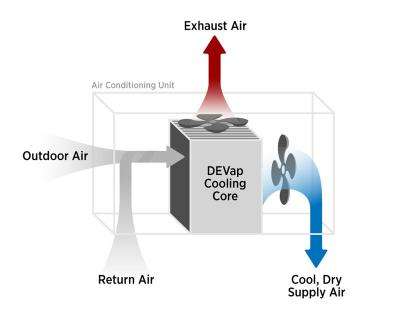
This illustration shows how the DEVap cooling core uses water and liquid desiccant to draw in outside air, exhaust some of that air and return cool, dry air to the area being cooled. DEVap's integrated evaporative component and its desiccant drying process offer improved dehumidification and, thus lower costs and much lower energy usage.
Cooling Requires Temperature Drop and Less MoistureCooling comes in two forms sensible cooling, which is a temperature drop, and latent cooling, which comes from pulling the moisture out of the air.
One intriguing product already on the market in arid, temperate climates is the Coolerado cooler. It differs from a typical evaporative cooler by never increasing the moisture content of the supply air. It provides cool air through indirect evaporative cooling. Indirect evaporative systems use a purge air stream that removes heat from the product or supply air stream that is then directed into a building.
That way, the Coolerado can cool the air all the way to the wet-bulb temperature.
"It's a big improvement on evaporative cooling because it doesn't add moisture and still gives you cold air," Kozubal said. However, in a humid climate, it still does not provide cold air or humidity control.
DEVap: Liquid Desiccants, Permeable Membranes
The DEVap solves that problem. It relies on the desiccants' capacity to create dry air using heat and evaporative coolers' capacity to take dry air and make cold air.
"By no means is the concept novel, the idea of combining the two," Kozubal said. "But no one has been able to come up with a practical and cost-effective way to do it."
HVAC engineers have known for decades the value of desiccants to air conditioning. In fact, one of the pioneers of early A/C, Willis Haviland Carrier, knew of its potential, but opted to go the refrigeration route.
Most people know of desiccants as the pebble-sized handfuls that come with new shoes to keep them dry.
The kind NREL uses are syrupy liquids highly concentrated aqueous salt solutions of lithium chloride or calcium chloride. They have a high affinity for water vapor, and can thus create very dry air.
Because of the complexity of desiccant cooling systems, they have traditionally only been used in industrial drying processes. Inventing a device simple enough for easy installation and maintenance is what has impaired desiccant cooling from entering into commercial and residential cooling markets.
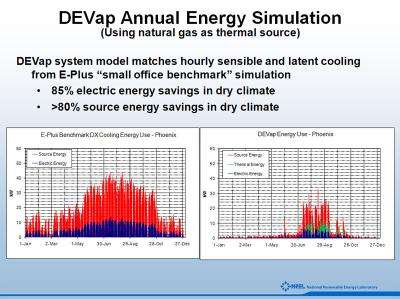
These graphs show the savings possible with DEVap in a warm, dry climate such as Phoenix, if natural gas is the source of energy.
To solve that problem, the NREL device uses thin membranes that simplify the process of integrating air flow, desiccants, and evaporative cooling. These result in an air conditioning system that provides superior comfort and humidity control.The membranes in the DEVap A/C are hydrophobic, which means water tends to bead up rather than soak through the membranes. Imagine rain falling on a freshly waxed car. That property allows the membranes to control the liquid flows within the cooling core. "It's that property that keeps the water and the desiccant separated from the air stream," Kozubal said.
"We bring the water and liquid desiccant into DEVap's heat-mass exchanger core," Kozubal said. "The desiccant and evaporative cooling effect work together to create cold-dry air."
The air is cooled and dried from a hot-humid condition to a cold and dry condition all in one step. This all happens in a fraction of a second as air flows through the DEVap air conditioner. The result is an air conditioner that controls both thermal and humidity loads.
DEVap helps the environment in many ways. DEVap uses 50 percent to 90 percent less energy than top-of-the-line refrigeration-based air conditioning.
Because DEVap uses salt solutions rather than refrigerants, there are no harmful chlorofluorocarbons (CFCs) or hydrochlorofluorocarbons (HCFCs) to worry about. A pound of CFC or HCFC in refrigerant-based A/Cs contributes as much to global warming as 2,000 pounds of carbon dioxide. A typical residential size A/C has as much as 13 pounds of these refrigerants. The release of this much refrigerant is equivalent to burning more than 1,300 gallons of gasoline, or driving over 60,000 miles in a 2010 Toyota Prius. That's based on the Environmental Protection Agency's fuel efficiency rating for the 2010 Toyota Prius and on the standard of 19.5 pounds of carbon dioxide for every gallon of gasoline burned.
Traditional air conditioners use a lot of electricity to run the refrigeration cycle, but DEVap replaces that refrigeration cycle with an absorption cycle that is thermally activated. It can be powered by natural gas or solar energy and uses very little electricity.
This means that DEVap could become the most energy efficient way to cool your house whether you live in Phoenix, New York, or Houston.
NREL has patented the DEVap concept, and Kozubal expects that over the next couple of years he will be working on making the device smaller and simpler and perfecting the heat transfer to make DEVap more cost effective.
Eventually, NREL will license the technology to industry, "We're never going to be in the air conditioner manufacturing business", said Ron Judkoff, Principle Program Manager for Building Energy Research at NREL. "But we'd like to work with manufacturers to bring DEVap to market and create a more efficient and environmentally benign air conditioning product."
More information: Thermally driven air conditioning - http://www.nrel.go … ir_cond.html
Provided by National Renewable Energy Laboratory
-
Keeping cool using the summer heat
Jan 23, 2009 |
not rated yet |
0
-
Staying Cool Shouldn't Burn a Hole in Your Wallet
Jul 07, 2006 |
not rated yet |
0
-
NIST helps heat pumps 'go with the flow' to boost output
Jan 23, 2008 |
not rated yet |
0
-
UC Davis challenge produces a better air conditioner
Aug 14, 2009 |
not rated yet |
0
-
Hotspots in developing countries will fuel demand for global energy
Jan 21, 2009 |
not rated yet |
0
-
Engineers build first sub-10-nm carbon nanotube transistor
Feb 01, 2012 |
4.9 / 5 (31) |
30
-
Something old, something new: Evolution and the structural divergence of duplicate genes
Jan 31, 2012 |
4.6 / 5 (7) |
1
-
The hidden nanoworld of ice crystals: Revealing the dynamic behavior of quasi-liquid layers
Jan 30, 2012 |
5 / 5 (3) |
1
-
Stock market network reveals investor clustering
Jan 27, 2012 |
3.9 / 5 (23) |
8
-
Of microchemistry and molecules: Electronic microfluidic device synthesizes biocompatible probes
Jan 26, 2012 |
5 / 5 (1) |
0
-
Calling function with no input argument
4 hours ago
-
Force free body diagram problem on gym equipment
5 hours ago
-
Empirical data regarding shower heads and water
13 hours ago
-
feed hold button on CNC lathe
Feb 09, 2012
-
RFAC in Fortran
Feb 09, 2012
-
dynamics 2/32
Feb 08, 2012
- More from Physics Forums - General Engineering
More news stories
Expat French get Internet vote for first time
French citizens will for the first time this year be able to vote in a parliamentary election over the Internet, an experiment that could be extended to other elections if successful.
1 hour ago |
not rated yet |
0
"Twisted Metal" gamers get shot at real gunplay
Fans of "Twisted Metal" will get to welcome a long-awaited sequel of the car-battle videogame with a real-world bang by blasting an ice cream truck to bits with a machine gun.
56 minutes ago |
not rated yet |
0
New error-correcting codes guarantee the fastest possible rate of data transmission
Error-correcting codes are one of the triumphs of the digital age. Theyre a way of encoding information so that it can be transmitted across a communication channel such as an optical fiber o ...
Technology / Computer Sciences
7 hours ago |
5 / 5 (3) |
4
|
Small modular reactor design could be a 'SUPERSTAR'
(PhysOrg.com) -- Though most of today's nuclear reactors are cooled by water, we've long known that there are alternatives; in fact, the world's first nuclear-powered electricity in 1951 came from a reactor ...
Technology / Energy & Green Tech
6 hours ago |
4.2 / 5 (10) |
14
|
Advanced power-grid model finds low-cost, low-carbon future in West
(PhysOrg.com) -- The least expensive way for the Western U.S. to reduce greenhouse gas emissions enough to help prevent the worst consequences of global warming is to replace coal with renewable and other ...
Technology / Energy & Green Tech
6 hours ago |
5 / 5 (2) |
6
|
Putting the squeeze on planets outside our solar system
(PhysOrg.com) -- Using high-powered lasers, scientists at Lawrence Livermore National Laboratory and collaborators discovered that molten magnesium silicate undergoes a phase change in the liquid state, abruptly ...
Employers feel no love for unscrupulous practice of 'service sweethearting'
A new study led by two Florida State University marketing professors finds that some frontline service employees who are rewarded for hikes in customer loyalty and satisfaction also may engage in "service ...
Human cognitive performance suffers following natural disasters, researchers find
Not surprisingly, victims of a natural disaster can experience stress and anxiety, but a new study indicates that it might also cause them to make more errors - some serious - in their daily lives. In their upcoming Human Fa ...
The power of estrogen -- male snakes attract other males
A new study has shown that boosting the estrogen levels of male garter snakes causes them to secrete the same pheromones that females use to attract suitors, and turned the males into just about the sexiest ...
Curry spice component may help slow prostate tumor growth
Curcumin, an active component of the Indian curry spice turmeric, may help slow down tumor growth in castration-resistant prostate cancer patients on androgen deprivation therapy (ADT), a study from researchers ...
Fool's gold may prove an unlikely alternative to overexploited catalytic materials
Catalytic materials, which lower the energy barriers for chemical reactions, are used in everything from the commercial production of chemicals to catalytic converters in car engines. However, with current catalytic materials ...


Jun 22, 2010
Rank: 4 / 5 (2)
Jun 22, 2010
Rank: not rated yet
Jun 22, 2010
Rank: 5 / 5 (1)
Jun 23, 2010
Rank: not rated yet
Jun 23, 2010
Rank: not rated yet
Still, if in the end it's the same efficiency as CFC technology this would be a great new replacement.
Jun 23, 2010
Rank: 5 / 5 (1)
The desiccant is indeed recycled, first pulling moisture out of the airstream and going from a strong to a weak solution in the process, then being pumped through a gas-fired boiler to drive off the collected water. They've been trying to use solar for years, but the required temperature vs. cost could never be satisfied. It is fundamentally a fascinating system, both efficient and safe, using only a suitable heat source, pumps, fans, and a brine solution, but no compressor or high-pressure refrigerant. Incidentally, I live in Phoenix and so am intimately familiar with the 'joys' of conventional 'swamp cooling' in the middle of August. I really wish they'd perfect this- 300/month electric bills suck.
Jun 23, 2010
Rank: 5 / 5 (1)
The answer is no, unfortunately. But, I would search for anything other than electric heat--the most inefficient form there is. If it's very cold, conventional heat pumps are out, but you might consider a geothermal heat pump, although they are pricey. Also, gas heat is cost-effective in many areas--more so than oil, in my opinion. Another thought is using one or more 'trumbe walls'. This is a passive heating technique. Also, solar thermal air or water systems with a large heat storage medium like river rock in an insulated pit can also reduce your heating costs, as long as you have substantial cloud-free conditions. Think outside the box, and do your research, and you might just find something that works within your budget and level of expertise...
Jun 23, 2010
Rank: not rated yet
"The membranes in the DEVap A/C are hydrophobic, which means water tends to bead up rather than soak through the membranes. Imagine rain falling on a freshly waxed car. That property allows the membranes to control the liquid flows within the cooling core." -mentioned in the article.
Jun 23, 2010
Rank: 5 / 5 (1)
Don't get excited. If this thing costs thousands of dollars, and saves me five hundred dollars a year on electricity and needs replaced every couple years then I can't use it.
If this technology even gets close to being actually feasable, then you'll see an entirely different sort of news release than this one. You'll hear an announcement that company XYZ has announced the construction of a new production facility and plans to begin production by the XYZ Quarter of XYZ year. With current government subsidies for green appliances, they must not even be close to the point where this thing will work, or they would be making them already.
You have to read between the lines, but my guess is that it costs too much and doesn't last long enough. It may even need constant adjustment and maintenance in order to work well, and who wants to have to work on the A/C all the time?
Jun 23, 2010
Rank: not rated yet
"Advanced liquid-to-air contactors have been developed that contain the desiccant without mist eliminators. This is a critical advance that eliminates the maintenance traditionally associated with liquid systems, making possible their broad application as packaged systems. These contactors further improve on the industrial state-of-the-art in that they can be mass manufactured, provide the same dehumidification at a fraction of the pressure drop, and incorporate independent cooling and dehumidification in one air-conditioning component to simplify and reduce the cost of the system."- another article.
I'm optimistic. I don't think it require a constant maintenance or is expensive. They said; this thing can be mass produced.
Jun 23, 2010
Rank: not rated yet
Jun 26, 2010
Rank: not rated yet
I find this a positive. Remember, government run/sponsored agencies have never been known for producing the most cost-effective solution and I'd be very surprised if the talent they have at their disposal are suitable to be entrusted with 'getting the costs down'.
After all, that's what the private sector is supposed to be for... and in their statement it's quite clear they are making plans to get this out to the private sector under some form of licensing agreement. My only wish is this technology is made available to all interested parties... Which I'm expecting to be the case. I just don't wanna see 'insert some AC giant' being the only one invited to the party.
Jun 26, 2010
Rank: not rated yet
Jun 27, 2010
Rank: not rated yet
It seems the "creative destruction" mechanism of highly regulated Capitalism is broken. But be of good cheer, all the large multi-nationals, like BP and GE, are firmly behind cap and trade.
You gotta wonder why.