Amniotic membrane used to repair human articular cartilage
June 23, 2010
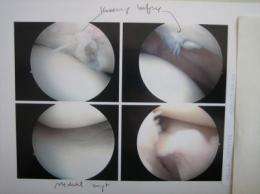
Osteoarthritis is characterized by impairment of cartilage and subchondral bone. In this image, an example of damaged knee cartilage is shown. Credit: Kristie Wells
Spanish scientists have proposed using human amniotic membrane as a new tool for repairing damaged human articular cartilage, which heals very poorly because of its low capacity for self-repair. Their research, published in the journal Cell and Tissue Banking, shows that the cellular density of the cartilage synthesized could be greater than that of the body's own natural cartilage.
"The objective was to evaluate the utility of cryo-preserved human amniotic membrane (HAM) as a support for repairing human articular cartilage injuries, which have a very limited capacity for self-healing", Francisco J. Blanco, lead author of the study and a researcher at the Institute of Biomedical Research of La Coruna (INIBIC), tells SINC.
The results, which have been published in the journal Cell and Tissue Banking, show that cryo-preserved HAM is useful as a scaffold for growing human chondrocytes in cell therapy and for repairing human cartilage injuries. "It provides a more regular surface and fills in the cavities and fissures", explains Blanco.
The authors cultivated the chondrocytes (cells that form part of the cartilaginous tissue), isolated from human articular cartilage, on the amniotic membrane over a period of three and four weeks. The amniotic membranes were used to develop 44 repair models of arthritic human articular cartilage in vitro, which was assessed between four and 16 weeks later.
The HAM also bonds well with the native cartilage. "In some models, we could not differentiate between where the native tissue stopped and the neo-synthesised tissue began", says the expert. This tissue had a fibrous appearance and high cellular density (cellularity), which in some cases was greater than that of the actual native cartilage.
The use of differentiated chondrocytes is a useful therapeutic option for repairing articular cartilage injuries. However, there are limitations to implanting these cells, since many patients will be ruled out due to their lack of healthy chondrocytes, and this technique also causes additional damage to the joint.
"Transplanting chondrocytes cultivated on different natural or synthetic 'scaffolds' is used today in cell tissue engineering. The HAM has sparked great interest over recent years, above all in the field of regenerative medicine", concludes Blanco.
Clinical solutions to osteoarthritis
Osteoarthritis (OA) is a major articular pathology that is characterised by alteration of the cartilage and the bone that supports it, the subchondral bone. As the current pharmacological and surgical treatments have only palliative effects, cell therapy is a new clinical approach for repairing damaged or destroyed tissues.
HAM has many clinical advantages as a support - it is an anti-microbial, anti-angiogenic, anti-tumour tissue, which reduces inflammation and pain and improves scarring. In addition, the amnios of the HAM has no immune response, meaning there are no risks associated with transplanting it, and it contains many of the components of natural cartilage.
More information: Silvia Díaz-Prado; MĒ Esther Rendal-Vázquez; Emma Muiņos-López; Tamara Hermida-Gómez; Margarita Rodríguez-Cabarcos; Isaac Fuentes-Boquete; Francisco J. de Toro; Francisco J. Blanco. "Potential use of the human amniotic membrane as a scaffold in human articular cartilage repair". Cell Tissue Bank (2010) 11:183-195 DOI 10.1007/s10561-009-9144-1
Provided by FECYT - Spanish Foundation for Science and Technology
-
Scientists progress in successful tissue engineering
Mar 23, 2007 |
not rated yet |
0
-
Tissue engineered scaffolding allows reproduction of cartilage tissue
May 09, 2007 |
not rated yet |
0
-
Stem cells offer cartilage repair hope for arthritis sufferers
Apr 11, 2008 |
not rated yet |
0
-
Growing Cartilage from Stem Cells
Oct 20, 2009 |
not rated yet |
0
-
Study assesses new surgical procedure for regenerating cartilage in damaged knee joints
Apr 09, 2009 |
not rated yet |
0
-
Engineers build first sub-10-nm carbon nanotube transistor
Feb 01, 2012 |
4.9 / 5 (29) |
30
-
Something old, something new: Evolution and the structural divergence of duplicate genes
Jan 31, 2012 |
4.6 / 5 (7) |
1
-
The hidden nanoworld of ice crystals: Revealing the dynamic behavior of quasi-liquid layers
Jan 30, 2012 |
5 / 5 (3) |
1
-
Stock market network reveals investor clustering
Jan 27, 2012 |
3.9 / 5 (23) |
8
-
Of microchemistry and molecules: Electronic microfluidic device synthesizes biocompatible probes
Jan 26, 2012 |
5 / 5 (1) |
0
-
Is Everyday Technology Killing Us?
23 hours ago
-
Exercise and weight loss
Feb 08, 2012
-
Why do we have head aches? Our brains can't feel anything.
Feb 07, 2012
-
"The end of diseases" by David Agus, interview from Daily Show with Jon Stewart
Feb 04, 2012
-
Oncolytic adenovirus
Feb 04, 2012
-
Nutrition label stuffs and diets
Feb 02, 2012
- More from Physics Forums - Medical Sciences
More news stories
New target for Alzheimer's drugs
(Medical Xpress) -- Biomedical scientists at the University of California, Riverside have identified a new link between a protein called beta-arrestin and short-term memory that could open new doors for the ...
11 minutes ago |
not rated yet |
0
|
Climate change to increase tropical disease range
According to climate modelling for 2050, northern sections of WA could present ideal conditions for dengue fever.
43 minutes ago |
not rated yet |
0
What kind of chocolate is best? The last you taste, says a new study
(Medical Xpress) -- Like to save the best for last? Heres good news: If its the last, youll like it the best. That is the finding of a new study published in Psychological Science, a journal of the Associ ...
Medicine & Health / Psychology & Psychiatry
1 hour ago |
not rated yet |
0
|
Stanford develops new tool for teaching doctors to treat sepsis
Jack was sinking fast, his vital signs registering alarming numbers. With every passing second, his doctor, Charles Prober, could see his patient being overwhelmed by sepsis, a deadly complication of infection ...
13 minutes ago |
not rated yet |
0
Right time for 'end-of-life' talk
The vast majority of patients with incurable lung or colorectal cancer talk with a physician about their options for care at the end of life, but often not until late in the course of their illness, according ...
3 minutes ago |
not rated yet |
0
Inspired by steel, nanomanufacturing gets wear-resistant carbide tip
(PhysOrg.com) -- Scientists at the University of Pennsylvania, the University of Wisconsin-Madison and IBM Research - Zurich have fabricated an ultrasharp silicon carbide tip possessing such high strength ...
Borexino Collaboration succeeds in spotting pep neutrinos emitted from the sun
(PhysOrg.com) -- To learn more about how the sun works, scientists study particles that are emitted from it into space due to thermonuclear reactions that occur inside; by applying known physics principles, ...
Samsung can continue selling Galaxy tabs in Germany: court
South Korea's Samsung Electronics can continue to sell its Galaxy Tab 10.1N tablet computer in Germany, a German court ruled Thursday, rejecting a bid by arch-rival Apple to have them banned.
New views show old NASA Mars landers
(PhysOrg.com) -- The High Resolution Imaging Science Experiment (HiRISE) camera on NASA's Mars Reconnaissance Orbiter recorded a scene on Jan. 29, 2012, that includes the first color image from orbit showing ...
Engineers find inspiration for new materials in Piranha-proof armor
(PhysOrg.com) -- Its a matchup worthy of a late-night cable movie: put a school of starving piranha and a 300-pound fish together, and who comes out the winner?
Explained: Sigma
It's a question that arises with virtually every major new finding in science or medicine: What makes a result reliable enough to be taken seriously? The answer has to do with statistical significance -- but ...