New method of peptide synthesis makes it easier to create drugs based on natural compounds
June 23, 2010
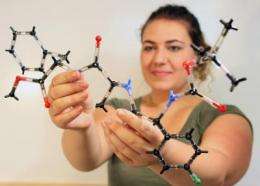
Graduate student Dawn Makley holding a model of a peptide created with new synthesis method. Credit: Steve Green, Vanderbilt University
A team of Vanderbilt chemists has developed a novel method for chemically synthesizing peptides that promises to lower the cost and increase the availability of drugs based on natural compounds.
The new synthesis technique is described in a paper published in the June 24 issue of the journal Nature.
Peptides are polymers made by stringing together two or more amino acids, the chemical building blocks of life, in a linear chain and folded into a globular form. DNA holds the blueprints for 20 "standard" amino acids, which cells use for manufacturing proteins - peptides that perform basic cell functions. However, cells also create peptides that contain "non-natural" amino acids for a variety of different purposes by modifying standard peptides after they are produced.
The pharmaceutical industry has a growing interest in using peptides and proteins as therapeutic agents because they have highly specific biological activity associated with low toxicity. However, peptide-based drugs currently make up only a few percent of the total pharmaceutical market . The vast majority of the drugs on the market today are "small molecule" drugs that are synthesized completely in the laboratory.
"Scientists from many disciplines have sought improved methods to streamline the synthesis of peptides through purely chemical means in order to increase the diversity of the chemical tools available for the design of improved therapeutics," says Professor of Chemistry Jeff Johnston, who directed the effort. "Our discovery of a conceptually new approach to peptide synthesis brings this capability much closer to reality."
In the last 40 years, peptide synthesis has become highly automated. Peptide synthesis machines are widely used in research laboratories around the world. However, these machines are limited to building molecules from standard amino acids and are best suited for making relatively small peptides.
The new approach addresses one of the key limitations of current methods of peptide synthesis: the difficulty of incorporating non-natural amino acids. That is one reason why most current pharmaceuticals based on "biologics" include active ingredients extracted from cells grown by the relatively difficult and expensive fermentation process instead of being synthesized "from scratch" in the laboratory.
The Vanderbilt process - developed by graduate students Bo Shen, who is now at Massachusetts Institute of Technology, and Dawn Makley - makes it much easier to create peptides that incorporate non-natural amino acids.
Another advantage of Johnston's technique is controlling the "handedness" - or chirality - of the molecules it creates. Most biological molecules, including amino acids, typically come in two versions - right-handed and left-handed - which can have significantly different biological activities. Cells generally create and use left-handed peptides. Controlling handedness in traditional methods of peptide synthesis requires adding a number of additional steps, which substantially reduces the overall efficiency of the synthesis. The new method significantly streamlines this process.
"Our method complements conventional peptide synthesis like the helicopter complements conventional jet transport," Johnston says, "If you wish to get from one major city to another quickly, the jet is your best option. But if you want greater diversity in destinations, the helicopter is your ticket. I must admit, however, that we have plans for a version of our chemistry comparable to the tilt-rotor Osprey that combines the advantages of helicopter and fixed-wing aircraft."
-
Peptides-on-demand: Researcher's radical new green chemistry makes the impossible possible
Feb 24, 2009 |
not rated yet |
0
-
New NIST reference material for peptide analysis
May 25, 2007 |
not rated yet |
0
-
Man-made proteins could be more useful than real ones
Feb 06, 2007 |
not rated yet |
0
-
Researchers find a peptide that encourages HIV infection
May 10, 2007 |
not rated yet |
0
-
Undercover Tactics
May 10, 2005 |
not rated yet |
0
-
Engineers build first sub-10-nm carbon nanotube transistor
Feb 01, 2012 |
4.9 / 5 (31) |
30
-
Something old, something new: Evolution and the structural divergence of duplicate genes
Jan 31, 2012 |
4.6 / 5 (7) |
1
-
The hidden nanoworld of ice crystals: Revealing the dynamic behavior of quasi-liquid layers
Jan 30, 2012 |
5 / 5 (3) |
1
-
Stock market network reveals investor clustering
Jan 27, 2012 |
3.9 / 5 (23) |
8
-
Of microchemistry and molecules: Electronic microfluidic device synthesizes biocompatible probes
Jan 26, 2012 |
5 / 5 (1) |
0
-
Stoichiometry
18 hours ago
-
Boiling and melting point of impure substances
19 hours ago
-
Safe nitrogen compound to decompose a 500 deg C in a furnace?
Feb 09, 2012
-
[ask]electron inside drinking water
Feb 08, 2012
-
How to avoid formation of Lithium Chromate ???
Feb 08, 2012
-
how to choose a reduced or oxidated form in a redox
Feb 08, 2012
- More from Physics Forums - Chemistry
More news stories
Fool's gold may prove an unlikely alternative to overexploited catalytic materials
Catalytic materials, which lower the energy barriers for chemical reactions, are used in everything from the commercial production of chemicals to catalytic converters in car engines. However, with current catalytic materials ...
10 hours ago |
4.6 / 5 (5) |
2
|
Unpicking HIV’s invisibility cloak
Drug researchers hunting for alternative ways to treat human immunodeficiency virus (HIV) infections may soon have a novel targetits camouflage coat. HIV hides inside a cloak unusually rich in a sugar ...
10 hours ago |
5 / 5 (4) |
0
No entry without protein recycling: Researchers discover new coherence in enzyme transport
The group of Prof. Dr. Ralf Erdmann at the Ruhr-Universität Bochum, Germany, discovered a connection of peroxisomal protein import and receptor export. In the Journal of Biological Chemistry, they disclo ...
10 hours ago |
not rated yet |
0
Under the microscope #7
In this video Dr Ingrid Graz shows us a thin layer of gold on top of rubber. Cracks in the gold allow it to stretch and we can use this for stretchable electronics.
12 hours ago |
not rated yet |
0
Hydrogen from acidic water: Researchers develop potential low cost alternative to platinum for splitting water
A technique for creating a new molecule that structurally and chemically replicates the active part of the widely used industrial catalyst molybdenite has been developed by researchers with the Lawrence Berkeley ...
Feb 09, 2012 |
5 / 5 (12) |
13
|
Google users warned of threat to smartphone wallets
Users of Google smartphone wallets were being warned on Friday that there is a way to crack pass codes intended to thwart thieves from going on illicit shopping sprees.
Anonymous knocks CIA website offline (Update)
The website of the Central Intelligence Agency was inaccessible on Friday after the hacker group Anonymous claimed to have knocked it offline.
Complex wiring of the nervous system may rely on a just a handful of genes and proteins
Researchers at the Salk Institute have discovered a startling feature of early brain development that helps to explain how complex neuron wiring patterns are programmed using just a handful of critical genes. ...
Putting the squeeze on planets outside our solar system
(PhysOrg.com) -- Using high-powered lasers, scientists at Lawrence Livermore National Laboratory and collaborators discovered that molten magnesium silicate undergoes a phase change in the liquid state, abruptly ...
NASA sees wide-eyed cyclone Jasmine
Cyclone Jasmine's eye has opened wider on NASA satellite imagery, as it moves through the Southern Pacific Ocean.
New error-correcting codes guarantee the fastest possible rate of data transmission
Error-correcting codes are one of the triumphs of the digital age. Theyre a way of encoding information so that it can be transmitted across a communication channel such as an optical fiber o ...
Jun 23, 2010
Rank: not rated yet