Physicists simulate sounds of the Higgs boson (w/ Video)
June 23, 2010 by Lisa Zyga weblog
LHCsound

Enlarge

You can listen to the sounds of different particles at www.LHCsound.com.

(PhysOrg.com) -- If particle physicists ever find the Higgs boson, they might be hearing its signature rather than - or in addition to - seeing it. The different sounds that particles make can give physicists another way to analyze their data, explains a team of physicists working on data sonification, which is the process of converting data into sounds. Partly for research and partly for public awareness, the scientists have simulated the sounds that the Higgs boson and other subatomic particles might make at the Large Hadron Collider (LHC).

"When you are hearing what the sonifications do you really are hearing the data,” said Archer Endrich, a composer and software engineer working on the project. “It's true to the data, and it's telling you something about the data that you couldn't know in any other way.”

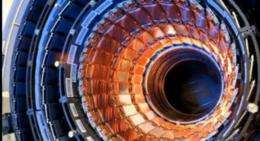
Some of the data comes from Atlas, one of six detectors at the LHC. Atlas uses a calorimeter to measure the energy of the particles that collide inside of it. The calorimeter consists of seven concentric layers, each of which can be represented by a note. The note’s volume and pitch depend on the amount of energy deposited in that layer and its location in the layer, respectively. As physicist Lily Asquith explained, large amounts of energy make louder sounds than small amounts, while energy closer to an observer will have a higher pitch than energy located further away.

This video is not supported by your browser at this time.

One of several tracks available at the LHCsound website, the "Higgs Boson Simple" represents the sounds of an emerging and decaying Higgs boson. Credit: LHCsound.

Although the project may give a new tool to analyze their data, the main goal is to bring attention to the beauty in science, helping promote public awareness of science exploration. You can listen to sounds of the and other particles at the project’s website. The LHCsounds team, led by Asquith, is also working on developing cellphone ringtones and plans to host a public performance of the sounds performed by musicians from its scientific community. Musicians from around the world are also working with the sounds to incorporate them into compositions.

"We can hear clear structures in the sound, almost as if they had been composed,” said Richard Dobson, a composer involved with the project. “They seem to tell a little story all to themselves. They're so dynamic and shifting all the time, it does like a lot of the music that you hear in contemporary composition. You feel closer to the mystery of Nature which I think a lot of scientists do when they get deep into these matters.”

To listen to more sounds of the LHC, visit www.lhcsound.com.

More information: via: BBC News

© 2010 PhysOrg.com

4.4 /5 (15 votes)  

Filter


Move the slider to adjust rank threshold, so that you can hide some of the comments.


Display comments: newest first

dtxx
Jun 23, 2010

Rank: 5 / 5 (4)
This is illusory correlation with music using arbitrary tones. How is that science?
Sonhouse
Jun 23, 2010

Rank: 5 / 5 (2)
It reminds me of a cat walking on my synthesizer:)
MarkyMark
Jun 24, 2010

Rank: not rated yet
This is illusory correlation with music using arbitrary tones. How is that science?

This is about getting people interested in science. And the simulated sounds is a form of science in itself.
hush1
Jun 26, 2010

Rank: not rated yet
What a wonderful extension of vocabulary. I wonder how many paths Nature chooses, to evolve a geometry (our hearing)that mimics the math (more vocabulary!)of Fourier Analysis. Almost, as if we are defining ourselves, regardless, or even despite measure. lol
Rank 4.4 /5 (15 votes)
Related Stories
Relevant PhysicsForums posts
  • How to calculate theoretical initial velocity?
    created57 minutes ago
  • Question about Gravity?
    created2 hours ago
  • Wearing black in a desert
    created3 hours ago
  • Did space exist before mass?
    created3 hours ago
  • How can E&M Waves be polarized?
    created3 hours ago
  • Does light travel for ever?
    created4 hours ago
  • More from Physics Forums - General Physics

More news stories

Putting the squeeze on planets outside our solar system

(PhysOrg.com) -- Using high-powered lasers, scientists at Lawrence Livermore National Laboratory and collaborators discovered that molten magnesium silicate undergoes a phase change in the liquid state, abruptly ...

Physics / Condensed Matter

created 10 hours ago | popularity 4.2 / 5 (6) | comments 0 | with audio podcast

Hovering not hard if you're top-heavy, researchers find

Top-heavy structures are more likely to maintain their balance while hovering in the air than are those that bear a lower center of gravity, researchers at New York University's Courant Institute of Mathematical Sciences ...

Physics / General Physics

created 11 hours ago | popularity 5 / 5 (1) | comments 1 | with audio podcast

SLAC, Stanford team focuses on high-energy electrons to treat cancer

Accelerator physicists at SLAC and cancer specialists from Stanford are working on a new technology that could dramatically reduce the time needed for cancer radiation treatments. The team ran an initial experiment ...

Physics / General Physics

created 14 hours ago | popularity 5 / 5 (1) | comments 0

Measurements from high-energy collisions lead to better understanding of why meson particles disappear

For several years, physicists at the Relativistic Heavy Ion Collider (RHIC) at Brookhaven National Laboratory (BNL), USA, have studied an unusual state of matter called the quark–gluon plasma, which they ...

Physics / General Physics

created 14 hours ago | popularity 4.5 / 5 (2) | comments 0

Explained: Sigma

It's a question that arises with virtually every major new finding in science or medicine: What makes a result reliable enough to be taken seriously? The answer has to do with statistical significance -- but ...

Physics / General Physics

created Feb 09, 2012 | popularity 5 / 5 (16) | comments 53


Anonymous knocks CIA website offline (Update)

The website of the Central Intelligence Agency was inaccessible on Friday after the hacker group Anonymous claimed to have knocked it offline.

Google users warned of threat to smartphone wallets

Users of Google smartphone wallets were being warned on Friday that there is a way to crack pass codes intended to thwart thieves from going on illicit shopping sprees.

New error-correcting codes guarantee the fastest possible rate of data transmission

Error-correcting codes are one of the triumphs of the digital age. They’re a way of encoding information so that it can be transmitted across a communication channel — such as an optical fiber o ...

Humans may have helped the decline of African rainforests 3000 years ago

(PhysOrg.com) -- Large areas of rainforests in Central Africa mysteriously disappeared over three thousand years ago, to be replaced by savannas. The prevailing theory has been that the cause was a change ...

Complex wiring of the nervous system may rely on a just a handful of genes and proteins

Researchers at the Salk Institute have discovered a startling feature of early brain development that helps to explain how complex neuron wiring patterns are programmed using just a handful of critical genes. ...

The power of estrogen -- male snakes attract other males

A new study has shown that boosting the estrogen levels of male garter snakes causes them to secrete the same pheromones that females use to attract suitors, and turned the males into just about the sexiest ...