Stem cells reverse blindness caused by burns
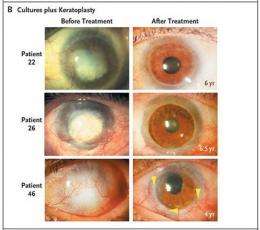
(AP) -- Dozens of people who were blinded or otherwise suffered severe eye damage when they were splashed with caustic chemicals had their sight restored with transplants of their own stem cells - a stunning success for the burgeoning cell-therapy field, Italian researchers reported Wednesday.
The treatment worked completely in 82 of 107 eyes and partially in 14 others, with benefits lasting up to a decade so far. One man whose eyes were severely damaged more than 60 years ago now has near-normal vision.
"This is a roaring success," said ophthalmologist Dr. Ivan Schwab of the University of California, Davis, who had no role in the study - the longest and largest of its kind.
Stem cell transplants offer hope to the thousands of people worldwide every year who suffer chemical burns on their corneas from heavy-duty cleansers or other substances at work or at home.
The approach would not help people with damage to the optic nerve or macular degeneration, which involves the retina. Nor would it work in people who are completely blind in both eyes, because doctors need at least some healthy tissue that they can transplant.
In the study, published online by the New England Journal of Medicine, researchers took a small number of stem cells from a patient's healthy eye, multiplied them in the lab and placed them into the burned eye, where they were able to grow new corneal tissue to replace what had been damaged. Since the stem cells are from their own bodies, the patients do not need to take anti-rejection drugs.
Adult stem cells have been used for decades to cure blood cancers such as leukemia and diseases like sickle cell anemia. But fixing a problem like damaged eyes is a relatively new use. Researchers have been studying cell therapy for a host of other diseases, including diabetes and heart failure, with limited success.
Adult stem cells, which are found around the body, are different from embryonic stem cells, which come from human embryos and have stirred ethical concerns because removing the cells requires destroying the embryos.
Currently, people with eye burns can get an artificial cornea, a procedure that carries such complications as infection and glaucoma, or they can receive a transplant using stem cells from a cadaver, but that requires taking drugs to prevent rejection.
The Italian study involved 106 patients treated between 1998 and 2007. Most had extensive damage in one eye, and some had such limited vision that they could only sense light, count fingers or perceive hand motions. Many had been blind for years and had had unsuccessful operations to restore their vision.
The cells were taken from the limbus, the rim around the cornea, the clear window that covers the colored part of the eye. In a normal eye, stem cells in the limbus are like factories, churning out new cells to replace dead corneal cells. When an injury kills off the stem cells, scar tissue forms over the cornea, clouding vision and causing blindness.
In the Italian study, the doctors removed scar tissue over the cornea and glued the laboratory-grown stem cells over the injured eye. In cases where both eyes were damaged by burns, cells were taken from an unaffected part of the limbus.
Researchers followed the patients for an average of three years and some as long as a decade. More than three-quarters regained sight after the transplant. An additional 13 percent were considered a partial success. Though their vision improved, they still had some cloudiness in the cornea.
Patients with superficial damage were able to see within one to two months. Those with more extensive injuries took several months longer.
"They were incredibly happy. Some said it was a miracle," said one of the study leaders, Graziella Pellegrini of the University of Modena's Center for Regenerative Medicine in Italy. "It was not a miracle. It was simply a technique."
The study was partly funded by the Italian government.
Researchers in the United States have been testing a different way to use self-supplied stem cells, but that work is preliminary.
One of the successful transplants in the Italian study involved a man who had severe damage in both eyes as a result of a chemical burn in 1948. Doctors grafted stem cells from a small section of his left eye to both eyes. His vision is now close to normal.
In 2008, there were 2,850 work-related chemical burns to the eyes in the United States, according to the Bureau of Labor Statistics.
Schwab of UC Davis said stem cell transplants would not help those blinded by burns in both eyes because doctors need stem cells to do the procedure.
"I don't want to give the false hope that this will answer their prayers," he said.
Dr. Sophie Deng, a cornea expert at the UCLA's Jules Stein Eye Institute, said the biggest advantage was that the Italian doctors were able to expand the number of stem cells in the lab. This technique is less invasive than taking a large tissue sample from the eye and lowers the chance of an eye injury.
"The key is whether you can find a good stem cell population and expand it," she said.
More information: New England Journal: http://www.nejm.org
©2010 The Associated Press. All rights reserved. This material may not be published, broadcast, rewritten or redistributed.


