Fish out of water: Gene clue to evolutionary step
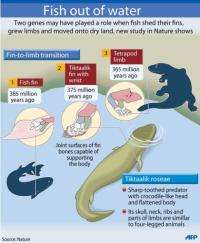
June 24, 2010Two genes controlling a tissue protein may have played a role in the key period when fish shed their fins and became limbed land-lovers, a study published by Nature on Thursday said.
Two genes controlling a tissue protein may have played a role in the key period when fish shed their fins and became limbed land-lovers, a study published by Nature on Thursday said.
Fossil evidence suggests that around 365 million years ago, fish, or fish-like creatures, emerged from shallow seas, moving onto land with the help of primitive, eight-fingered limbs, which later simplified to five digits under evolutionary pressure.
The newly-found genes control proteins called actinotrichia, whose tough, thin fibrils form a scaffold on which pectoral fins develop.
They were spotted by a team led by Marie-Andree Akimenko, from the University of Ottawa in Canada, as it was scanning development in the zebrafish, a highly-studied lab animal.
Neither of the genes are present in four-limbed vertebrates known as tetrapods, which became the basis for terrestrial animals, the researchers realised.
When the two genes were switched off in zebrafish embryos through genetic engineering, the fish developed only truncated fins, without bony rays.
The switchoff also unleashed a pattern of gene activity seen in research elsewhere, in the development of limbs and digits in terrestrial animals.
Further work is needed to confirm the theory, as it is unclear whether the fin genes were knocked out to help make the transition to land -- or whether they were eliminated after the transition, as they were no longer needed.
(c) 2010 AFP
-
Fossils suggest earlier land-water transition of tetrapod
Apr 17, 2009 |
not rated yet |
0
-
Chinese report important fish fossil find
May 05, 2006 |
not rated yet |
0
-
Fossil footprints give land vertebrates a much longer history
Jan 06, 2010 |
not rated yet |
0
-
Following the Glow: Researchers Use 'Fluorescent Fish' to Study Gene Function
Jan 18, 2010 |
not rated yet |
0
-
New piece in the jigsaw puzzle of human origins
Jan 15, 2009 |
not rated yet |
0
-
Engineers build first sub-10-nm carbon nanotube transistor
Feb 01, 2012 |
4.9 / 5 (31) |
30
-
Something old, something new: Evolution and the structural divergence of duplicate genes
Jan 31, 2012 |
4.6 / 5 (7) |
1
-
The hidden nanoworld of ice crystals: Revealing the dynamic behavior of quasi-liquid layers
Jan 30, 2012 |
5 / 5 (3) |
1
-
Stock market network reveals investor clustering
Jan 27, 2012 |
3.9 / 5 (23) |
8
-
Of microchemistry and molecules: Electronic microfluidic device synthesizes biocompatible probes
Jan 26, 2012 |
5 / 5 (1) |
0
-
Protease cleavage
5 hours ago
-
Pertubance in a model
12 hours ago
-
Cancer drugs and Alzheimer's, Oh my!
20 hours ago
-
Squishing cells
21 hours ago
-
Any books/articles for evolutionary stable strategy models in humans?
Feb 09, 2012
-
Science behind the bore feeling?
Feb 09, 2012
- More from Physics Forums - Biology
More news stories
The power of estrogen -- male snakes attract other males
A new study has shown that boosting the estrogen levels of male garter snakes causes them to secrete the same pheromones that females use to attract suitors, and turned the males into just about the sexiest ...
10 hours ago |
4.8 / 5 (5) |
0
|
Grass to gas: Researchers' genome map speeds biofuel development
Researchers at the University of Georgia have taken a major step in the ongoing effort to find sources of cleaner, renewable energy by mapping the genomes of two originator cells of Miscanthus x giganteus, a large perenn ...
7 hours ago |
3.7 / 5 (3) |
0
|
Experts reveal how plants don't get sunburn
(PhysOrg.com) -- Experts at the University of Glasgow have discovered how plants survive the harmful rays of the sun.
10 hours ago |
5 / 5 (2) |
0
|
Protein libraries in a snap
(PhysOrg.com) -- A Rice University undergraduate will depart with not only a degree but also a possible patent for his invention of an efficient way to create protein libraries, an important component of biomolecular ...
14 hours ago |
5 / 5 (3) |
0
|
Miami battling invasion of giant African snails
No one knows how they got there. But an invasion of African giant snails has southern Florida in a panic over potential crop damage, disease and general yuckiness surrounding the slimy gastropods.
14 hours ago |
4 / 5 (1) |
4
Google users warned of threat to smartphone wallets
Users of Google smartphone wallets were being warned on Friday that there is a way to crack pass codes intended to thwart thieves from going on illicit shopping sprees.
Anonymous knocks CIA website offline (Update)
The website of the Central Intelligence Agency was inaccessible on Friday after the hacker group Anonymous claimed to have knocked it offline.
Complex wiring of the nervous system may rely on a just a handful of genes and proteins
Researchers at the Salk Institute have discovered a startling feature of early brain development that helps to explain how complex neuron wiring patterns are programmed using just a handful of critical genes. ...
New error-correcting codes guarantee the fastest possible rate of data transmission
Error-correcting codes are one of the triumphs of the digital age. Theyre a way of encoding information so that it can be transmitted across a communication channel such as an optical fiber o ...
Putting the squeeze on planets outside our solar system
(PhysOrg.com) -- Using high-powered lasers, scientists at Lawrence Livermore National Laboratory and collaborators discovered that molten magnesium silicate undergoes a phase change in the liquid state, abruptly ...
NASA sees wide-eyed cyclone Jasmine
Cyclone Jasmine's eye has opened wider on NASA satellite imagery, as it moves through the Southern Pacific Ocean.
Jun 24, 2010
Rank: 1 / 5 (4)
I'm glad to see it reported as being "suggests" rather than is a fact.
It's only certain expedient human beings who have assumed that they can now make it into a fact.
Why on earth would a fish want to leave it's nice and cosy watery home to eek out a struggle on land? And have to develop lungs in the process? Just how did those lungs develop?
OK, so it could have been the other "fish-like" creature that decided to get out....maybe it already had lungs and was just living in the water, like an otter....
Go ahead heap your scorn. Just remember the word: "suggests".
Jun 24, 2010
Rank: 4 / 5 (1)
The waters were full of creatures predating the fish, unlike the case with land, where the largest animals were insects.
At the moment the view on lung evolution is that lungs evolved in the pine swamps populated by fishes because the swamp water was likely to have been low in oxygen, unlike the land.
Lungs are separate from gills, so their evolution didn't hinder the gill funtion. In fact, most fishes today have the evolved forms of ancient lungs, called swim bladders, and some fishes, like mudskipper, have lungs.
Jun 24, 2010
Rank: not rated yet
Jun 24, 2010
Rank: 5 / 5 (3)
This is like asking, why would you want to drive a car or ride a bike, when you have an awesome set of legs already.
Environmental benefit, no matter how slight, is always selected for within nature.
I'd like you to tell us what meaning of the word you think the context refers to. Please put it in sentence form.
Jun 24, 2010
Rank: 5 / 5 (3)
Would you like to discuss this? Or just keep going on faith alone.
Ethelred