Was Venus once a habitable planet?
June 24, 2010
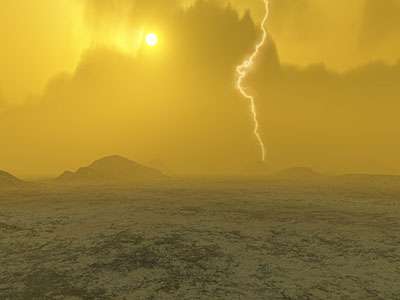
This artist’s concept of Venus, dated 2006, suggests the presence of lightning in the atmosphere. Credits: J. Whatmore
(PhysOrg.com) -- ESA's Venus Express is helping planetary scientists investigate whether Venus once had oceans. If it did, it may even have begun its existence as a habitable planet similar to Earth.
These days, Earth and Venus seem completely different. Earth is a lush, clement world teeming with life, whilst Venus is hellish, its surface roasting at temperatures higher than those of a kitchen oven.
But underneath it all the two planets share a number of striking similarities. They are nearly identical in size and now, thanks to ESA’s Venus Express orbiter, planetary scientists are seeing other similarities too.
“The basic composition of Venus and Earth is very similar,” says Hľkan Svedhem, ESA Venus Express Project Scientist. Just how similar planetary scientists from around the world will be discussing in Aussois, France, where they are gathering this week for a conference.
One difference stands out: Venus has very little water. Were the contents of Earth’s oceans to be spread evenly across the world, they would create a layer 3 km deep. If you were to condense the amount of water vapour in Venus’ atmosphere onto its surface, it would create a global puddle just 3 cm deep.
Yet there is another similarity here. Billions of years ago, Venus probably had much more water. Venus Express has certainly confirmed that the planet has lost a large quantity of water into space.
It happens because ultraviolet radiation from the Sun streams into Venus’ atmosphere and breaks up the water molecules into atoms: two hydrogens and one oxygen. These then escape to space.
Venus Express has measured the rate of this escape and confirmed that roughly twice as much hydrogen is escaping as oxygen. It is therefore believed that water is the source of these escaping ions. It has also shown that a heavy form of hydrogen, called deuterium, is progressively enriched in the upper echelons of Venus’s atmosphere, because the heavier hydrogen will find it less easy to escape the planet’s grip.
“Everything points to there being large amounts of water on Venus in the past,” says Colin Wilson, Oxford University, UK. But that does not necessarily mean there were oceans on the planet’s surface.
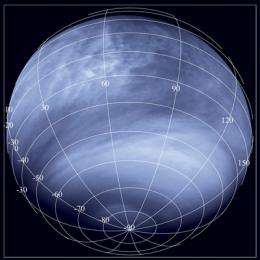
Venus Monitoring Camera image taken in the ultraviolet (0.365 micrometres), from a distance of about 30 000 km. It shows numerous high-contrast features, caused by an unknown chemical in the clouds that absorbs ultraviolet light, creating the bright and dark zones. With data from Venus Express, scientists have learnt that the equatorial areas on Venus that appear dark in ultraviolet light are regions of relatively high temperature, where intense convection brings up dark material from below. In contrast, the bright regions at mid-latitudes are areas where the temperature in the atmosphere decreases with depth. The temperature reaches a minimum at the cloud tops suppressing vertical mixing. This annulus of cold air, nicknamed the ‘cold collar’, appears as a bright band in the ultraviolet images. Credits: ESA/MPS/DLR/IDA
Eric Chassefičre, Université Paris-Sud, France, has developed a computer model that suggests the water was largely atmospheric and existed only during the very earliest times, when the surface of the planet was completely molten. As the water molecules were broken into atoms by sunlight and escaped into space, the subsequent drop in temperature probably triggered the solidification of the surface. In other words: no oceans.Although it is difficult to test this hypothesis it is a key question. If Venus ever did possess surface water, the planet may possibly have had an early habitable phase.
Even if true, Chassefičre’s model does not preclude the chance that colliding comets brought additional water to Venus after the surface crystallised, and these created bodies of standing water in which life may have been able to form.
There are many open questions. “Much more extensive modelling of the magma ocean-atmosphere system and of its evolution is required to better understand the evolution of the young Venus,” says Chassefičre.
When creating those computer models, the data provided by Venus Express will prove crucial.
-
Europe's Venus Express is ready for launch
Nov 08, 2005 |
not rated yet |
0
-
Venus: Earth’s twin planet?
Nov 29, 2007 |
not rated yet |
0
-
Venus Express spacecraft fires main engine
Feb 20, 2006 |
not rated yet |
0
-
Spacecraft Tandem Provide New Views of Venus
Jul 19, 2007 |
not rated yet |
0
-
Venus Express nears its launch date
Oct 13, 2005 |
not rated yet |
0
-
Engineers build first sub-10-nm carbon nanotube transistor
Feb 01, 2012 |
4.9 / 5 (31) |
30
-
Something old, something new: Evolution and the structural divergence of duplicate genes
Jan 31, 2012 |
4.6 / 5 (7) |
1
-
The hidden nanoworld of ice crystals: Revealing the dynamic behavior of quasi-liquid layers
Jan 30, 2012 |
5 / 5 (3) |
1
-
Stock market network reveals investor clustering
Jan 27, 2012 |
3.9 / 5 (23) |
8
-
Of microchemistry and molecules: Electronic microfluidic device synthesizes biocompatible probes
Jan 26, 2012 |
5 / 5 (1) |
0
-
Scale of the Universe
12 hours ago
-
Titan's lack of impact craters
Feb 09, 2012
-
Real pictures of black hole eating a star?
Feb 08, 2012
-
Hypothetical way to travel faster than light, but not technically exceed lightspeed
Feb 06, 2012
-
How do scientists monitor the Sun's activity?
Feb 05, 2012
-
Search patterns in observational studies
Feb 05, 2012
- More from Physics Forums - General Astronomy
More news stories
Humans may have helped the decline of African rainforests 3000 years ago
(PhysOrg.com) -- Large areas of rainforests in Central Africa mysteriously disappeared over three thousand years ago, to be replaced by savannas. The prevailing theory has been that the cause was a change ...
Could Venus be shifting gear?
(PhysOrg.com) -- ESAs Venus Express spacecraft has discovered that our cloud-covered neighbour spins a little slower than previously measured. Peering through the dense atmosphere in the infrared, the ...
Space & Earth / Space Exploration
19 hours ago |
5 / 5 (7) |
8
|
NASA budget will axe Mars deal with Europe: scientists
US President Barack Obama's budget proposal to be submitted next week for 2013 will cut NASA's budget by 20 percent and eliminate a major partnership with Europe on Mars exploration, scientists said Thursday.
Space & Earth / Space Exploration
22 hours ago |
5 / 5 (2) |
19
Mars Science Laboratory computer issue resolved
(PhysOrg.com) -- Engineers have found the root cause of a computer reset that occurred two months ago on NASA's Mars Science Laboratory and have determined how to correct it.
Space & Earth / Space Exploration
20 hours ago |
4.7 / 5 (6) |
4
|
Two new moons for Jupiter
Advances in technology have lead to the discovery of new planets outside of our Solar System, and now even new moons in our own backyard.
Space & Earth / Space Exploration
19 hours ago |
4 / 5 (1) |
7
Anonymous knocks CIA website offline (Update)
The website of the Central Intelligence Agency was inaccessible on Friday after the hacker group Anonymous claimed to have knocked it offline.
New error-correcting codes guarantee the fastest possible rate of data transmission
Error-correcting codes are one of the triumphs of the digital age. Theyre a way of encoding information so that it can be transmitted across a communication channel such as an optical fiber o ...
Small modular reactor design could be a 'SUPERSTAR'
(PhysOrg.com) -- Though most of today's nuclear reactors are cooled by water, we've long known that there are alternatives; in fact, the world's first nuclear-powered electricity in 1951 came from a reactor ...
New power source discovered
(PhysOrg.com) -- Researchers at the Massachusetts Institute of Technology (MIT) and RMIT University have made a breakthrough in energy storage and power generation.
The power of estrogen -- male snakes attract other males
A new study has shown that boosting the estrogen levels of male garter snakes causes them to secrete the same pheromones that females use to attract suitors, and turned the males into just about the sexiest ...
Google users warned of threat to smartphone wallets
Users of Google smartphone wallets were being warned on Friday that there is a way to crack pass codes intended to thwart thieves from going on illicit shopping sprees.

Jun 24, 2010
Rank: 5 / 5 (1)
@genastropsychicalst,
Did you mean "[+1]leptoweak realistic Downboson (=bleu)minus relative 1 Nuclearhyperon, to be read downunder my blog"? It makes much more sense!
Jun 25, 2010
Rank: 5 / 5 (2)
"Unlike Earth, Venus does not generate a magnetic field. This is significant because Earth’s magnetic field protects its atmosphere from the solar wind. At Venus, however, the solar wind strikes the upper atmosphere and carries off particles into space. Planetary scientists think that the planet has lost part of its water in this way over the four-and-a-half-thousand million years since the planet’s birth." ( http://www.esa.in...F_0.html )
This confirmed a similar result of a 2007 ESA study of Venus: http://www.esa.in...F_0.html
Jun 26, 2010
Rank: 3.7 / 5 (3)
It is a mystery, isn't it?
It is more than a little strange that Venus lacks a magnetic field, having formed in what one would presume to have been a part of the disc more or less identical to Earth.
Add to that the fact that Venus' surface exhibits very little by way of cratering, and therefore, most likely, is tectonically/geologically active enough to be continuously creating new crust, and it makes the mystery that much more mysterious.
If not radioisotopes, then what is producing the heat to drive vulcanism/tectonics?
Jun 28, 2010
Rank: 5 / 5 (1)
Your points and questions are excellent.
It's suggested, due to a lack of plate tectonics, Venus' mantle is too hot to allow the dynamo effect to develop.
See: "Magnetic field and core" http://en.wikiped...and_core
And it's suggested that plate tectonics are largely driven by the presence of our Earth's moon.
See: "Tidal forces" http://en.wikiped...l_forces
Interestingly, Venus has two high plateaus (or "continents"), suggesting the possibility of early oceans and an earth-like water cycle.
Thus it seems apparent that for earth-like worlds to survive, a large tidal moon is required.
I wonder how common such binary planetary systems are in other star systems?
Jun 28, 2010
Rank: 5 / 5 (1)
We may have meaningful statistics on such systems in just a few years (fingers crossed!).