Researchers design more reliable invisibility cloak
June 24, 2010 By Lisa Zyga feature
Researchers design more reliable invisibility cloak

Enlarge

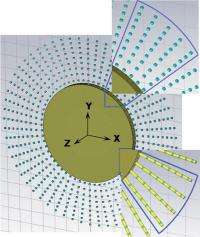
The design of the invisibility cloak consists of a spoke-like configuration of glass resonators, which form a magnetic resonance that is used to obtain the desired parameters of the medium. The illustration shows the glass cloak designed to hide a metal cylinder of 15 micrometers in diameter. Image credit: Semouchkina, et al.

(PhysOrg.com) -- Researchers have proposed a new design for an invisibility cloak - a device that could make objects invisible by guiding light around anything placed inside the cloak.

In the study, Elena Semouchkina from Michigan Technological University and Pennsylvania State University and her coauthors designed an made of glass for the infrared range. Currently, most metamaterial cloak designs require that the metamaterial response be homogeneous. However, the new design relies on simulations of a true multi-element cloak structure and takes into account the inhomogeneity of a real metamaterial response.

“This is one of the first designs of an optical cloak, in particular, of a cylindrical shell,” Semouchkina told PhysOrg.com. “This is a non-metallic low-loss all-dielectric cloak. ... In contrast to the previous designs, the design of our cloak has been developed at a careful control of interactions between resonators, since a true multi-resonator structure has been simulated. It makes the design essentially more reliable.”

The structure of the proposed cloak consists of identical nanosized chalcogenide glass resonators arranged in a concentric pattern. In simulations, the researchers found that glass resonators in the shape of a cylinder with a diameter of 300 nm and a height of 150 nm provided the best results for the of 1 micron.

“The design employs identical resonators in all layers of the cloak, which, from the point of view of fabrication tolerance, presents a tremendous advantage versus fabricating nano-sized elements of different prescribed dimensions,” Semouchkina said.

The spoke-like configuration of the resonators forms radial magnetic moments despite different incidence angles of incoming light. As Semouchkina explained, the magnetic resonance response creates the desired effective parameters of the medium.

“Our cloak is based on the in dielectric resonators,” Semouchkina said. “This resonance is used to obtain the desired values of the effective permeability of the medium. The simulations of real 3D resonators, and not of effective medium layers, allowed us to find optimal shapes and their arrangement to assure the formation in resonators illuminated under different incidence angles.”

The researchers simulated cloaked cylindrical objects of infinite lengths and of diameters ranging from 5 to 15 wavelengths. Simulations also showed that objects could be cloaked over a wide range of infrared frequencies at the manipulation of inter-resonator distances.

Overall, the new design is one more example of the progress made in invisibility cloaks since they were first designed in 2006. Since then, researchers have been working on different design approaches in an attempt to expand the cloaking spectrum, simplify fabrication, and make other improvements.

“We are currently performing detailed investigations of the interactions between the resonators in metamaterials and their role in controlling the wave propagation, as well as working on the experimental demonstration of an all-dielectric cloak operation at microwaves,” Semouchkina said.

More information: Elena Semouchkina, et al. “An infrared invisibility cloak composed of glass.” Applied Physics Letters 96, 233503 (2010). DOI:10.1063/1.3447794

Copyright 2010 PhysOrg.com.
All rights reserved. This material may not be published, broadcast, rewritten or redistributed in whole or part without the express written permission of PhysOrg.com.

4.4 /5 (33 votes)  

Filter


Move the slider to adjust rank threshold, so that you can hide some of the comments.


Display comments: newest first

nanotech_republika_pl
Jun 24, 2010

Rank: 5 / 5 (1)
Can you speculate if this kind of research on the invisibility cloak is going to lead to any real life applications? It seems to me that especially in optical range it won't be possible to create a device that would render a big object, say a ship, for all continuous wavelengths. Not to mentioned that the device itself has to be hidden.
cmn
Jun 24, 2010

Rank: 3.7 / 5 (3)
I'm guessing the "cylindrical shell" design would work nicely for a missile.
nevdka
Jun 24, 2010

Rank: 1 / 5 (3)
There's nothing in the mathematics that says it's impossible to work with multiple wavelengths, but the construction of metamaterials with the required behavior is difficult, and I've not heard of it being done yet. Theoretically it should be possible to cloak a ship. However, you would still notice the large gap in the ocean that looks roughly aircraft-carrier sized...

I'd speculate that it should be possible, but not withing the next few years, anyway. There's a lot of work being done on engineering refractive indicies in materials, which would probably be necessary. However, most metamaterials research is being done on monochromatic light/radio waves.
Scientifica
Jun 24, 2010

Rank: 1 / 5 (3)
I just happen to have been born in Hancock, MI...right across the river from Michigan Tech. I also studied for two years at Michigan Tech. I have also watched many hockey games at Michigan Tech.
bredmond
Jun 24, 2010

Rank: 5 / 5 (3)
It may have applications for optical computers also. Maybe it could hide buildings so we can see a more beautiful skyline.
Parsec
Jun 25, 2010

Rank: 5 / 5 (6)
Forget all the buildings and stuff like that. The main applications for this is in circuitry, or in transparent screens, where we could hide embedded metallic/opaque elements, or in optic circuitry where we could do the same. Also notice that these developments will make it vastly easier to build all optical computers.
almighty
Jun 25, 2010

Rank: 1 / 5 (2)
when an object is hided then it would become only invisible to our eye or it would physically displaced? please answer this question
xamien
Jun 25, 2010

Rank: 4 / 5 (1)
this has nothing to do with physical displacement, almighty. the purpose of invisibility is to hide the object by bending light around it or prevent light from reaching it altogether. physical displacement is for cars.
Coldstatic
Jun 25, 2010

Rank: 1 / 5 (1)
i speculate that the military already has these "invisbility cloaks"
trekgeek1
Jun 25, 2010

Rank: 3 / 5 (2)
i speculate that the military already has these "invisbility cloaks"


It does make me wonder. How long was the stealth in service before it was officially revealed to the public? I would like to know exactly how far ahead the highest tech of the tech is compared to what we know about. 10 years, 15? And as far as the cloak goes, the Romulans aren't gonna like this.
ralph_wiggum
Jun 25, 2010

Rank: 5 / 5 (2)
when an object is hided then it would become only invisible to our eye or it would physically displaced? please answer this question


It's actually a trick. While her scantily clad assistants distract the press, Elena Semouchkina from Michigan Technological University and Pennsylvania State University quickly removes the object from behind the "cloak". The US military has already contracted David Blaine to mass-produce fighter planes that function on the same principle.
antialias
Jun 25, 2010

Rank: 4.3 / 5 (3)
With this type of 'invisibility' one should also note:
1) if light is bent around the object then no light will hit the object (i.e. the object will be unable to 'see' the outside). So if we get an invisibility cloak then it will make the wearer also blind.
2) these methods only work at selected frequencies - you'd still be able to see the object at all other frequencies. Also the phase shift will give a cloaked object away (since the 'bent' rays will travel longer paths)
3) Invisibility cloaks are interesting for applications in optical switches - not making battleships invisible.
I would like to know exactly how far ahead the highest tech of the tech is compared to what we know about. 10 years, 15?

Stuff that is published in conference proceedings is at the forefront of reesearch (i.e. the result of the last 1-2 years of work which has just been completed). Journals lag, usully, 6 months to a year behind.
ralph_wiggum
Jun 25, 2010

Rank: 2.2 / 5 (5)
By the way, this is actually alien technology. But don't take my word for it.Consider the fact that the earliest use of military invisibility cloak took place in Philadelphia Naval Shipyard in 1943 (well covered by the 1984 documentary film "The Philadelphia Experiment). Now consider the most famous person to have come out of West Philadelphia -- Will Smith. Who, after spending most of his days on the playground, just so happened to go on to fight and defeat alien invaders as documented in "The Independence Day". Q.E.D.
hypermach
Jun 25, 2010

Rank: 4.8 / 5 (4)
Could this kind of technology ever work for higher energy radiation? For example, shielding space structures or ships from cosmic rays?
Au-Pu
Jun 25, 2010

Rank: 4.3 / 5 (3)
hypermach, an interesting question. One that I hope someone who actually understands the subject might care to answer.
MarkyMark
Jun 26, 2010

Rank: 3 / 5 (1)
Could this kind of technology ever work for higher energy radiation? For example, shielding space structures or ships from cosmic rays?

Now that is a very good question. I wonder if this could one day be adapted as a form of heat shield as well. Afterall heat is just a different wavelength on the scale?
lomed
Jun 26, 2010

Rank: 4.5 / 5 (4)
Could this kind of technology ever work for higher energy radiation? For example, shielding space structures or ships from cosmic rays?
As far as I know, all metamaterials require structures (~10x) smaller than the wavelength of light at which they cloak objects. This means that it will not be possible to cloak wavelengths less than a few tens of nanometers (Extreme UV and xrays) with materials made of atoms. Nothing smaller than ~10^-16m (~12 GeV gamma ray) even with materials of nuclear density. So, no it won't be possible to shield against extremely high energy gamma rays or cosmic rays using metamaterials (at least not with any material humans will be working with, much less engineering, any time soon).
antialias_physorg
Jun 26, 2010

Rank: 3.5 / 5 (2)
Could this kind of technology ever work for higher energy radiation? For example, shielding space structures or ships from cosmic rays?


The frequency range of cosmic radiation is very big. 'Invisibility cloaks' only work for very narrow frequency ranges. So no: There is not going to be a cosmic ray shield based on this technology.
gpn
Jun 28, 2010

Rank: 5 / 5 (1)
I'll believe it when I see it.

Then again, if I could see it,that would mean it doesn't work.
Dissident_Penguin
Jun 28, 2010

Rank: 3 / 5 (1)
Actually cosmic rays are mostly protons (Around 90%). If I understand correctly this technology works only for electromagnetic radiation, so I would assume it will never work for cosmic rays.
Quarl
Jun 29, 2010

Rank: not rated yet
Actually cosmic rays are mostly protons (Around 90%). If I understand correctly this technology works only for electromagnetic radiation, so I would assume it will never work for cosmic rays.


So to make a ship or station 'invisible' to most cosmic rays should require a rather powerful magnetic field like that used for a particle accelerator, correct? Still require some protection from the magnetic field, though. As for the metamaterial cloak, we will probably have to invent some sort of non-Newtonian fluid inside a clear restraint. The object would be visible for a moment until the fluid adjusted to the 'pressure' of the ambient background light. However, it's unlikely to be damage-resistant unless we invent some form of plastalloy first...
antialias
Jun 30, 2010

Rank: not rated yet
We don't need an invisibility cloak for spaceships. Spaceships don't need to bend the radiation back towards its original path (what would be the point?).

Spaceships just need to be able to deflect and/or absorb the radiation before it impacts on the biological entities aboard.

Invisibility cloaks are special because the metamaterials used can have negative refraction indices. To deflect oncoming radiation that is not needed.
Nartoon
Jul 03, 2010

Rank: not rated yet
Oh yeah, well how did Chris Angel make a stealth bomber disappear?
Mercury_01
Jul 03, 2010

Rank: not rated yet
Im pretty sure if someone held up a 15 micron wire, I probably wouldnt be able to see it in the first place.
Rank 4.4 /5 (33 votes)
Relevant PhysicsForums posts
  • Strength of induced magnetic field inside an inductor
    created3 hours ago
  • increasing time of daylight
    created4 hours ago
  • Light & Sight
    created5 hours ago
  • Wind Turbine Power
    created8 hours ago
  • Steam Table issues
    created10 hours ago
  • electrostatic induction in a conductor should be immpossible
    created13 hours ago
  • More from Physics Forums - General Physics

More news stories

Putting the squeeze on planets outside our solar system

(PhysOrg.com) -- Using high-powered lasers, scientists at Lawrence Livermore National Laboratory and collaborators discovered that molten magnesium silicate undergoes a phase change in the liquid state, abruptly ...

Physics / Condensed Matter

created 3 hours ago | popularity 5 / 5 (1) | comments 0 | with audio podcast

Hovering not hard if you're top-heavy, researchers find

Top-heavy structures are more likely to maintain their balance while hovering in the air than are those that bear a lower center of gravity, researchers at New York University's Courant Institute of Mathematical Sciences ...

Physics / General Physics

created 4 hours ago | popularity 5 / 5 (1) | comments 1 | with audio podcast

SLAC, Stanford team focuses on high-energy electrons to treat cancer

Accelerator physicists at SLAC and cancer specialists from Stanford are working on a new technology that could dramatically reduce the time needed for cancer radiation treatments. The team ran an initial experiment ...

Physics / General Physics

created 7 hours ago | popularity 5 / 5 (1) | comments 0

Measurements from high-energy collisions lead to better understanding of why meson particles disappear

For several years, physicists at the Relativistic Heavy Ion Collider (RHIC) at Brookhaven National Laboratory (BNL), USA, have studied an unusual state of matter called the quark–gluon plasma, which they ...

Physics / General Physics

created 8 hours ago | popularity 5 / 5 (1) | comments 0

Quantum physicist explains $100K offer for proof scaled-up quantum computing is impossible

(PhysOrg.com) -- MIT researcher Scott Aaronson has certainly riled the physics community with his offer this past Friday, of $100,000 to anyone who can prove that scaled-up quantum computing is impossible. ...

Physics / Quantum Physics

created Feb 08, 2012 | popularity 4.1 / 5 (11) | comments 32 | with audio podcast weblog


NASA sees wide-eyed cyclone Jasmine

Cyclone Jasmine's eye has opened wider on NASA satellite imagery, as it moves through the Southern Pacific Ocean.

NASA sees Giovanna reach cyclone strength, threaten Madagascar

Tropical Storm 12S built up steam and became a cyclone on February 10, 2012 as NASA's Terra satellite passed overhead. Residents of east-central Madagascar should prepare for this cyclone to make landfall ...

CIA website offline, Anonymous takes credit

The website of the Central Intelligence Agency was unresponsive on Friday after the hacker group Anonymous claimed to have knocked it offline.

Complex wiring of the nervous system may rely on a just a handful of genes and proteins

Researchers at the Salk Institute have discovered a startling feature of early brain development that helps to explain how complex neuron wiring patterns are programmed using just a handful of critical genes. ...

The power of estrogen -- male snakes attract other males

A new study has shown that boosting the estrogen levels of male garter snakes causes them to secrete the same pheromones that females use to attract suitors, and turned the males into just about the sexiest ...

New error-correcting codes guarantee the fastest possible rate of data transmission

Error-correcting codes are one of the triumphs of the digital age. They’re a way of encoding information so that it can be transmitted across a communication channel — such as an optical fiber o ...