Pleasing to the eye: Even brooding female birds are sensitive to visual stimulation
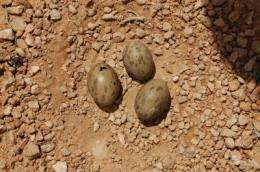
In a breeding experiment with Houbara bustards - a North African bird species with a very distinctive courtship behaviour, scientists have concluded that visual stimulation from attractive males of the same species positively affects brooding females, improving offspring growth.
Females that observed highly displaying male birds in the experiment were more fertile and had a greater breeding success due to an increased allocation of testosterone into their eggs, leading to an increase in the growth rate in chicks. The results showed that using artificial insemination without appropriate stimulation of breeding females probably has negative impacts on their breeding performance and can therefore even affect the survival of a species, according to Adeline Loyau and Frederic Lacroix in the online edition of Proceedings of the Royal Society B.
For the experiment, Loyau of the Helmholtz Center for Environmental Research (UFZ) and the French CNRS station for experimental ecology and her colleague Lacroix (ECWP) confronted 90 brooding Houbara bustard females (Chlamydotis undulata undulata) with various individuals of the same species. In the Emirates Center for Wildlife Propagation (ECWP) in Moroccan Missour, 30 female birds were visually confronted with either highly displaying male birds, poorly displaying male birds, or females. During the experiment the female birds under investigation were artificially inseminated and kept isolated in aviaries five meters apart from birds of the same species in other aviaries. That way the scientists were able to exclude any other factors from playing a role in the experiment other than that of visual stimulation.
"To my knowledge our study is the first example in species conservation of a successful manipulation of maternal allocation of resources through sensory stimulation ", explains behavioural biologist Adeline Loyau from the UFZ, "Our results show that it is possible to control maternal allocation of resources independent of the quality of male genes." Male display courtship constitutes an effective signal thereby providing conservationists with a simple and inexpensive means. The results could therefore be very significant for the improvement of captive breeding programs of other threatened bird species.
The Houbara bustard is a sandy-coloured resident of deserts, with its distribution ranging from North Africa to Mongolia. In the Arab world it is common prey for falcon hunting. Both hunting and a loss of habitat have diminished Houbara bustard populations and in the meantime the species is classified as vulnerable. It is bred in captive breeding programs to support the conservation of in-situ populations. It was for this purpose that the Emirates Center for Wildlife Propagation (ECWP) was founded in Moroccan Missour by the emir of Abu Dhabi, sheikh Zayid bin Sultan Al Nahyan.
Already in 2007, Adeline Loyau and colleagues found that females of the Blue Peacock (Pavo cristatus) that had mated with attractive males increased the allocation of resources into their eggs compared to females that had mated with unattractive males. With attractive partners they laid larger eggs and increased the yolk testosterone levels, which has a direct influence on the growth rate of offspring. Generally, it is known that various factors can have an effect on female birds and their offspring such as the quality of male genes or food availability. Under unfavourable conditions it can be more effective to invest less in the current offspring but to put more effort into the following season. With their most recent experiment Loyau and Lacroix were finally able to show that visual stimulation can also influence chick growth.
The data were analysed by Loyau in the laboratories of the UFZ in Leipzig during her time there as a visiting researcher. In the meantime the French biologist is working at the station for experimental ecology (SEEM) of the French Research Center CNRS in Moulis in the Pyrenees.
More information: Adeline Loyau and Frederic Lacroix (2010): Watching sexy displays improves hatching success and offspring growth through maternal allocation. Proceedings of the Royal Society B. dx.doi.org/10.1098/rspb.2010.0473
Provided by Helmholtz Association of German Research Centres


