Climate change complicates plant diseases of the future
Human-driven changes in the earth's atmospheric composition are likely to alter plant diseases of the future. Researchers predict carbon dioxide will reach levels double those of the preindustrial era by the year 2050, complicating agriculture's need to produce enough food for a rapidly growing population.
University of Illinois researchers are studying the impact of elevated carbon dioxide, elevated ozone and higher atmospheric temperatures on plant diseases that could challenge crops in these changing conditions.
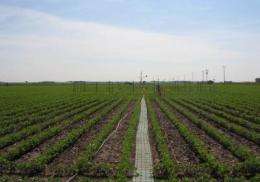
Darin Eastburn, U of I associate professor of crop sciences, evaluated the effects of elevated carbon dioxide and ozone on three economically important soybean diseases under natural field conditions at the soybean-free air-concentrating enrichment (SoyFACE) facility in Urbana.
The diseases downy mildew, Septoria brown spot, and sudden death syndrome were observed from 2005 to 2007 using visual surveys and digital image analysis. While changes in atmospheric composition altered disease expression, the responses of the three pathosystems varied considerably, Eastburn said.
Elevated carbon dioxide levels are more likely to have a direct effect on plant diseases through changes to the plant hosts rather than the plant pathogens.
"Plants growing in a high carbon dioxide environment tend to grow faster and larger, and they have denser canopies," Eastburn said. "These dense plant canopies favor the development of some diseases because the low light levels and reduced air circulation allow higher relative humidity levels to develop, and this promotes the growth and sporulation of many plant pathogens."
At the same time, plants grown in high carbon dioxide environments also close their stomata, pores in the leaves that allow the plant to take in carbon dioxide and release oxygen, more often. Because plant pathogens often enter the plant through the stomata, the more frequent closing of the stomata may help prevent some pathogens from getting into the plant.
In elevated ozone, plant growth is inhibited and results in shorter plants with less dense canopies. This can slow the growth and reproduction of certain pathogens. However, ozone also damages plant tissues that can help pathogens infect the plant more easily.
"Elevated levels of carbon dioxide and ozone can make a plant more susceptible to some diseases, but less susceptible to others," Eastburn said. "This is exactly what we've observed in our climate change experiments."
U of I's SoyFACE was the first facility to expose plants to elevated ozone under completely open-air conditions within an agricultural field.
"The SoyFACE facility allowed us to evaluate the influence of natural variability of meteorological factors such as drought and temperature in conjunction with imposed atmospheric composition (elevated carbon dioxide and ozone) on naturally occurring soybean diseases across several growing seasons," Eastburn said.
He believes rising temperatures and changes in rainfall patterns will also affect development of plant disease epidemics.
"In some cases, changes of only a few degrees have allowed plant diseases to become established earlier in the season, resulting in more severe disease epidemics," Eastburn said. "The ranges of some diseases are expanding as rising temperatures are allowing pathogens to overwinter in regions that were previously too cold for them."
For example, warmer winters may allow kudzu to expand its range northward. Because kudzu is an alternate host for the soybean rust pathogen, one result of rising temperatures may be that soybean rust arrives in Illinois earlier in the soybean growing season, Eastburn said.
"Information derived from climate change studies will help us prepare for the changes ahead by knowing which diseases are most likely to become more problematic," he said. "Now is the time for plant pathologists, plant breeders, agronomists and horticulturalists to adapt disease management strategies to the changing environment."
Eastburn's soybean research, "Elevated atmospheric carbon dioxide and ozone alter soybean diseases at SoyFACE," was recently published in Global Change Biology. Researchers also included Melissa DeGennaro and Evan DeLucia of the U of I, Orla Dermody of Pioneer Hi-Bred Switzerland, and Andrew McElrone of the University of California - Davis.
Provided by University of Illinois at Urbana-Champaign


