New Clues Suggest Wet Era on Early Mars Was Global (w/ Video)

June 24, 2010
Lyot Crater, pictured here, is one of at least nine craters in the northern lowlands of Mars with exposures of hydrated minerals detected from orbit, according to a June 25, 2010, report. Image Credit: NASA/ESA/JPL-Caltech/JHU-APL/IAS
(PhysOrg.com) -- Minerals in northern Mars craters seen by two orbiters suggest that a phase in Mars' early history with conditions favorable to life occurred globally, not just in the south.
Southern and northern Mars differ in many ways, so the extent to which they shared ancient environments has been open to question.
In recent years, the European Space Agency's Mars Express orbiter and NASA's Mars Reconnaissance Orbiter have found clay minerals that are signatures of a wet environment at thousands of sites in the southern highlands of Mars, where rocks on or near the surface are about four billion years old. Until this week, no sites with those minerals had been reported in the northern lowlands, where younger volcanic activity has buried the older surface more deeply.
French and American researchers report in the journal Science this week that some large craters penetrating younger, overlying rocks in the northern lowlands expose similar mineral clues to ancient wet conditions.
"We can now say that the planet was altered on a global scale by liquid water about four billion years ago," said John Carter of the University of Paris, the report's lead author.
This video is not supported by your browser at this time.
Mars Express' OMEGA sensor has provided the first hints that there may be hydrated silicates beneath the northern plains of Mars, as well as in the southern highlands. This suggests that the early wet phase of Mars was global in extent. Credit: ESA (C. Carreau)
Other types of evidence about liquid water in later epochs on Mars tend to point to shorter durations of wet conditions or water that was more acidic or salty.The researchers used the Compact Reconnaissance Imaging Spectrometer for Mars (CRISM), an instrument on the Mars Reconnaissance Orbiter, to check 91 craters in the northern lowlands. In at least nine, they found clays and clay-like minerals called phyllosilicates, or other hydrated silicates that form in wet environments on the surface or underground.
Earlier observations with the OMEGA spectrometer on Mars Express had tentatively detected phyllosilicates in a few craters of the northern plains, but the deposits are small, and CRISM can make focused observations on smaller areas than OMEGA.
"We needed the better spatial resolution to confirm the identifications," Carter said. "The two instruments have different strengths, so there is a great advantage to using both."
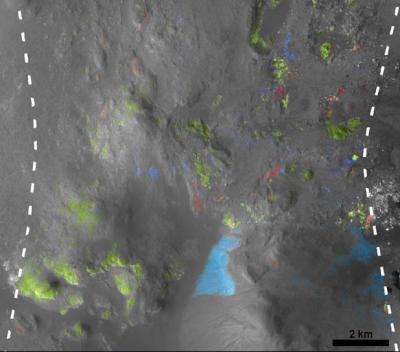
Observations of craters in northern Mars, including Stokes Crater, have found hydrated minerals indicating that a wet phase of early Martian history extended to the whole planet. Image Credit: NASA/ESA/JPL-Caltech/JHU-APL/MSSS/FU-Berlin
CRISM Principal Investigator Scott Murchie of Johns Hopkins University Applied Physics Laboratory, Laurel, Md., a co-author of the new report, said that the findings aid interpretation of when the wet environments on ancient Mars existed relative to some other important steps in the planet's early history.The prevailing theory for how the northern part of the planet came to have a much lower elevation than the southern highlands is that a giant object slammed obliquely into northern Mars, turning nearly half of the planet's surface into the solar system's largest impact crater. The new findings suggest that the formation of water-related minerals, and thus at least part of the wet period that may have been most favorable to life, occurred between that early giant impact and the later time when younger sediments formed an overlying mantle.
"That large impact would have eliminated any evidence for the surface environment in the north that preceded the impact," Murchie said. "It must have happened well before the end of the wet period."
The report's other two authors are Francois Poulet and OMEGA Principal Investigator Jean-Pierre Bibring, both of the University of Paris.
-
APL mineral-mapper has key role in selecting next Mars rover landing site
Oct 20, 2007 |
not rated yet |
0
-
Mineral Mapper Uncovering Clues of Martian Surface Composition
Feb 16, 2007 |
not rated yet |
0
-
Compact Reconnaissance Imaging Spectrometer Begins Mission at Mars
Sep 28, 2006 |
not rated yet |
0
-
Layers in a Mars Crater Record a History of Changes
Feb 11, 2010 |
not rated yet |
0
-
NASA Orbiter Reveals New Details of Mars, Young and Old
Oct 16, 2006 |
not rated yet |
0
-
Engineers build first sub-10-nm carbon nanotube transistor
Feb 01, 2012 |
4.9 / 5 (31) |
30
-
Something old, something new: Evolution and the structural divergence of duplicate genes
Jan 31, 2012 |
4.6 / 5 (7) |
1
-
The hidden nanoworld of ice crystals: Revealing the dynamic behavior of quasi-liquid layers
Jan 30, 2012 |
5 / 5 (3) |
1
-
Stock market network reveals investor clustering
Jan 27, 2012 |
3.9 / 5 (23) |
8
-
Of microchemistry and molecules: Electronic microfluidic device synthesizes biocompatible probes
Jan 26, 2012 |
5 / 5 (1) |
0
-
Scale of the Universe
4 hours ago
-
Titan's lack of impact craters
Feb 09, 2012
-
Real pictures of black hole eating a star?
Feb 08, 2012
-
Hypothetical way to travel faster than light, but not technically exceed lightspeed
Feb 06, 2012
-
How do scientists monitor the Sun's activity?
Feb 05, 2012
-
Search patterns in observational studies
Feb 05, 2012
- More from Physics Forums - General Astronomy
More news stories
NASA sees wide-eyed cyclone Jasmine
Cyclone Jasmine's eye has opened wider on NASA satellite imagery, as it moves through the Southern Pacific Ocean.
Space & Earth / Earth Sciences
3 hours ago |
not rated yet |
1
NASA sees Giovanna reach cyclone strength, threaten Madagascar
Tropical Storm 12S built up steam and became a cyclone on February 10, 2012 as NASA's Terra satellite passed overhead. Residents of east-central Madagascar should prepare for this cyclone to make landfall ...
Space & Earth / Earth Sciences
3 hours ago |
not rated yet |
0
Humans may have helped the decline of African rainforests 3000 years ago
(PhysOrg.com) -- Large areas of rainforests in Central Africa mysteriously disappeared over three thousand years ago, to be replaced by savannas. The prevailing theory has been that the cause was a change ...
Could Venus be shifting gear?
(PhysOrg.com) -- ESAs Venus Express spacecraft has discovered that our cloud-covered neighbour spins a little slower than previously measured. Peering through the dense atmosphere in the infrared, the ...
Space & Earth / Space Exploration
11 hours ago |
5 / 5 (7) |
7
|
Mars Science Laboratory computer issue resolved
(PhysOrg.com) -- Engineers have found the root cause of a computer reset that occurred two months ago on NASA's Mars Science Laboratory and have determined how to correct it.
Space & Earth / Space Exploration
12 hours ago |
4.7 / 5 (6) |
3
|
Google users warned of threat to smartphone wallets
Users of Google smartphone wallets were being warned on Friday that there is a way to crack pass codes intended to thwart thieves from going on illicit shopping sprees.
Anonymous knocks CIA website offline (Update)
The website of the Central Intelligence Agency was inaccessible on Friday after the hacker group Anonymous claimed to have knocked it offline.
Complex wiring of the nervous system may rely on a just a handful of genes and proteins
Researchers at the Salk Institute have discovered a startling feature of early brain development that helps to explain how complex neuron wiring patterns are programmed using just a handful of critical genes. ...
New error-correcting codes guarantee the fastest possible rate of data transmission
Error-correcting codes are one of the triumphs of the digital age. Theyre a way of encoding information so that it can be transmitted across a communication channel such as an optical fiber o ...
Putting the squeeze on planets outside our solar system
(PhysOrg.com) -- Using high-powered lasers, scientists at Lawrence Livermore National Laboratory and collaborators discovered that molten magnesium silicate undergoes a phase change in the liquid state, abruptly ...
The power of estrogen -- male snakes attract other males
A new study has shown that boosting the estrogen levels of male garter snakes causes them to secrete the same pheromones that females use to attract suitors, and turned the males into just about the sexiest ...

Jun 24, 2010
Rank: 3 / 5 (2)
I wonder if Marvin was from North Mars or South Mars?
Jun 24, 2010
Rank: 2.5 / 5 (2)
Jun 24, 2010
Rank: 5 / 5 (1)
Wouldn't it be wise to rule out any abiogenic origin for Martian methane first?
Jun 24, 2010
Rank: 3 / 5 (2)
Jun 24, 2010
Rank: 3 / 5 (1)
Jun 25, 2010
Rank: 3 / 5 (2)
Here's an image:
http://cdn.physor...rexa.jpg
Obviously this isn't proof of life, but it's an interesting find.
Jun 25, 2010
Rank: 5 / 5 (2)
Jun 25, 2010
Rank: not rated yet