Chimpanzee trend-setters: New study shows that chimps 'ape' the prestigious
June 25, 2010
chimpanzee

Enlarge

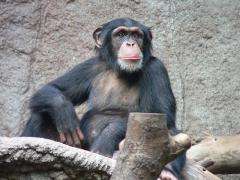
Common chimpanzee in the Leipzig Zoo. Image credit: Thomas Lersch, via Wikipedia.

(PhysOrg.com) -- Chimpanzees look up to those they consider to be more prestigious, echoing the way that young people admire celebrities such as David Beckham and Cheryl Cole, according to a new study.

Researchers found that apes copy the actions of those they consider to have high status within their group.

The study is a collaboration between Professor Andrew Whiten of the University of St Andrews and Drs Victoria Horner and Frans de Waal at the Yerkes National Research Center in Atlanta.

Professor Whiten commented, “Teenagers look to pop stars as social models, copying their clothing, mannerisms and speech. Adults are inspired by prominent members of their society, such as successful professionals. Our study shows that chimpanzees are similarly selective in their choice of trendsetters.”

Earlier studies by Whiten and an international team of primatologists showed that chimpanzee populations in Africa differ from one another in their use of tools, communication and foraging techniques. For example, some populations use stones to crack nuts and others do not.

Professor Whiten continued, “Previous studies have focused on how chimpanzees learn these behaviors from one another through observation and imitation, but much less is known about how they decide whose behavior to copy. Is the spread of chimpanzee behavior influenced by ‘prestigious’ individuals, as it is in humans?”

To answer the question, Professor Whiten and his colleagues allowed chimpanzees to observe the successful foraging skills of either older, higher-ranking apes with good track records of solving puzzles, or lower ranking ones with no such experience. They noted apes overwhelmingly copied the behaviour of the higher status individuals.

The high-ranking female apes were Georgia, who has a long history of introducing new behaviors, inventing a new style of grooming at age fifteen, and Ericka, a matriarch who manages her group with a delicate touch, grooming nearly every individual frequently, ensuring her broad support within the group.

Professor Whiten explained, “We gave the higher and lower status females foraging puzzles to solve, and when the observing were later given their turn, they overwhelmingly aped Georgia and Ericka, the high status individuals within the group.”

The researchers concluded that the popularity of Georgia and Ericka as role models reflected their high prestige positions in the group. They believe that if similar biases operate in wild animal populations, the spread of cultural behaviors may be much shaped by the prestige of certain individuals.

More information: The research paper is published in Public Library of Science ONE (PLoS-ONE) 2010, 5, e10625, which is freely available online at http://www.plosone.org

The research will be showcased in ‘Culture Evolves’, an exhibit in the Royal Society’s Summer Science Exhibition, to be held in London’s Southbank Centre, 25 June - 4 July. The free, public exhibition will showcase cutting edge science in the UK.

Provided by University of St Andrews


Rank 5 /5 (3 votes)
Related Stories
Relevant PhysicsForums posts
  • Flowering Plant Revived After 30,000 Years in Permafrost
    createdFeb 21, 2012
  • Toba volcano eruptions - 1.000 - 10,000 breeding pairsunb
    createdFeb 20, 2012
  • How is a specific gene removed from DNA
    createdFeb 20, 2012
  • Reproduction and Human evolution
    createdFeb 19, 2012
  • Viruses: Living or Non-living organisms
    createdFeb 19, 2012
  • Would you eat brainless animals?
    createdFeb 16, 2012
  • More from Physics Forums - Biology

More news stories

Surprising diversity at a synapse hints at complex diversity of neural circuitry

A new study reveals a dazzling degree of biological diversity in an unexpected place – a single neural connection in the body wall of flies.

Biology / Other

created 7 hours ago | popularity 5 / 5 (4) | comments 0 | with audio podcast

Men might not 'become extinct' after all: Theory of the 'rotting' Y chromosome dealt a fatal blow

If you were to discover that a fundamental component of human biology has survived virtually intact for the past 25 million years, you'd be quite confident in saying that it is here to stay.

Biology / Biotechnology

created 10 hours ago | popularity 5 / 5 (6) | comments 1 | with audio podcast

Climate change affects bird migration timing in North America

Bird migration timing across North America has been affected by climate change, according to a study published Feb. 22 in the open access journal PLoS ONE.

Biology / Ecology

created 6 hours ago | popularity 4.5 / 5 (2) | comments 2

New family of legless amphibians found in India

Since before the age of dinosaurs it has burrowed unbothered beneath the monsoon-soaked soils of remote northeast India - unknown to science and mistaken by villagers as a deadly, miniature snake.

Biology / Plants & Animals

created 18 hours ago | popularity 5 / 5 (8) | comments 3

New iridescent lizard species found in Cambodia

A new species of lizard with striking iridescent rainbow skin, a long tail and very short legs has been discovered in the rainforest in northeast Cambodia, conservationists announced Wednesday.

Biology / Plants & Animals

created 7 hours ago | popularity not rated yet | comments 0


Researchers build first physical 'metatronic' circuit

(PhysOrg.com) -- The technological world of the 21st century owes a tremendous amount to advances in electrical engineering, specifically, the ability to finely control the flow of electrical charges using ...

Faster than light neutrinos? More like faulty wiring

You can shelf your designs for a warp drive engine (for now) and put the DeLorean back in the garage; it turns out neutrinos may not have broken any cosmic speed limits after all.

Spitzer finds solid buckyballs in space

(PhysOrg.com) -- Astronomers using data from NASA's Spitzer Space Telescope have, for the first time, discovered buckyballs in a solid form in space. Prior to this discovery, the microscopic carbon spheres ...

Physicists surprised by disappearing and reappearing superconductivity in iron selenium chalcogenides

Superconductivity is a rare physical state in which matter is able to conduct electricity -- maintain a flow of electrons -- without any resistance. This phenomenon can only be found in certain materials at low temperatures, ...

Scientists create potent molecules aimed at treating muscular dystrophy

While RNA is an appealing drug target, small molecules that can actually affect its function have rarely been found. But now scientists from the Florida campus of The Scripps Research Institute have for the first time designed ...

Stanford research team cracks animated NuCaptcha

(PhysOrg.com) -- The research team from Stanford University, led by Elie Bursztein, that previously had cracked regular CAPTCHAs and then audio CAPTCHAs, now has also successfully cracked the animated version called NuCapt ...