Answer to what ended the last ice age may be blowing in the winds, paper says
June 25, 2010
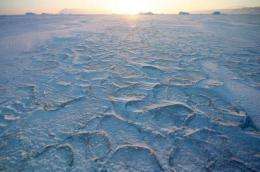
Sea ice in the North Atlantic may have reorganized Earth's winds, spreading warmth from the northern hemisphere to south at the end of the last ice age. Credit: NASA.
Scientists still puzzle over how Earth emerged from its last ice age, an event that ushered in a warmer climate and the birth of human civilization. In the geological blink of an eye, ice sheets in the northern hemisphere began to collapse and warming spread quickly to the south. Most scientists say that the trigger, at least initially, was an orbital shift that caused more sunlight to fall across Earth's northern half. But how did the south catch up so fast?
In a review paper published this week in the journal Science, a team of researchers look to a global shift in winds for the answer. They propose a chain of events that began with the melting of the large northern hemisphere ice sheets about 20,000 years ago. The melting ice sheets reconfigured the planet's wind belts, pushing warm air and seawater south, and pulling carbon dioxide from the deep ocean into the atmosphere, allowing the planet to heat even further. Their hypothesis makes use of climate data preserved in cave formations, polar ice cores and deep-sea sediments to describe how Earth finally thawed out.
"This paper pulls together several recent studies to explain how warming triggered in the north moves to the south, ending an ice age," said study co-author Bob Anderson, a geochemist at Columbia University's Lamont-Doherty Earth Observatory. "Finally, we have a clear picture of the global teleconnections in Earth's climate system that are active across many time scales. These same linkages that brought the earth out of the last ice age are active today, and they will almost certainly play a role in future climate change as well."
Earth regularly goes into an ice age every 100,000 years or so, as its orientation toward the sun shifts in what are called Milankovitch cycles. At the peak of the last ice age, about 20,000 years ago, with New York City and large parts of Europe and Asia buried under thick sheets of ice, Earth's orbit shifted. More summer sunlight began falling on the northern hemisphere, melting those massive ice sheets and sending icebergs and fresh water into the North Atlantic Ocean.
It may sound counterintuitive, but the paper says freshening of the North Atlantic triggered a series of cold spells in Greenland and northern Europe by shutting down the Gulf Stream current, which usually carries warm water north from the equator. Sea ice spread across the North Atlantic, bringing bitter cold winters to Europe and profoundly reshaping the planet's wind belts.
With the North Atlantic in a deep freeze, the tropical trade winds shifted south, bringing dry spells across much of Asia and rain to normally arid regions of Brazil. The displaced winds moved not only rain further south, but hot air and warm seawater, heating up the southern hemisphere.
The southern hemisphere westerly winds also shifted south, bringing warm air and seawater to the mid-latitudes. By about 18,000 years ago, mountain glaciers in South America and New Zealand started to melt as the displaced winds blew warm air their way. By 16,000 years ago, the glaciers had beaten a spectacular retreat. This shift in westerly winds would also amplify the warming in both hemispheres by resetting the planet's thermostat, as Anderson has proposed in an earlier study in Science. The displaced westerlies caused heavy mixing in the Southern Ocean around Antarctica, pumping dissolved carbon dioxide from the water into the air. Ice core records show that between 18,000 and 11,000 years ago atmospheric carbon dioxide levels rose from 185 parts per million to 265 parts per million. (Today levels are 393 parts per million, after a sustained rise during the industrial era.) The infusion of carbon dioxide came just as the planet's orientation was shifting, and summer sunlight to the northern hemisphere was declining, at about 11,000 years ago. The boost in carbon dioxide may have prevented Earth from falling into another ice age, the scientists say.
"It's the great global warming of all time," said the study's lead author, George Denton, a glaciologist at the University of Maine, and an adjunct scientist at Lamont. "We're trying to answer the puzzle: why does the Earth, when it appears so firmly in the grip of an ice age, start to warm?"
Scientists have long suspected that carbon dioxide played a major role in the last ice age but have had trouble explaining the early warming in the southern hemisphere, where glaciers in Patagonia and New Zealand were melting before carbon dioxide levels rose significantly. Some scientists suggest that a change in ocean currents, triggered by the freshening of the North Atlantic, caused this early warming. But computer models using ocean circulation to explain the rapid warming in the south have been unable to recreate the large temperature jumps seen in the paleoclimate record. Now, with the evidence for shifting southern hemisphere westerlies, the rapid warming is readily explained.
Richard Alley, a glaciologist at Penn State University who was not involved in the study, called the hypothesis comprehensive and convincing. "This subject has long intrigued policy-makers, and although the issue in no way changes the very strong evidence that adding CO2 to the atmosphere has a warming effect, the inability of the scientific community to provide a complete explanation of the natural CO2 changes across ice-age cycles may have led some people to more broadly question climate science. Testing this hypothesis will be very interesting, to see whether it successfully "predicts" the observed timing of CO2 and temperature changes in the south."
-
Wind shifts may stir CO2 from Antarctic depths
Mar 12, 2009 |
not rated yet |
0
-
Ice core studies confirm accuracy of climate models
Sep 11, 2008 |
not rated yet |
0
-
Carbon dioxide is the missing link to past global climate changes
Jun 17, 2010 |
not rated yet |
0
-
Study Offers Preview of Ice Sheet Melting, Rapid Climate Changes
Mar 14, 2006 |
not rated yet |
0
-
Oceanic seesaw links Northern and Southern hemisphere during abrupt climate change
Feb 25, 2009 |
not rated yet |
0
-
Stars containing dark matter should look different from other stars
Feb 20, 2012 |
4.5 / 5 (17) |
11
-
Physicists discover evidence of rare hypernucleus, a component of strange matter
Feb 17, 2012 |
4.7 / 5 (38) |
22
-
Fast photon control brings quantum photonic technologies closer
Feb 13, 2012 |
5 / 5 (8) |
1
-
Engineers build first sub-10-nm carbon nanotube transistor
Feb 01, 2012 |
4.9 / 5 (36) |
32
-
Something old, something new: Evolution and the structural divergence of duplicate genes
Jan 31, 2012 |
4.6 / 5 (7) |
1
-
Is the Earth really going to die
14 hours ago
-
Do some geologists actually act a lot like Randy Marsh?
Feb 11, 2012
-
Discrepancy between oxygen and carbon-dioxide levels
Feb 09, 2012
-
where gems are found in the world
Feb 09, 2012
-
Wind Waves in Reservoir ~ Wind run-up and Wind set-up
Feb 08, 2012
-
Balance of oxygen in the atmosphere
Feb 01, 2012
- More from Physics Forums - Earth
More news stories
Spitzer finds solid buckyballs in space
(PhysOrg.com) -- Astronomers using data from NASA's Spitzer Space Telescope have, for the first time, discovered buckyballs in a solid form in space. Prior to this discovery, the microscopic carbon spheres ...
14 hours ago |
4.7 / 5 (12) |
8
|
Going up: Japan builder eyes space elevator
A Japanese construction firm claimed Wednesday it could execute an out-of-this-world plan to put tourists in space within 40 years by building an elevator that stretches a quarter of the way to the moon.
Space & Earth / Space Exploration
21 hours ago |
3.5 / 5 (13) |
26
ENASA satellite finds Earth's clouds are getting lower
(PhysOrg.com) -- Earth's clouds got a little lower -- about one percent on average -- during the first decade of this century, finds a new NASA-funded university study based on NASA satellite data. The results ...
Space & Earth / Earth Sciences
18 hours ago |
5 / 5 (8) |
13
|
Fresh scandal embroils US climate science debate
A fresh scandal over climate change has erupted in the United States after leaked documents appeared to show a right-wing funded campaign to influence how climate science is taught in schools.
11 hours ago |
4.1 / 5 (9) |
8
World's oceans get an acid bath
Among the repercussions of global climate change, the effect of ocean acidification on marine life is one of the least-understood variables.
18 hours ago |
4.3 / 5 (6) |
4
|
Researchers build first physical 'metatronic' circuit
(PhysOrg.com) -- The technological world of the 21st century owes a tremendous amount to advances in electrical engineering, specifically, the ability to finely control the flow of electrical charges using ...
Faster than light neutrinos? More like faulty wiring
You can shelf your designs for a warp drive engine (for now) and put the DeLorean back in the garage; it turns out neutrinos may not have broken any cosmic speed limits after all.
Physicists surprised by disappearing and reappearing superconductivity in iron selenium chalcogenides
Superconductivity is a rare physical state in which matter is able to conduct electricity -- maintain a flow of electrons -- without any resistance. This phenomenon can only be found in certain materials at low temperatures, ...
Stanford research team cracks animated NuCaptcha
(PhysOrg.com) -- The research team from Stanford University, led by Elie Bursztein, that previously had cracked regular CAPTCHAs and then audio CAPTCHAs, now has also successfully cracked the animated version called NuCapt ...
Flesh-eating bacteria inspire superglue
(PhysOrg.com) -- A bio-inspired superglue has been developed by Oxford University researchers that cant be matched for sticking molecules together and not letting go.
Scientists create potent molecules aimed at treating muscular dystrophy
While RNA is an appealing drug target, small molecules that can actually affect its function have rarely been found. But now scientists from the Florida campus of The Scripps Research Institute have for the first time designed ...
Jun 25, 2010
Rank: 1 / 5 (8)
"every 100,000 years or so, as its orientation toward the sun shifts in what are called Milankovitch cycles"
"More summer sunlight began falling on the northern hemisphere, melting those massive ice sheets"
"These same linkages that brought the earth out of the last ice age are active today"
Really? I don't see any massive ice sheets covering the northern hemisphere, and I don't think it's been 100,000 years since the last Milankovitch cycle.
"Testing this hypothesis will be very interesting, to see whether it successfully "predicts" the observed timing of CO2 and temperature changes in the south"
Now THAT part makes sense.
Jun 25, 2010
Rank: 2 / 5 (4)
We're still in the warming phase from the last one. Something many alarmists seem to either forget or ignore.
Jun 25, 2010
Rank: 1 / 5 (4)
The problem/the initiator of Ice Ages is a hot ocean.... once this cools the cycle is reversed.
Unless you can postulate a SIMPLE cycle, rather than fantasising a complex series of events, your explanations hold no credence.
The key to all this is salinity
and the fresh water to salt water ratio... it naturally oscillates which is reflected in glacial and interglacial periods.
Jun 26, 2010
Rank: 1 / 5 (5)
wrong question, the planet is always warming and at apex points it abruptly changes. volcanism
Jun 26, 2010
Rank: 1 / 5 (2)
And just who would these be?
Jun 26, 2010
Rank: 5 / 5 (6)
Jun 26, 2010
Rank: not rated yet
http://en.wikiped...h_cycles
http://upload.wik...tion.jpg
It also seems to me that, in general, the earth had been cooling since a few million years ago, until about maybe 0.5 or 0.4 million years ago, while also gaining greater variance between its highs and lows.
http://upload.wik...ange.png
The current temperatures aren't out of the norm of the expected amounts. We've still yet to exceed the last peak (excluding our current peak), which was about 130 000 years ago, or 3 peaks ago, ~325 000 years ago. Looking at the two following graphs, it seems like the current peak could have hit its maximum about 10 000 years ago.
http://upload.wik...data.svg]http://upload.wik...data.svg[/url]
Jun 26, 2010
Rank: not rated yet
Well, there's Greenland, of course, but those ice-sheets have gone underground as permafrost-- And that seems to be thawing...
Jun 26, 2010
Rank: 5 / 5 (2)
Jun 26, 2010
Rank: not rated yet
Well, until it doesn't anymore. Sun cycles are only one factor in the earth's periodic climate shifts and probably not the only major one.
Jun 30, 2010
Rank: not rated yet