Green energy from algae
June 25, 2010
Green energy from algae

(PhysOrg.com) -- Visitors to this year’s UK Royal Society Summer Exhibition will have a chance to discover how scientists from the University of Cambridge are studying ways to harness algae as a renewable energy source.

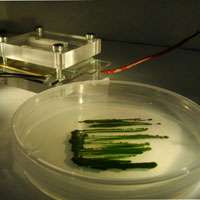
Part of the Cambridge team - which includes plant scientists, biochemists, mathematicians, and chemical engineers - is developing a biophotovoltaic device to produce green electricity by tapping into the ability of algae to harness solar .

This is the first time that whole cells of algae have been used to power an electrical device. Although the technology is at least 5-10 years away from market the team has already succeeded in hooking up thin films of algae to power an electronic clock.

According to Paolo Bombelli, a member of the Cambridge team which invented the original concept: "Compared with silicon-based , a solar cell that uses biological material to capture light energy would be cheaper to produce, self-repairing, self-replicating, biodegradable and much more sustainable - real ."

This video is not supported by your browser at this time.

Algae, like other green plants, use photosynthesis to take electrons from water using energy from the sun. The challenge for the Cambridge team is to find the best way of harvesting some of those electrons.

The Cambridge exhibit - Meet the Algae - features other ways in which algae could be exploited, including for production of biodiesel and high-value products such as vitamins. Algae - often thought of as just pond slime - are a fantastically diverse group of photosynthetic organisms. They can be found everywhere - from glaciers, to hot springs and moist soil, to the open ocean. The exhibit will provide hands-on demonstrations illustrating the role of algae in natural ecosystems, their extraordinary beauty and diversity, and aspects of their movement and how they harvest sunlight.

"Algae offer considerable potential as a source of bioenergy. By studying fundamentals of their metabolism and and by understanding the fantastic natural variation in the different types of we can harness this potential for energy production," says Professor Sir David Baulcombe, Head of Department of Plant Sciences.

More information: The Royal Society Summer Science Exhibition takes place at the Royal Festival Hall, Southbank Centre, London from Friday 25 June to Sunday 4 July 2010. Open Friday 25 June 6pm - 8.30pm, then daily 10am - 8.30pm.

Provided by University of Cambridge (news : web)


Rank 5 /5 (2 votes)
Related Stories
Relevant PhysicsForums posts
  • Stoichiometry
    created21 hours ago
  • Boiling and melting point of impure substances
    created22 hours ago
  • Safe nitrogen compound to decompose a 500 deg C in a furnace?
    createdFeb 09, 2012
  • [ask]electron inside drinking water
    createdFeb 08, 2012
  • How to avoid formation of Lithium Chromate ???
    createdFeb 08, 2012
  • how to choose a reduced or oxidated form in a redox
    createdFeb 08, 2012
  • More from Physics Forums - Chemistry

More news stories

Fool's gold may prove an unlikely alternative to overexploited catalytic materials

Catalytic materials, which lower the energy barriers for chemical reactions, are used in everything from the commercial production of chemicals to catalytic converters in car engines. However, with current catalytic materials ...

Chemistry / Materials Science

created 13 hours ago | popularity 4.3 / 5 (7) | comments 5 | with audio podcast

Unpicking HIV’s invisibility cloak

Drug researchers hunting for alternative ways to treat human immunodeficiency virus (HIV) infections may soon have a novel target—its camouflage coat. HIV hides inside a cloak unusually rich in a sugar ...

Chemistry / Biochemistry

created 13 hours ago | popularity 5 / 5 (4) | comments 0

No entry without protein recycling: Researchers discover new coherence in enzyme transport

The group of Prof. Dr. Ralf Erdmann at the Ruhr-Universität Bochum, Germany, discovered a connection of peroxisomal protein import and receptor export. In the Journal of Biological Chemistry, they disclo ...

Chemistry / Biochemistry

created 13 hours ago | popularity not rated yet | comments 0

Hydrogen from acidic water: Researchers develop potential low cost alternative to platinum for splitting water

A technique for creating a new molecule that structurally and chemically replicates the active part of the widely used industrial catalyst molybdenite has been developed by researchers with the Lawrence Berkeley ...

Chemistry / Materials Science

created Feb 09, 2012 | popularity 5 / 5 (12) | comments 13 | with audio podcast

Under the microscope #7

In this video Dr Ingrid Graz shows us a thin layer of gold on top of rubber. Cracks in the gold allow it to stretch and we can use this for stretchable electronics.

Chemistry / Other

created 15 hours ago | popularity not rated yet | comments 0


Anonymous knocks CIA website offline (Update)

The website of the Central Intelligence Agency was inaccessible on Friday after the hacker group Anonymous claimed to have knocked it offline.

Google users warned of threat to smartphone wallets

Users of Google smartphone wallets were being warned on Friday that there is a way to crack pass codes intended to thwart thieves from going on illicit shopping sprees.

New error-correcting codes guarantee the fastest possible rate of data transmission

Error-correcting codes are one of the triumphs of the digital age. They’re a way of encoding information so that it can be transmitted across a communication channel — such as an optical fiber o ...

Complex wiring of the nervous system may rely on a just a handful of genes and proteins

Researchers at the Salk Institute have discovered a startling feature of early brain development that helps to explain how complex neuron wiring patterns are programmed using just a handful of critical genes. ...

Humans may have helped the decline of African rainforests 3000 years ago

(PhysOrg.com) -- Large areas of rainforests in Central Africa mysteriously disappeared over three thousand years ago, to be replaced by savannas. The prevailing theory has been that the cause was a change ...

The power of estrogen -- male snakes attract other males

A new study has shown that boosting the estrogen levels of male garter snakes causes them to secrete the same pheromones that females use to attract suitors, and turned the males into just about the sexiest ...