New molecular framework could lead to flexible solar cells
June 29, 2010 By Lauren Gold
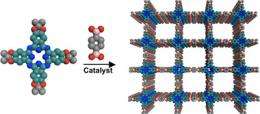
The Dichtel group in the Department of Chemistry and Chemical Biology has developed a method to organize organic dyes into stacked, porous two-dimensional sheets. These materials may ultimately be incorporated into inexpensive, flexible solar cells.
(PhysOrg.com) -- Making better solar cells: Cornell University researchers have discovered a simple process - employing molecules typically used in blue jean and ink dyes - for building an organic framework that could lead to economical, flexible and versatile solar cells. The discovery is reported in the journal Nature Chemistry.
Think of solar cells, and you probably imagine the thick, heavy silicon panels on rooftops in sunny climates.
Those panels are effective, but they can also be expensive and unwieldy. In the search for a better alternative, a team led by William Dichtel, assistant professor of chemistry and chemical biology, has discovered a simple process for building an organic molecular framework that could pave the way for the development of more economical, flexible and versatile solar cells.
The discovery is reported in an article published online on June 20 by the journal Nature Chemistry.
Dichtel's strategy uses organic dye molecules assembled into a structure known as a covalent organic framework (COF). Organic materials have long been recognized as having potential to create thin, flexible and low-cost photovoltaic devices, but it has been proven difficult to organize their component molecules reliably into ordered structures likely to maximize device performance.
COFs, a class of materials first reported in 2005, offer a new way to address this long-range ordering problem; but until now, the known methods for creating them had significant limitations.
"We had to develop a completely new way of making the materials in general," Dichtel said. The strategy uses a simple acid catalyst and relatively stable molecules called protected catechols to assemble key organic molecules into a neatly ordered two-dimensional sheet. These sheets stack on top of one another to form a lattice that provides pathways for charge to move through the material.
The reaction is also reversible, allowing for errors in the process to be undone and corrected.
"The whole system is constantly forming wrong structures alongside the correct one," Dichtel said, "but the correct structure is the most stable, so eventually, the more perfect structures end up dominating." The result is a structure with high surface area that maintains its precise and predictable molecular ordering over large areas.
The researchers used X-ray diffraction to confirm the material's molecular structure and surface area measurements to determine its porosity.
At the core of the framework are molecules called phthalocyanines, a class of common industrial dyes used in products from blue jeans to ink pens.
Phthalocyanines are also closely related in structure to chlorophyll, the compound in plants that absorbs sunlight for photosynthesis. The compounds absorb almost the entire solar spectrum -- a rare property for a single organic material.
"For most organic materials used for electronics, there's a combination of some design to get the materials to perform well enough, and there's a little bit of an element of luck," Dichtel said. "We're trying to remove as much of that element of luck as we can."
The structure by itself is not a solar cell yet, but it is a model that will significantly broaden the scope of materials that can be used in COFs, Dichtel said. "We also hope to take advantage of their structural precision to answer fundamental scientific questions about moving electrons through organic materials."
Once the framework is assembled, the pores between the molecular latticework could potentially be filled with another organic material to form a light, flexible, highly efficient and easy-to-manufacture solar cell.
The next step is to begin testing ways of filling in the gaps with complementary molecules. "This is the very beginning of our work," he said.
More information: The article, "Lewis acid-catalysed formation of two-dimensional phthalocyanine covalent organic frameworks," appears in the online edition of the journal Nature Chemistry, June 20, 2010.
-
Chemists create molecule with promising semiconductor properties
Feb 11, 2010 |
not rated yet |
0
-
Renewable energies : the promise of organic solar cells
Apr 08, 2009 |
not rated yet |
0
-
Molecular breakthrough for plastic electronics
Apr 12, 2005 |
not rated yet |
0
-
A new structural view of organic electronic devices
Sep 12, 2005 |
not rated yet |
0
-
Scientists squeeze more out of metal-organic framework
Jan 12, 2010 |
not rated yet |
0
-
Engineers build first sub-10-nm carbon nanotube transistor
Feb 01, 2012 |
4.9 / 5 (31) |
30
-
Something old, something new: Evolution and the structural divergence of duplicate genes
Jan 31, 2012 |
4.6 / 5 (7) |
1
-
The hidden nanoworld of ice crystals: Revealing the dynamic behavior of quasi-liquid layers
Jan 30, 2012 |
5 / 5 (3) |
1
-
Stock market network reveals investor clustering
Jan 27, 2012 |
3.9 / 5 (23) |
8
-
Of microchemistry and molecules: Electronic microfluidic device synthesizes biocompatible probes
Jan 26, 2012 |
5 / 5 (1) |
0
-
Stoichiometry
22 hours ago
-
Boiling and melting point of impure substances
23 hours ago
-
Safe nitrogen compound to decompose a 500 deg C in a furnace?
Feb 09, 2012
-
[ask]electron inside drinking water
Feb 08, 2012
-
How to avoid formation of Lithium Chromate ???
Feb 08, 2012
-
how to choose a reduced or oxidated form in a redox
Feb 08, 2012
- More from Physics Forums - Chemistry
More news stories
Fool's gold may prove an unlikely alternative to overexploited catalytic materials
Catalytic materials, which lower the energy barriers for chemical reactions, are used in everything from the commercial production of chemicals to catalytic converters in car engines. However, with current catalytic materials ...
14 hours ago |
4.4 / 5 (8) |
5
|
Unpicking HIV’s invisibility cloak
Drug researchers hunting for alternative ways to treat human immunodeficiency virus (HIV) infections may soon have a novel targetits camouflage coat. HIV hides inside a cloak unusually rich in a sugar ...
14 hours ago |
5 / 5 (5) |
0
No entry without protein recycling: Researchers discover new coherence in enzyme transport
The group of Prof. Dr. Ralf Erdmann at the Ruhr-Universität Bochum, Germany, discovered a connection of peroxisomal protein import and receptor export. In the Journal of Biological Chemistry, they disclo ...
14 hours ago |
not rated yet |
0
Hydrogen from acidic water: Researchers develop potential low cost alternative to platinum for splitting water
A technique for creating a new molecule that structurally and chemically replicates the active part of the widely used industrial catalyst molybdenite has been developed by researchers with the Lawrence Berkeley ...
Feb 09, 2012 |
4.8 / 5 (14) |
14
|
Under the microscope #7
In this video Dr Ingrid Graz shows us a thin layer of gold on top of rubber. Cracks in the gold allow it to stretch and we can use this for stretchable electronics.
16 hours ago |
not rated yet |
0
Google users warned of threat to smartphone wallets
Users of Google smartphone wallets were being warned on Friday that there is a way to crack pass codes intended to thwart thieves from going on illicit shopping sprees.
Anonymous knocks CIA website offline (Update)
The website of the Central Intelligence Agency was inaccessible on Friday after the hacker group Anonymous claimed to have knocked it offline.
New error-correcting codes guarantee the fastest possible rate of data transmission
Error-correcting codes are one of the triumphs of the digital age. Theyre a way of encoding information so that it can be transmitted across a communication channel such as an optical fiber o ...
Humans may have helped the decline of African rainforests 3000 years ago
(PhysOrg.com) -- Large areas of rainforests in Central Africa mysteriously disappeared over three thousand years ago, to be replaced by savannas. The prevailing theory has been that the cause was a change ...
Complex wiring of the nervous system may rely on a just a handful of genes and proteins
Researchers at the Salk Institute have discovered a startling feature of early brain development that helps to explain how complex neuron wiring patterns are programmed using just a handful of critical genes. ...
New power source discovered
(PhysOrg.com) -- Researchers at the Massachusetts Institute of Technology (MIT) and RMIT University have made a breakthrough in energy storage and power generation.