Arctic climate may be more sensitive to warming than thought, says new study
June 29, 2010
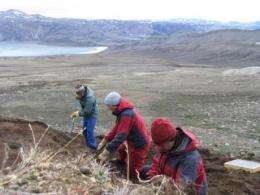
From left to right, Ashley Ballantyne of the University of Colorado at Boulder, Dara Finney of Environment Canada and Natalia Rybczynski of the Canadian Museum of Nature search for fossils in a peat deposit at Strathcona Fiord on Ellesmere Island in Canada's High Arctic. Credit: Photo courtesy Dara Finney, Environment Canada.
A new study shows the Arctic climate system may be more sensitive to greenhouse warming than previously thought, and that current levels of Earth's atmospheric carbon dioxide may be high enough to bring about significant, irreversible shifts in Arctic ecosystems.
Led by the University of Colorado at Boulder, the international study indicated that while the mean annual temperature on Ellesmere Island in the High Arctic during the Pliocene Epoch 2.6 to 5.3 million years ago was about 34 degrees Fahrenheit, or 19 degrees Celsius, warmer than today, CO2 levels were only slightly higher than present. The vast majority of climate scientists agree Earth is warming due to increased concentrations of heat-trapping atmospheric gases generated primarily by human activities like fossil fuel burning and deforestation.
The team used three independent methods of measuring the Pliocene temperatures on Ellesmere Island in Canada's High Arctic. They included measurements of oxygen isotopes found in the cellulose of fossil trees and mosses that reveal temperatures and precipitation levels tied to ancient water, an analysis of the distribution of lipids in soil bacteria which correlate with temperature, and an inventory of ancient Pliocene plant groups that overlap in range with contemporary vegetation.
"Our findings indicate that CO2 levels of approximately 400 parts per million are sufficient to produce mean annual temperatures in the High Arctic of approximately 0 degrees Celsius (32 degrees F)," Ballantyne said. "As temperatures approach 0 degrees Celsius, it becomes exceedingly difficult to maintain permanent sea and glacial ice in the Arctic. Thus current levels of CO2 in the atmosphere of approximately 390 parts per million may be approaching a tipping point for irreversible ice-free conditions in the Arctic."
A paper on the subject is being published in the July issue of the journal Geology. Co-authors included David Greenwood of Brandon University in Manitoba, Canada, Jaap Sinninghe Damste of the Royal Netherlands Institute for Sea Research, Adam Csank of the University of Arizona, Natalia Rybczynski of the Canadian Museum of Nature in Ottawa and Jaelyn Eberle, curator of fossil vertebrates at the University of Colorado Museum of Natural History and an associate professor in the geological sciences department.
Arctic temperatures have risen by about 1.8 degrees F, or 1 degree C, in the past two decades in response to anthropogenic greenhouse warming, a trend expected to continue in the coming decades and centuries, said Ballantyne. Greenhouse gases in the atmosphere have risen from about 280 parts per million during the pre-industrial era on Earth to about 390 parts per million today.
During the Pliocene, Ellesmere Island hosted forests of larch, dwarf birch and northern white cedar trees, as well as mosses and herbs, including cinquefoils. The island also was home to fish, frogs and now extinct mammals that included tiny deer, ancient relatives of the black bear, three-toed horses, small beavers, rabbits, badgers and shrews. Because of the high latitude, the Ellesmere Island site on the Strathcona Fiord was shrouded by darkness six months out of the year, said Rybczynski.
Fossils are often preserved in a process known as permineralization, in which mineral deposits form internal casts of organisms. But at the Ellesmere Island site known as the "Beaver Pond site," organic materials -- including trees, plants and mosses -- have been "mummified" in peat deposits, allowing the researchers to conduct detailed, high-quality analyses, said Eberle.
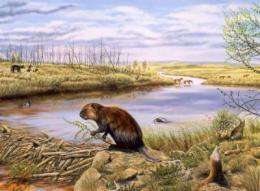
This is an artist's rendering of the Beaver Pond site on Ellesmere Island, in Canada's High Arctic, as it may have looked about 3 to 5 million years ago. Credit: George
Ballantyne said the high level of preservation of trees and mosses at Ellesmere Island allowed the team to measure the ratio of oxygen isotopes in plant cellulose, providing information on water absorbed from precipitation during the Pliocene and which yielded estimates of past surface temperatures. The team also compared data on the width of tree rings in larch trees at the Beaver Pond site to trees at lower latitudes today to help them estimate past temperatures and precipitation levels.The researchers also analyzed the distribution of ancient membrane lipids from soil bacteria known as tetraethers, which correlate to temperature. The chemical structure of the fossilized tetraethers makes them highly sensitive to both temperature and acidity, or pH, said Ballantyne.
The last line of evidence put forward by the CU-Boulder-led team was a comparison of Pliocene ancient vegetation at the site with vegetation present today, providing a clear "climate window" showing the overlap of the two time periods. "The results of the three independent temperature proxies are remarkably consistent," said Eberle. "We essentially were able to 'read' the vegetation in order to estimate air temperatures in the Pliocene."
Today, Ellesmere Island is a polar desert that features tundra, permafrost, ice sheets, sparse vegetation and a few small mammals. Temperatures range from roughly minus 37 degrees F, or minus 38 degrees C, in winter to 48 degrees F, or 9 degrees C, in summer. The region is one of the coldest, driest environments on Earth.
"Our findings are somewhat disconcerting regarding the temperatures and greenhouse gas levels during the Pliocene," said Eberle. "We already are seeing evidence of both mammals and birds moving northward as the climate warms, and I can't help but wonder if the Arctic is headed toward conditions similar to those that existed during the Pliocene."
Elevated Arctic temperatures during the Pliocene -- which occurred shortly before Earth plunged into an ice age about 2.5 million years ago -- are thought to have been driven by the transfer of heat to the polar regions and perhaps by decreased reflectivity of sunlight hitting the Arctic due to a lack of ice, said Ballantyne. One big question is why the Arctic was so sensitive to warming during this period, he said.
Multiple feedback mechanisms have been proposed to explain the amplification of Arctic temperatures, including the reflectivity strength of the sun on Arctic ice and changes in vegetation seasonal cloud cover, said Ballantyne. "I suspect that it is the interactions between these different feedback mechanisms that ultimately produce the warming temperatures in the Arctic."
In 2009, CU-Boulder's National Snow and Ice Data Center showed the September Arctic sea ice extent was 649,000 square miles, or 1,680,902 square kilometers, below the 1979-2000 average, and is declining at a rate of 11.2 percent per decade. Some climate change experts are forecasting that the Arctic summers will become ice-free summers within a decade or two.
In addition to its exceptional preservation of fossil wood, plants, insects and mollusks, the Beaver Pond site on Ellesmere Island is the only reported Pliocene fossil site in the High Arctic to yield vertebrate remains, said Rybczynski.
Eberle said there is high concern by scientists over a proposal to mine coal on Ellesmere Island near the Beaver Pond site by WestStar Resources Inc. headquartered in Vancouver, British Columbia. "Paleontological sites like the Beaver Pond site are unique and extremely valuable resources that are of international importance," said Eberle. "Our concern is that coal mining activities could damage such sites and they will be lost forever."
-
53 million-year-old high Arctic mammals wintered in darkness
Jun 01, 2009 |
not rated yet |
0
-
Arctic could face warmer and ice-free conditions
Dec 29, 2009 |
not rated yet |
0
-
Arctic summer in Arctic wintertime
Jan 26, 2006 |
not rated yet |
0
-
Getting warmer? Prehistoric climate can help forecast future changes
Nov 24, 2008 |
not rated yet |
0
-
Arctic sea ice minimum shatters all-time record low, report University of Colorado scientists
Sep 20, 2007 |
not rated yet |
0
-
Engineers build first sub-10-nm carbon nanotube transistor
Feb 01, 2012 |
4.9 / 5 (30) |
30
-
Something old, something new: Evolution and the structural divergence of duplicate genes
Jan 31, 2012 |
4.6 / 5 (7) |
1
-
The hidden nanoworld of ice crystals: Revealing the dynamic behavior of quasi-liquid layers
Jan 30, 2012 |
5 / 5 (3) |
1
-
Stock market network reveals investor clustering
Jan 27, 2012 |
3.9 / 5 (23) |
8
-
Of microchemistry and molecules: Electronic microfluidic device synthesizes biocompatible probes
Jan 26, 2012 |
5 / 5 (1) |
0
-
Discrepancy between oxygen and carbon-dioxide levels
11 hours ago
-
where gems are found in the world
14 hours ago
-
Wind Waves in Reservoir ~ Wind run-up and Wind set-up
Feb 08, 2012
-
Balance of oxygen in the atmosphere
Feb 01, 2012
-
The case for a methanol-based economy
Jan 30, 2012
-
Weather in a rotating cylinder
Jan 25, 2012
- More from Physics Forums - Earth
More news stories
Clam fields found at deep, low-temperature Mariana vents
(PhysOrg.com) -- Scientists have marveled at the unusual life forms thriving at high temperature hydrothermal vents of the deep ocean.
Space & Earth / Earth Sciences
48 minutes ago |
not rated yet |
0
|
Could Venus be shifting gear?
(PhysOrg.com) -- ESAs Venus Express spacecraft has discovered that our cloud-covered neighbour spins a little slower than previously measured. Peering through the dense atmosphere in the infrared, the ...
Space & Earth / Space Exploration
16 minutes ago |
5 / 5 (1) |
0
|
Streams need trees to withstand climate change
(PhysOrg.com) -- More than twenty years of biological monitoring have confirmed the importance of vegetation for protecting Australia's freshwater streams and rivers against the ravages of drought and climate ...
57 minutes ago |
not rated yet |
0
The turbulent birth of super star clusters in galaxy mergers
By combining two of the most advanced telescopes in the world -- the new Atacama Large Millimeter Array (ALMA) and the Very Large Telescope (VLT) of ESO -- a team of French astronomers from the Institut d'astrophysique ...
39 minutes ago |
not rated yet |
0
What does a nebula sound like?
What do things sound like out in the cosmos? Of course, sound waves cant travel through the vacuum of space; however, electromagnetic waves can. These electromagnetic waves can be recorded by devices called spectrographs ...
Space & Earth / Space Exploration
23 minutes ago |
5 / 5 (1) |
0
Seeing colors in music, tasting flavors in shapes may happen in life's early months
Famed violinist Itzhak Perlman sees a deep forest green whenever he plays a B-flat on his Stradivarius' G string. The A on the E string is red.
Is that sleepiness during pregnancy normal or a sign of sleep apnea?
(Medical Xpress) -- Most pregnant women complain of being tired. Some of them however, could be suffering more than normal fatigue associated with their pregnancy; they may have developed obstructive sleep apnea (OSA), a ...
Engineering images bring life to submerged city
(PhysOrg.com) -- Photo-realistic 3D mapping and digital reconstruction of an ancient underwater city in Greece have earned a team from the University of Sydney's Faculty of Engineering and Information Technologies ...
Numeracy: The educational gift that keeps on giving?
(Medical Xpress) -- Cancer risks. Investment alternatives. Calories. Numbers are everywhere in daily life, and they figure into all sorts of decisions. A new article published in Current Directions in Psychological Science, a journal of the Association for Psychological Science, examin ...
New power source discovered
(PhysOrg.com) -- Researchers at the Massachusetts Institute of Technology (MIT) and RMIT University have made a breakthrough in energy storage and power generation.
Measurements from high-energy collisions lead to better understanding of why meson particles disappear
For several years, physicists at the Relativistic Heavy Ion Collider (RHIC) at Brookhaven National Laboratory (BNL), USA, have studied an unusual state of matter called the quarkgluon plasma, which they ...

Jun 29, 2010
Rank: 2.8 / 5 (15)
I'd like to know what this idiot's definition of irreversible is...
Jun 29, 2010
Rank: 2.7 / 5 (17)
Wrong.
Jun 29, 2010
Rank: 3.2 / 5 (13)
Well... just a guess, but I suspect that any good dictionary would give you the answer. Irreversible in this case represents a state change. To move back would require CO2 levels MUCH lower than todays. While your dictionary is open, check out the definition of 'tipping point'.
Jun 29, 2010
Rank: 3.6 / 5 (17)
Are you a scientist? I know that there are a few that believe that global warming doesn't exist, but they get fewer every day. There are scientists that believe in creationism too... but most don't.
Jun 29, 2010
Rank: 3.4 / 5 (10)
But that aside...very interesting, and quite worrisome, as well. One thing strikes me, though; these temperatures are measured over the period during which North and South America finally joined together, cutting off the Atlantic from the Pacific. I know that even five million years ago, the gap between the two continents wasn't exactly very large, so I'd be surprised if there was much of a current through the passage--but if there was, its presence might've had some effect on global climate, and perhaps enough to explain some of the high temperatures around Ellesmere island. It'd be very interesting to try to put together a similar record for other northerly islands, and see if the same temperatures existed there, as well.
Jun 29, 2010
Rank: 3.2 / 5 (11)
Jun 29, 2010
Rank: 2.6 / 5 (5)
http://www.merria...versible
Fail.
He might fail as a scientist, but he'd be a hell of a used car salesman...or perhaps a game show host.
Jun 29, 2010
Rank: 3 / 5 (5)
"Ellesmere Island is the only reported Pliocene fossil site in the High Arctic to yield vertebrate remains"
This site is not typical.
Jun 29, 2010
Rank: 3.4 / 5 (10)
Jun 29, 2010
Rank: 3 / 5 (2)
Well, that's what he's saying...
Let me fix that quote for you...
In addition to its exceptional preservation of fossil wood, plants, insects and mollusks, the Beaver Pond site on Ellesmere Island is the only reported Pliocene fossil site in the High Arctic to yield vertebrate remains, said Rybczynski.
Jun 30, 2010
Rank: 3 / 5 (8)
Poles warming, plus more rain... Voila! More farmland!
Jun 30, 2010
Rank: 2.6 / 5 (5)
I have not seen a report that looks at everything in a big picture.
Jun 30, 2010
Rank: 3 / 5 (10)
This site is not typical, it is an outlier, and should be rejected.
See dictionary for outlier.
Jun 30, 2010
Rank: 3 / 5 (6)
yes, that is what happens but it is not due to CO2
it is due to over hot oceans putting a floor under minimum day temperatures
The over hot ocean is due to the ubiquitous petroleum oil present in the surface marine micro-layer. This oil reduces water evaporation and thus heats the oceans.
The released fresh water from ice melt and the over-hot ocean will precipitate an Ice Age.
see
http://www.omegaf...amp;t=46
Jun 30, 2010
Rank: 3.3 / 5 (7)
I couldn't have said it better myself. I still say that the real point of the story is the coal mine though. They are trying to say that peat deposits should be protected. Oh, and it just happens that peat and coal are geologically related, since peat can turn into coal. It's common to find peat and coal nearby one another. So, by saying that the peat should be protected and setting a precedent for this, they can block a lot of future coal mining. There's an agenda here, or else they wouldn't have mentioned the mine in this "scientific" (read non-scientific) article.
About 90% of the climate articles on this site are politically motivated with some agenda other than science. My BS detector goes nuts every time I read one of these.
Jun 30, 2010
Rank: 2.3 / 5 (6)
Jun 30, 2010
Rank: 2.4 / 5 (7)
Jun 30, 2010
Rank: 1 / 5 (1)
Your point about the connection of north and south america is a valid one, and upon looking it up, seems to be a well-known and well-established fact. I wonder why the supposed experts who wrote this article failed to mention shuch an obvious factor which would have major impact on the interpretation of their observations. The sources I found say that the connection of the panama isthmus cut off the equatorial current and caused the Atlantic to cool drastically in a short time, leading to the glaciation of North America, Greenland, and Europe, as well as the polar ice cap formation. So, it looks like you were spot on about that, and the people writing about the coal mine are a bit confused about a thing or two. lol.
Jun 30, 2010
Rank: 2.3 / 5 (3)
There was a marine mass extinction, probably caused by the supernova, but who knows for sure. I would suspect that a massive decrease in algea and other marine plants would have a prety big effect on CO2 and O2 concentrations, but I'm no scientist.
Jun 30, 2010
Rank: 3.7 / 5 (3)
I just hate it when clowns like this Ballantyne character make serious climate scientists lose credibility by publishing this kind of junk. Don't you agree that such an obviously flawed paper hurts more than it helps your cause? It makes you look like idiots by association, just like when Tegiri posts something that agrees with me.
Jul 03, 2010
Rank: 3.3 / 5 (7)
Jul 03, 2010
Rank: 2.6 / 5 (5)
Freeman Dyson. A majority of one.
Jul 03, 2010
Rank: 3.4 / 5 (5)
He actually worked as a Climate Scientist. His specialty is combining data from many separate systems. He is the world's supreme multi-disciplinarian.
You fear-mongers (that's what Dyson calls you) know that, yes?
Jul 03, 2010
Rank: 2.3 / 5 (3)
Jul 04, 2010
Rank: 3 / 5 (4)
Jul 04, 2010
Rank: 2 / 5 (8)
Jul 04, 2010
Rank: 2.6 / 5 (5)
- water is 1000 times denser than air
- there is a greater mass of ocean water than air on Gaia.
Where have you been... not drinking cool-aid or harrasing escorts...
Jul 04, 2010
Rank: 1.7 / 5 (6)
Jul 04, 2010
Rank: 2.3 / 5 (3)
http://www.examin...and-more
Jul 04, 2010
Rank: 3 / 5 (4)
Instead of going to scientific papers you link to an Examiner piece on John Cristi. Try linking to something that has science behind it instead of calling names and linking to fluff. Maybe fluff is all you can link to (not that it will matter - here are some up-to-date links that I am sure you will just resort to name calling on:
http://nsidc.org/...icenews/
http://arctic.atm...osphere/
http://www.osdpd....our.html
http://www.metoff.../latest/
http://data.giss..../graphs/
So, I have just given you links to data and analyses that back up what I said before. Time for you to explain why I am a Marxist and back up your claim the wheels are coming of.
Jul 04, 2010
Rank: 3 / 5 (2)
http://online.wsj...244.html
Jul 04, 2010
Rank: not rated yet
how about some ice news.
http://wattsupwit...re-21373
http://wattsupwit...-record/
now again address the message and not the messenger. i know that unless a paper is written at berkley and published by an agw friendly institution you wont accept the conclusions therein and thats fine.
as far as fluff goes lets delve into your sources for a moment.
giss gets it wrong over and over again. faulty data, graphs that misrepresent, etc.
http://climateaud...us-data/
the met office?
http://www.indepe...694.html
http://autonomous...d-wrong/
http://www.boltva...m/met-of
Jul 04, 2010
Rank: 1 / 5 (1)
http://wattsupwit...orecast/
i refer to it as marxist propaganda because agw cultists, like marxists wont be happy until we(the industrialized world) all live in mud huts and live off rice and soy patties. the sad part is there are plenty of useful idiots who will pitch in and help them fulfill this ideal.so while i once again thank you for your service, if that hits a little too close to home and you feel insulted-well, i think i can live with that.
Jul 04, 2010
Rank: 1 / 5 (1)
http://wattsupwit...ranking/
http://www.judici...docs.pdf
http://climaterea...?id=5806
Jul 05, 2010
Rank: 2 / 5 (4)
Jul 05, 2010
Rank: 2.3 / 5 (3)
Jul 05, 2010
Rank: 3.7 / 5 (3)
As for this research specifically... Albedo changes more at the poles. You go from white (high albedo) to brown or green (lower albedo). The Earth absorbs more heat from the Sun when the ice melts, and so heats up more, leading to more melting ice... Easy.
Jul 05, 2010
Rank: 2 / 5 (4)
Jul 05, 2010
Rank: 3 / 5 (2)
Anybody who convinces themselves that an "Easy" description of the Earth's environment gives them deep insight into a fantastically complex system is only accomplishing self delusion.
thermodynamics: name calling tells me you are not mature enough to engage in rational conversation.
Jul 05, 2010
Rank: 4 / 5 (4)
Last night, my oven went up to about 400 degrees Fahrenheit. Obviously, the presence of potatoes causes increased temperatures, and any model that doesn't take that into account must be wrong.
I try to base theories on scientific/physical principles, rather than observations. It's not enough to describe what's going on, but to understand why it's going on. At present, there is no known reason why the Earth should be getting colder, but there is a reason it should be getting warmer.
Jul 06, 2010
Rank: 3 / 5 (2)
I was also subtly making fun of thermodynamics, but I see that was completely missed as well.
You then go further and make several unfortunate statements:
You implied that the temperature of the Moon's day lit surface with no atmosphere is utterly unrelated to the temperature of the Earth with an atmosphere (presence of potatoes and the temperature of your oven.) This is far from the case, do you know the succinct explanation?
Then you imply that observational data is not part of scientific/physical principles.
Then you state there are no known reason[sic] (which in context implies mechanisms) that could cause the Earth to cool.
These are basic elements of a discussion of agw, I do not think you are well informed.
Jul 06, 2010
Rank: 3 / 5 (4)
Jul 06, 2010
Rank: 3.7 / 5 (3)
1) Do you believe the Earth is warming?
2) Do you think that CO2 can have any role in warming the Earth (if you said yes to question 1)?
3) Do you think that humans have contributed to the build up of atmospheric CO2 (no matter how you answered question 1)?
4) Do you believe the Earth is cooling?
5) Do you believe there is a conspiracy by a large number of scientists to scare people into contributing to their AGW research?
Just trying to see where you are coming from. You are welcome to ask me any question you would like and I will try to answer to the best of my ability.
Jul 06, 2010
Rank: 5 / 5 (2)
Jul 07, 2010
Rank: 5 / 5 (1)
Jul 12, 2010
Rank: not rated yet
http://www.newswe...eat.html
Jul 12, 2010
Rank: not rated yet
"Oh, and it just happens that peat and coal are geologically related, since peat can turn into coal. It's common to find peat and coal nearby one another."
Seperated usually by a few hundred feet of sedimentary rock...
"About 90% of the climate articles on this site are politically motivated with some agenda other than science."
This site is simply an aggregator
http://en.wikiped...gregator