Deaths in the family cause bacteria to flee
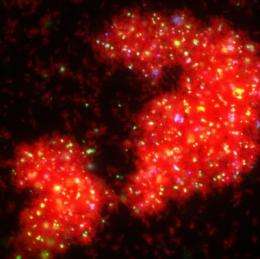
(PhysOrg.com) -- The deaths of nearby relatives has a curious effect on the bacterium Caulobacter crescentus -- surviving cells lose their stickiness.
Indiana University Bloomington biologists report in an upcoming issue of Molecular Microbiology that exposure to the extracellular DNA (eDNA) released by dying neighbors stops the sticky holdfasts of living Caulobacter from adhering to surfaces, preventing cells from joining bacterial biofilms. Less sticky cells are more likely to escape established colonies, out to where conditions may be better.
Harmless Caulobacter live in nutrient-poor, aqueous environments like lakes, rivers, and even tap water. Like many other bacteria, Caulobacter form biofilms, aggregations of cells held in place by a sticky matrix produced by the bacteria themselves. Bacteria in biofilms are more resistant to predators and to antibiotics, and are less affected by environmental stress. However, if environmental conditions worsen, it becomes advantageous for the bacteria to get away.
That presents a special problem for Caulobacter. In 2006, microbiologist Yves Brun, the project's principal investigator, and Brown University colleagues learned that the sugar-protein glue the bacteria use to attach themselves to the biofilm matrix is the strongest adhesive known in nature. Once a cell joins the collective, it is stuck there.
Caulobacter solves the problem of getting stuck in poor conditions by producing a clone of itself through cell replication. The mother cell heroically stays behind. But the daughter cell, called the "swarmer," starts out life with a flagellum, allowing it to move through water. The daughter has the option of swimming away from its mother and its relatives in the biofilm, or of settling in the same biofilm where it was born.
"It appears that a product of cell death can help these swarmer cells sense their environment and determine if this is a good place to settle," said IU Bloomington postdoctoral fellow Cécile Berne, the paper's lead author.
As is often the case in science, the discovery was a result of serendipity.
"We initially noticed that by mixing two crowded cultures of the bacterium, we would get less biofilm formation," Berne said. "This got us thinking about the fact that throughout the living world, high population density stimulates dispersal. We set out to test whether bacteria were producing something that allowed them to switch between these two very different states of bacterial life, staying put in a biofilm or dispersing to colonize new surfaces. We found that eDNA released by dead cells as they lyse, or blow up, was binding directly to the holdfast of the newborn swarmer cells and making it less sticky. It's kind of like having a sticky substance on your fingertip and covering it with dust -- once the holdfast is coated with eDNA, it can't stick to a new surface, so the cell will be more likely to swim away."
The researchers don't know for certain whether the escape behavior of swarmer cells is a result of happenstance -- a happy accident that the holdfasts and eDNA interact -- or whether the interaction represents an active process that has been modified and fine-tuned through natural selection. Irrespective, more cells will die in worse environments, producing more eDNA, and stimulating more dispersal of the swarmer cells.
"Responding to relatives' eDNA makes a lot of sense for a bacterium because the DNA will be almost identical," Brun said. "What may be good for one bacterial species may be bad for another and vice versa. So you would not want to respond to DNA from another species, which has a different sequence than your and your siblings' DNA. What better way to sense whether the environment is bad for your species or your type than to be sensitive to the deaths of your close relatives? Generally, biofilms are good for bacteria. But when your siblings are starting to die around you, you know it's time to find a better place to live."
But a major mystery remains, says postdoctoral fellow David Kysela, a co-author of the paper.
"How does Caulobacter discriminate between its siblings' DNA and other DNA in the environment?" Kysela asked. "Clearly there's something special about Caulobacter DNA, since swimming cells ignore DNA from unrelated species. Everything we've seen so far indicates that something about the particular sequence of Caulobacter DNA is responsible, but we're still digging. A lot of bacterial species use a similar holdfast to stick to surfaces and form biofilms. It will be interesting to see if these species also respond to their own DNA."
More information: "A bacterial extracellular DNA inhibits settling of motile progeny cells within a biofilm," by Cécile Berne, David T. Kysela, and Yves V. Brun, Molecular Microbiology (online; iss. TBD)
Provided by Indiana University


