Genetic Code 2.0: Novel artificial proteins for industry and science
June 29, 2010
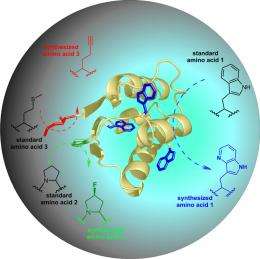
For the first time, three amino acids of one protein could be changed at the same time in a single experiment. Image: Nediljko Budisa / MPI of Biochemistr
(PhysOrg.com) -- The creation of synthetic proteins plays an important role for economy and science. By the integration of artificial amino acids in proteins (genetic code engineering), their already existing qualities can be systematically improved, allowing new biological features to arise.
Now, scientists at the Max Planck Institute of Biochemistry (MPIB) in Martinsried near Munich, Germany, have succeeded in taking another important step in this research area: For the first time, they were able to integrate three different synthetic amino acids into one protein in a single experiment. (Angewandte Chemie, June 24, 2010).
Proteins are the main actors in our body: They transport substances, convey messages or carry out vital processes in their role as molecular machines. The "helmsmen of the cell" are composed of amino acids, whose sequence is already defined by the heritable information in every living being. The translation of this information during the production of proteins (protein synthesis) is determined by the genetic code. 20 amino acids form the standard set of which proteins are built. In natural conditions, however, several hundred amino acids can be found and, of course, new amino acids can also be produced in the laboratory.
With regard to their properties, they differ from the 20 standard amino acids, because of which, by their integration in proteins, specific structural and biological characteristics of proteins can be systematically changed. So far, only one type of synthetic amino acid could be inserted into a protein during a single experiment in a residue-specific manner; thus, only one property of a protein could be modified at once.
Nediljko Budisa, head of the research group Molecular Biotechnology at the MPIB, has now made important methodical progress in the area of genetic code engineering. The scientists were able to substitute three different natural amino acids by synthetic ones at the same time in a single experiment. The biochemist is pleased: "The research area of genetic code engineering and code extension has with this result reached a new development phase."
Budisa’s method could be of great importance, particularly for the industry and economy, because the production of artificial proteins by genetic code engineering in his view demonstrates a solid basis for the development of new technologies. "During integration, synthetic amino acids confer their characteristics to proteins. Thus, the development will allow the synthesis of totally new classes of products, whose chemical synthesis has not been possible so far by conventional protein engineering using only the 20 standard amino acids", explains Budisa regarding to future prospects. "Thanks to our method, in the future it will be possible to tailor industrial relevant proteins with novel properties: for example proteins containing medical components."
More information: S. Lepthien, L. Merkel, N. Budisa, In vivo double and triple labeling of proteins using synthetic amino acids. Angewandte Chemie, June 24, 2010. DOI:10.1002/anie.201000439
-
Research breakthrough for the protein factories of tomorrow
Sep 22, 2006 |
not rated yet |
0
-
'Fishy' clue helps establish how proteins evolve
Jan 27, 2009 |
not rated yet |
0
-
Expanded blueprint: Genetic incorporation of two different noncanonic amino acids into one protein
Apr 15, 2010 |
not rated yet |
0
-
The pre-history of life: Elegantly simple organizing principles seen in ribosomes
Apr 12, 2010 |
not rated yet |
0
-
Core tenets of the 'histone code' are universal
Sep 06, 2007 |
not rated yet |
0
-
Engineers build first sub-10-nm carbon nanotube transistor
Feb 01, 2012 |
4.9 / 5 (31) |
30
-
Something old, something new: Evolution and the structural divergence of duplicate genes
Jan 31, 2012 |
4.6 / 5 (7) |
1
-
The hidden nanoworld of ice crystals: Revealing the dynamic behavior of quasi-liquid layers
Jan 30, 2012 |
5 / 5 (3) |
1
-
Stock market network reveals investor clustering
Jan 27, 2012 |
3.9 / 5 (23) |
8
-
Of microchemistry and molecules: Electronic microfluidic device synthesizes biocompatible probes
Jan 26, 2012 |
5 / 5 (1) |
0
-
Stoichiometry
22 hours ago
-
Boiling and melting point of impure substances
23 hours ago
-
Safe nitrogen compound to decompose a 500 deg C in a furnace?
Feb 09, 2012
-
[ask]electron inside drinking water
Feb 08, 2012
-
How to avoid formation of Lithium Chromate ???
Feb 08, 2012
-
how to choose a reduced or oxidated form in a redox
Feb 08, 2012
- More from Physics Forums - Chemistry
More news stories
Fool's gold may prove an unlikely alternative to overexploited catalytic materials
Catalytic materials, which lower the energy barriers for chemical reactions, are used in everything from the commercial production of chemicals to catalytic converters in car engines. However, with current catalytic materials ...
14 hours ago |
4.4 / 5 (8) |
5
|
Unpicking HIV’s invisibility cloak
Drug researchers hunting for alternative ways to treat human immunodeficiency virus (HIV) infections may soon have a novel targetits camouflage coat. HIV hides inside a cloak unusually rich in a sugar ...
14 hours ago |
5 / 5 (5) |
0
No entry without protein recycling: Researchers discover new coherence in enzyme transport
The group of Prof. Dr. Ralf Erdmann at the Ruhr-Universität Bochum, Germany, discovered a connection of peroxisomal protein import and receptor export. In the Journal of Biological Chemistry, they disclo ...
14 hours ago |
not rated yet |
0
Hydrogen from acidic water: Researchers develop potential low cost alternative to platinum for splitting water
A technique for creating a new molecule that structurally and chemically replicates the active part of the widely used industrial catalyst molybdenite has been developed by researchers with the Lawrence Berkeley ...
Feb 09, 2012 |
4.8 / 5 (14) |
14
|
Under the microscope #7
In this video Dr Ingrid Graz shows us a thin layer of gold on top of rubber. Cracks in the gold allow it to stretch and we can use this for stretchable electronics.
16 hours ago |
not rated yet |
0
Google users warned of threat to smartphone wallets
Users of Google smartphone wallets were being warned on Friday that there is a way to crack pass codes intended to thwart thieves from going on illicit shopping sprees.
Anonymous knocks CIA website offline (Update)
The website of the Central Intelligence Agency was inaccessible on Friday after the hacker group Anonymous claimed to have knocked it offline.
New error-correcting codes guarantee the fastest possible rate of data transmission
Error-correcting codes are one of the triumphs of the digital age. Theyre a way of encoding information so that it can be transmitted across a communication channel such as an optical fiber o ...
Humans may have helped the decline of African rainforests 3000 years ago
(PhysOrg.com) -- Large areas of rainforests in Central Africa mysteriously disappeared over three thousand years ago, to be replaced by savannas. The prevailing theory has been that the cause was a change ...
Complex wiring of the nervous system may rely on a just a handful of genes and proteins
Researchers at the Salk Institute have discovered a startling feature of early brain development that helps to explain how complex neuron wiring patterns are programmed using just a handful of critical genes. ...
New power source discovered
(PhysOrg.com) -- Researchers at the Massachusetts Institute of Technology (MIT) and RMIT University have made a breakthrough in energy storage and power generation.
Jun 30, 2010
Rank: 1 / 5 (1)
I just hope that they are equally diligent in checking for and creating safety firewalls to prevent harm to other biological systems.