Non-contact sensors can detect a heartbeat up to a meter away
June 29, 2010
Research team's non-contact sensors set to transform telecare heart monitoring

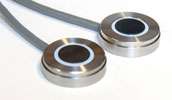
(PhysOrg.com) -- Sensors that can detect a heartbeat up to a meter away are now a reality thanks to a team of scientists at the University of Sussex.

The Electric Potential (EPS) are the first electrical sensors that can detect precisely the of the heart without direct resistive contact with the body. The new sensors will make monitoring a patient's heartbeat, whilst they relax in their hospital bed or in their home, easier and less invasive than ever before.

With commercial interest building quickly, the team of Sussex researchers believes the EPS will offer medical and home health professionals the opportunity to develop patient-friendly, self administered systems to monitor their vital signs with the minimum impact on their mobility.

The sensitivity of these sensors means they can also be used to detect muscle signals and eye movements and, in future, will be developed to detect brain and nerve-fibre signals. The EPS research group team, based in the University of Sussex's School of Engineering and Design, is lead by Dr Robert Prance, Professor of Sensor Technology.

Dr Prance said: "These sensors are the result of a sustained research programme at Sussex. For the first time we are able to detect electrical signals from the body passively, without making physical contact, and in familiar environments such as the home or hospital."

Thanks to a South East Health Technology Alliance (SEHTA) grant, the team is currently working with in-home smart technology company PassivSystems to evaluate whether the sensors could be used to help elderly and frail people live independently in their homes by monitoring occupancy in a room and even whether someone's heartbeat has changed.

SEHTA Chief Executive Officer David Parry explained: "Remote telecare can play a crucial role in helping people to remain in their homes rather than going into sheltered accommodation, but the current Passive InfraRed sensors require movement to detect a person's presence and cannot easily differentiate between multiple people in a room. The sensors developed by the University of Sussex have incredible potential."

More information: For more information go to: http://www.sinc.co … sensors.html

Provided by University of Sussex (news : web)

3.9 /5 (11 votes)  

Filter


Move the slider to adjust rank threshold, so that you can hide some of the comments.


Display comments: newest first

Bob_Kob
Jun 30, 2010

Rank: not rated yet
Closer to the modern warfare2 'heartbeat detector'!
kevinrtrs
Jun 30, 2010

Rank: 1 / 5 (1)
Strange that all the benefits are discussed but nothing is said about the technology involved, specifically what makes it so good.
Rank 3.9 /5 (11 votes)
Related Stories
Relevant PhysicsForums posts
  • Calling function with no input argument
    created1 hour ago
  • Force free body diagram problem on gym equipment
    created2 hours ago
  • Empirical data regarding shower heads and water
    created10 hours ago
  • feed hold button on CNC lathe
    createdFeb 09, 2012
  • RFAC in Fortran
    createdFeb 09, 2012
  • dynamics 2/32
    createdFeb 08, 2012
  • More from Physics Forums - General Engineering

More news stories

Zuckerberg's focus drives Facebook's ascent

When Mark Zuckerberg showed up to rent Judy Fusco's Los Altos, Calif., house in the fall of 2004, soon after he'd arrived in Silicon Valley, the landlord was immediately struck by his confidence.

Technology / Internet

created 36 minutes ago | popularity 1 / 5 (1) | comments 0

Netflix light on flicks as viewers soak up TV shows

Like most fresh faces that arrive in Hollywood, Netflix wanted to be a movie star. But now it's learning what many in Tinseltown have known for decades: Movies are sexy, but the real money is in television.

Technology / Business

created 1 hour ago | popularity not rated yet | comments 1

New error-correcting codes guarantee the fastest possible rate of data transmission

Error-correcting codes are one of the triumphs of the digital age. They’re a way of encoding information so that it can be transmitted across a communication channel — such as an optical fiber o ...

Technology / Computer Sciences

created 4 hours ago | popularity 5 / 5 (3) | comments 2 | with audio podcast

Small modular reactor design could be a 'SUPERSTAR'

(PhysOrg.com) -- Though most of today's nuclear reactors are cooled by water, we've long known that there are alternatives; in fact, the world's first nuclear-powered electricity in 1951 came from a reactor ...

Technology / Energy & Green Tech

created 4 hours ago | popularity 5 / 5 (6) | comments 10 | with audio podcast

Sony's Hirai refuses to abandon dire TV business

Struggling Japanese entertainment giant Sony will not abandon its cash-bleeding television business, its incoming CEO says, but he acknowledges tough decisions lie ahead including over redundancies.

Technology / Business

created 2 hours ago | popularity not rated yet | comments 0


New understanding of DNA repair could eventually lead to cancer therapy

A research group in the Faculty of Medicine & Dentistry at the University of Alberta is hoping its latest discovery could one day be used to develop new therapies that target certain types of cancers.

Antidepressants and pregnancy: Women must consider the impact of drugs on baby, and of depression on baby, themselves

Upon learning they are pregnant, most women dutifully nix the alcohol, sushi and caffeine. But what about antidepressants?

Both maternal and paternal age linked to autism

Older maternal and paternal age are jointly associated with having a child with autism, according to a recently published study led by researchers at The University of Texas Health Science Center at Houston (UTHealth).

Night, weekend delivery OK for babies with birth defects

Weekday delivery is no better than night or weekend delivery for infants with birth defects, according to a new study presented today at The Pregnancy Meeting, the Society for Maternal-Fetal Medicine's annual conference. ...

Sonic Cradle lands spot in TED exhibition

A Simon Fraser University graduate student project that melds music, meditation and modern technology has landed a rare spot as an exhibit at TEDActive 2012 in Palm Springs, California this month.

From virginity to Viagra

Americans will spend more than $17 billion on Valentine's Day, but far less on programs like sex education for adolescents. The editors of the new book, Sex for Life, From Virginity to Viagra, How Sexuality Changes Throughout ...