World's smallest whale population faces extinction
June 30, 2010
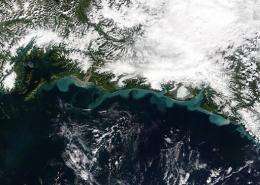
Alaska's southern coast in 2003

Enlarge

This NASA Terra satellite image shows Alaska's southern coast in 2003. The world's smallest known whale population has dwindled to about 30 individuals, only eight of them females, according to a study released Tuesday. The Bering Sea and Gulf of Alaska once teemed with tens of thousands of North Pacific right whales.

The world's smallest known whale population has dwindled to about 30 individuals, only eight of them females, according to a study released Tuesday.

The and once teemed with tens of thousands of North Pacific right whales.

But hunting in the 19th century wiped out most of them, with up to 30,000 slaughtered in the 1840s alone, according to the International Union for the of Nature (IUCN).

Poaching by the Soviet Union during the 1960s claimed several hundred more, making Eubalaena japonica probably the most endangered species of whale on Earth.

"Its precarious status today ... is a direct consequence of uncontrolled and illegal whaling, and highlights the past failure of international management to prevent such abuse," said the study, published in the British Royal Society's Biology Letters.

Numbering well under 50, the eastern North Pacific right whale -- which can reach up to 18 metres (60 feet) in length -- falls below the IUCN's threshold of likely viability as a species.

The small number of females is especially worrisome, said the study, led by Paul Wade of the Alaska Fisheries Science Center.

A genetically distinct population of right whales in the western Northern Pacific is in slightly better shape with several hundred individuals, but is nonetheless listed as "critically endangered" on the IUCN's Red List, the most scientifically respected index of threat level.

across the northern Pacific are also especially vulnerable to ship collisions because the animals cross a major trans-Pacific as they move to and from feeding and breeding grounds.

"The probability of ship-strike mortalities may increase with the likely future opening of an ice-free ," the researchers note.

To carry out their grim census, Wade and colleagues used two standard method for measuring whale populations.

One was based on photos taken during visual sightings, from airplanes during the period 1998 to 2001 and again in 2008, and from ships in 2005 and 2007.

The other involved collecting biopsy tissue samples to gather genetic material, with a total of 43 taken over a 10-year period.

The two independent methods yielded nearly identical results -- 31 individuals through photography, 28 through genotyping -- thus lending more weight to the results.

(c) 2010 AFP

4.2 /5 (6 votes)  

Rank 4.2 /5 (6 votes)
Related Stories
Relevant PhysicsForums posts
  • Protease cleavage
    created5 hours ago
  • Pertubance in a model
    created12 hours ago
  • Cancer drugs and Alzheimer's, Oh my!
    created20 hours ago
  • Squishing cells
    created21 hours ago
  • Any books/articles for evolutionary stable strategy models in humans?
    createdFeb 09, 2012
  • Science behind the bore feeling?
    createdFeb 09, 2012
  • More from Physics Forums - Biology

More news stories

The power of estrogen -- male snakes attract other males

A new study has shown that boosting the estrogen levels of male garter snakes causes them to secrete the same pheromones that females use to attract suitors, and turned the males into just about the sexiest ...

Biology / Plants & Animals

created 10 hours ago | popularity 4.8 / 5 (5) | comments 0 | with audio podcast

Grass to gas: Researchers' genome map speeds biofuel development

Researchers at the University of Georgia have taken a major step in the ongoing effort to find sources of cleaner, renewable energy by mapping the genomes of two originator cells of Miscanthus x giganteus, a large perenn ...

Biology / Biotechnology

created 7 hours ago | popularity 3.7 / 5 (3) | comments 0 | with audio podcast

Experts reveal how plants don't get sunburn

(PhysOrg.com) -- Experts at the University of Glasgow have discovered how plants survive the harmful rays of the sun.

Biology / Cell & Microbiology

created 10 hours ago | popularity 5 / 5 (2) | comments 0 | with audio podcast

Protein libraries in a snap

(PhysOrg.com) -- A Rice University undergraduate will depart with not only a degree but also a possible patent for his invention of an efficient way to create protein libraries, an important component of biomolecular ...

Biology / Cell & Microbiology

created 13 hours ago | popularity 5 / 5 (2) | comments 0 | with audio podcast

Miami battling invasion of giant African snails

No one knows how they got there. But an invasion of African giant snails has southern Florida in a panic over potential crop damage, disease and general yuckiness surrounding the slimy gastropods.

Biology / Ecology

created 14 hours ago | popularity 4 / 5 (1) | comments 4


Google users warned of threat to smartphone wallets

Users of Google smartphone wallets were being warned on Friday that there is a way to crack pass codes intended to thwart thieves from going on illicit shopping sprees.

Anonymous knocks CIA website offline (Update)

The website of the Central Intelligence Agency was inaccessible on Friday after the hacker group Anonymous claimed to have knocked it offline.

Complex wiring of the nervous system may rely on a just a handful of genes and proteins

Researchers at the Salk Institute have discovered a startling feature of early brain development that helps to explain how complex neuron wiring patterns are programmed using just a handful of critical genes. ...

NASA sees wide-eyed cyclone Jasmine

Cyclone Jasmine's eye has opened wider on NASA satellite imagery, as it moves through the Southern Pacific Ocean.

Putting the squeeze on planets outside our solar system

(PhysOrg.com) -- Using high-powered lasers, scientists at Lawrence Livermore National Laboratory and collaborators discovered that molten magnesium silicate undergoes a phase change in the liquid state, abruptly ...

NASA sees Giovanna reach cyclone strength, threaten Madagascar

Tropical Storm 12S built up steam and became a cyclone on February 10, 2012 as NASA's Terra satellite passed overhead. Residents of east-central Madagascar should prepare for this cyclone to make landfall ...