Warmer ecosystems could absorb less atmospheric carbon dioxide
June 30, 2010
Warmer ecosystems could absorb less atmospheric carbon dioxide

Enlarge

(PhysOrg.com) -- Research by scientists at Queen Mary, University of London has found that a predicted rise in global temperature of 4°C by 2100 could lead to a 13% reduction in ecosystems' ability to absorb carbon dioxide (CO2) from the atmosphere.

Writing in Philosophical Transactions of the Royal Society B, the scientists describe a new model to predict how the capacity of ecosystems would respond to future global warming. They tested their predictions against data collected from experimental ponds which were warmed to simulate global warming, revealing a 13% reduction in the amount of CO2 absorbed by the warmed ecosystems.

Lead author of the Philosophical Transactions paper, Gabriel Yvon-Durocher from Queen Mary's School of Biological and Chemical Sciences said: "The beauty of this model is in its simplicity. We made our prediction based on just two parameters - the 'activation energies' for photosynthesis and respiration, and the increase in temperature which exactly predicted the changes observed in our experiment."

He explains: "Photosynthesis by plants absorbs CO2 while respiration by animals returns CO2 to the atmosphere. Respiration has a higher 'activation energy' than photosynthesis meaning that it increases more rapidly with increasing temperature. So if climate change raises environmental temperatures, the balance between respiration and in the ecosystem will change, favouring more and less CO2 absorption."

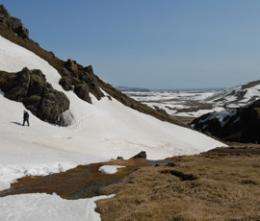
The work is complemented by another paper published this month by Dr Guy Woodward and other Queen Mary colleagues in the journal Global Change Biology. This research compared animals living in 15 similar Icelandic streams, a rare long-term 'natural experiment' in which geothermal activity heats some streams up to 45°C. The unique situation meant researchers could study how temperature affects Arctic ecosystems, where is predicted to cause a rise of around 7.5°C within the next century.

Dr Woodward says: "We found dramatic changes in the type and number of species in cold streams compared with the warmer ones. It was notable that fish and other larger predatory animals were absent from the coldest streams. We saw longer food-chains, with predators becoming bigger and more abundant as temperatures increased from 5°C to 25°C. We also have more recent (as yet unpublished) data collected from the Icelandic streams by colleagues at the Macaulay Institute that show similar patterns to those seen in the experimental ponds: namely the warmer streams emitted far more CO2 than the cooler streams and acted as sources of carbon, rather than sinks."

More information:
-- Gabriel Yvon-Durocher, J Iwan Jones, Mark Trimmer, Guy Woodward and Jose M Montoya, "Warming alters the metabolic balance of ecosystems" is published in the journal Philosophical Transactions of the Royal Society B DOI:10.1098/rstb.2010.0055
-- Guy Woodward, John B. Dybkjær, Jón S Ólafsson, Gísli M Gíslason, Elísabet R Hannesdóttir, Nikolai Friberg, "Sentinel systems on the razor's edge: effects of warming on Arctic geothermal stream ecosystems" is published in the journal Global Change Biology DOI: 10.1111/j.1365-2486.2009.02052.x

Provided by Queen Mary, University of London (news : web)

2.6 /5 (5 votes)  

Filter


Move the slider to adjust rank threshold, so that you can hide some of the comments.


Display comments: newest first

TegiriNenashi
Jun 30, 2010

Rank: not rated yet
Yet another article from the Annals of Improbable Research. Metabolism of living things increasing with temperature is common knowledge. Warmer climates host incredible abundance and diversity of life forms. Significant C02 absorbing ecosystems such as Amazon rain forest are located in warmer climates. One can care less about alleged O2/CO2 consumption/production relative rate changes influenced by temperature, as long as absolute values grow and, more importantly, the number of living things multiplying.
GSwift7
Jun 30, 2010

Rank: 5 / 5 (2)
And how much CO2 is exchanged through the ice of a frozen lake when sunlight can't reach the algea for photosynthesis to occur? I think they need to rethink the methodology of the experiment. Once again, using a unique location that isn't typical of real world conditions will yield results different than those seen elsewhere. Claiming that warmer temperatures will lead to less carbon consumption is patently absurd. The lowest possible level of carbon consumption HAS to be when the water is frozen, so cooler climate is worse than warmer. Even a pro-AGW nutball can't argue with that one.
GSwift7
Jun 30, 2010

Rank: 4 / 5 (1)
Oh, and the same thing goes for carbon consumption on land. Plants covered in snow and ice can't be doing much photosynthisis, not to mention the fact that many trees shed their leaves when it gets cold. If it stays warm all year long, then there's going to be more photosynthis, especially if temperate climate broadleaf trees move north to replace cold climate connifers.
Rank 2.6 /5 (5 votes)
Related Stories
Relevant PhysicsForums posts
  • Discrepancy between oxygen and carbon-dioxide levels
    created23 hours ago
  • where gems are found in the world
    createdFeb 09, 2012
  • Wind Waves in Reservoir ~ Wind run-up and Wind set-up
    createdFeb 08, 2012
  • Balance of oxygen in the atmosphere
    createdFeb 01, 2012
  • The case for a methanol-based economy
    createdJan 30, 2012
  • Weather in a rotating cylinder
    createdJan 25, 2012
  • More from Physics Forums - Earth

More news stories

Humans may have helped the decline of African rainforests 3000 years ago

(PhysOrg.com) -- Large areas of rainforests in Central Africa mysteriously disappeared over three thousand years ago, to be replaced by savannas. The prevailing theory has been that the cause was a change ...

Space & Earth / Environment

created 16 hours ago | popularity 4.2 / 5 (9) | comments 10 | with audio podcast report

NASA sees wide-eyed cyclone Jasmine

Cyclone Jasmine's eye has opened wider on NASA satellite imagery, as it moves through the Southern Pacific Ocean.

Space & Earth / Earth Sciences

created 4 hours ago | popularity 2 / 5 (1) | comments 1

Could Venus be shifting gear?

(PhysOrg.com) -- ESA’s Venus Express spacecraft has discovered that our cloud-covered neighbour spins a little slower than previously measured. Peering through the dense atmosphere in the infrared, the ...

Space & Earth / Space Exploration

created 12 hours ago | popularity 5 / 5 (7) | comments 7 | with audio podcast

NASA sees Giovanna reach cyclone strength, threaten Madagascar

Tropical Storm 12S built up steam and became a cyclone on February 10, 2012 as NASA's Terra satellite passed overhead. Residents of east-central Madagascar should prepare for this cyclone to make landfall ...

Space & Earth / Earth Sciences

created 4 hours ago | popularity not rated yet | comments 0

Mars Science Laboratory computer issue resolved

(PhysOrg.com) -- Engineers have found the root cause of a computer reset that occurred two months ago on NASA's Mars Science Laboratory and have determined how to correct it.

Space & Earth / Space Exploration

created 13 hours ago | popularity 4.7 / 5 (6) | comments 3 | with audio podcast


Google users warned of threat to smartphone wallets

Users of Google smartphone wallets were being warned on Friday that there is a way to crack pass codes intended to thwart thieves from going on illicit shopping sprees.

Anonymous knocks CIA website offline (Update)

The website of the Central Intelligence Agency was inaccessible on Friday after the hacker group Anonymous claimed to have knocked it offline.

Complex wiring of the nervous system may rely on a just a handful of genes and proteins

Researchers at the Salk Institute have discovered a startling feature of early brain development that helps to explain how complex neuron wiring patterns are programmed using just a handful of critical genes. ...

New error-correcting codes guarantee the fastest possible rate of data transmission

Error-correcting codes are one of the triumphs of the digital age. They’re a way of encoding information so that it can be transmitted across a communication channel — such as an optical fiber o ...

The power of estrogen -- male snakes attract other males

A new study has shown that boosting the estrogen levels of male garter snakes causes them to secrete the same pheromones that females use to attract suitors, and turned the males into just about the sexiest ...

Putting the squeeze on planets outside our solar system

(PhysOrg.com) -- Using high-powered lasers, scientists at Lawrence Livermore National Laboratory and collaborators discovered that molten magnesium silicate undergoes a phase change in the liquid state, abruptly ...