New technique improves efficiency of biofuel production
June 30, 2010
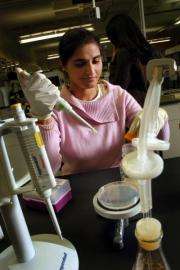
Dr. Ratna Sharma-Shivappa and her colleagues at North Carolina State University have developed a more efficient technique for producing biofuels from woody plants that significantly reduces the waste that results from conventional biofuel production techniques. "Our eventual goal is to use this technique for any type of feedstock, to produce any biofuel or biochemical that can use these sugars," Sharma-Shivappa says. Credit: Roger W. Winstead, North Carolina State University
Researchers at North Carolina State University have developed a more efficient technique for producing biofuels from woody plants that significantly reduces the waste that results from conventional biofuel production techniques. The technique is a significant step toward creating a commercially viable new source of biofuels.
"This technique makes the process more efficient and less expensive," says Dr. Ratna Sharma-Shivappa, associate professor of biological and agricultural engineering at NC State and co-author of the research. "The technique could open the door to making lignin-rich plant matter a commercially viable feedstock for biofuels, curtailing biofuel's reliance on staple food crops."
Traditionally, to make ethanol, butanol or other biofuels, producers have used corn, beets or other plant matter that is high in starches or simple sugars. However, since those crops are also significant staple foods, biofuels are competing with people for those crops.
However, other forms of biomass - such as switchgrass or inedible corn stalks - can also be used to make biofuels. But these other crops pose their own problem: their energy potential is locked away inside the plant's lignin - the woody, protective material that provides each plant's structural support. Breaking down that lignin to reach the plant's component carbohydrates is an essential first step toward making biofuels.
At present, researchers exploring how to create biofuels from this so-called "woody" material treat the plant matter with harsh chemicals that break it down into a carbohydrate-rich substance and a liquid waste stream. These carbohydrates are then exposed to enzymes that turn the carbohydrates into sugars that can be fermented to make ethanol or butanol.
This technique often results in a significant portion of the plant's carbohydrates being siphoned off with the liquid waste stream. Researchers must either incorporate additional processes to retrieve those carbohydrates, or lose them altogether.
But now researchers from NC State have developed a new way to free the carbohydrates from the lignin. By exposing the plant matter to gaseous ozone, with very little moisture, they are able to produce a carbohydrate-rich solid with no solid or liquid waste.
"This is more efficient because it degrades the lignin very effectively and there is little or no loss of the plant's carbohydrates," Sharma-Shivappa says. "The solid can then go directly to the enzymes to produce the sugars necessary for biofuel production."
Sharma notes that the process itself is more expensive than using a bath of harsh chemicals to free the carbohydrates, but is ultimately more cost-effective because it makes more efficient use of the plant matter.
The researchers have recently received a grant from the Center for Bioenergy Research and Development to fine-tune the process for use with switchgrass and miscanthus grass. "Our eventual goal is to use this technique for any type of feedstock, to produce any biofuel or biochemical that can use these sugars," Sharma-Shivappa says.
More information: The research, "Effect of ozonolysis on bioconversion of miscanthus to bioethanol," was presented June 23 at the 2010 Annual International Meeting of the American Society for Agricultural and Biological Engineers in Pittsburgh, PA
-
Fermenting fodder into fuel
Jan 28, 2010 |
not rated yet |
0
-
Process can cut the cost of making cellulosic biofuels
Jan 22, 2009 |
not rated yet |
0
-
Sweet success for sustainable biofuel research
Jan 25, 2010 |
not rated yet |
0
-
Sustainable biofuels from forests, grasslands and rangelands
Apr 28, 2010 |
not rated yet |
0
-
More economical process for making ethanol from nonfood sources
Mar 25, 2010 |
not rated yet |
0
-
Engineers build first sub-10-nm carbon nanotube transistor
Feb 01, 2012 |
4.9 / 5 (31) |
30
-
Something old, something new: Evolution and the structural divergence of duplicate genes
Jan 31, 2012 |
4.6 / 5 (7) |
1
-
The hidden nanoworld of ice crystals: Revealing the dynamic behavior of quasi-liquid layers
Jan 30, 2012 |
5 / 5 (3) |
1
-
Stock market network reveals investor clustering
Jan 27, 2012 |
3.9 / 5 (23) |
8
-
Of microchemistry and molecules: Electronic microfluidic device synthesizes biocompatible probes
Jan 26, 2012 |
5 / 5 (1) |
0
-
Mitosis
7 hours ago
-
Stem cell question.
9 hours ago
-
Protease cleavage
15 hours ago
-
Pertubance in a model
22 hours ago
-
Cancer drugs and Alzheimer's, Oh my!
Feb 09, 2012
-
Squishing cells
Feb 09, 2012
- More from Physics Forums - Biology
More news stories
The power of estrogen -- male snakes attract other males
A new study has shown that boosting the estrogen levels of male garter snakes causes them to secrete the same pheromones that females use to attract suitors, and turned the males into just about the sexiest ...
19 hours ago |
4.8 / 5 (6) |
2
|
Miami battling invasion of giant African snails
No one knows how they got there. But an invasion of African giant snails has southern Florida in a panic over potential crop damage, disease and general yuckiness surrounding the slimy gastropods.
23 hours ago |
4 / 5 (1) |
4
Grass to gas: Researchers' genome map speeds biofuel development
Researchers at the University of Georgia have taken a major step in the ongoing effort to find sources of cleaner, renewable energy by mapping the genomes of two originator cells of Miscanthus x giganteus, a large perenn ...
16 hours ago |
3.8 / 5 (5) |
0
|
Experts reveal how plants don't get sunburn
(PhysOrg.com) -- Experts at the University of Glasgow have discovered how plants survive the harmful rays of the sun.
19 hours ago |
4.8 / 5 (5) |
0
|
Protein libraries in a snap
(PhysOrg.com) -- A Rice University undergraduate will depart with not only a degree but also a possible patent for his invention of an efficient way to create protein libraries, an important component of biomolecular ...
23 hours ago |
4.8 / 5 (4) |
1
|
Anonymous knocks CIA website offline (Update)
The website of the Central Intelligence Agency was inaccessible on Friday after the hacker group Anonymous claimed to have knocked it offline.
Humans may have helped the decline of African rainforests 3000 years ago
(PhysOrg.com) -- Large areas of rainforests in Central Africa mysteriously disappeared over three thousand years ago, to be replaced by savannas. The prevailing theory has been that the cause was a change ...
New error-correcting codes guarantee the fastest possible rate of data transmission
Error-correcting codes are one of the triumphs of the digital age. Theyre a way of encoding information so that it can be transmitted across a communication channel such as an optical fiber o ...
Small modular reactor design could be a 'SUPERSTAR'
(PhysOrg.com) -- Though most of today's nuclear reactors are cooled by water, we've long known that there are alternatives; in fact, the world's first nuclear-powered electricity in 1951 came from a reactor ...
New power source discovered
(PhysOrg.com) -- Researchers at the Massachusetts Institute of Technology (MIT) and RMIT University have made a breakthrough in energy storage and power generation.
Google users warned of threat to smartphone wallets
Users of Google smartphone wallets were being warned on Friday that there is a way to crack pass codes intended to thwart thieves from going on illicit shopping sprees.
Jun 30, 2010
Rank: 3 / 5 (2)
The energy cost of ozone is really high. So the viability of this would depend on how many molecules of ozone are required to convert each carbon atom from lignin to a simpler enzyme digestible carbohydrate (of course the carbohydrates have more than one carbon, I am simplifying the ratios while preserving the idea).
I am presuming the above ratio would be something like .01 or so, but if its very high then the whole thing breaks down. I do not know the break even point.
Jun 30, 2010
Rank: 5 / 5 (1)
Imagine a 500 MW powerplant running on wood chips. One dump truck can carry 25 tons of wood, which contains approximately 5 kWh/kg. The powerplant needs 1500 MW to run, which means it needs 300 tons of wood per hour, which means it needs to have a dump truck visiting every five minutes.
Or the wood may come in on a train, but still, somewhere out there someone must be logging a dumptruck full of woodchips every five minutes to satisfy the demand for one single powerplant.
Jun 30, 2010
Rank: not rated yet
Take an average consumption of 0.07 litres per kilometer, and about 10,000 km per year, which gives you 700 litres at 8.76 kWh/L, which is 6132 kWh, or 1.2 tons of wood per year. To account for the losses, you have to increase that figure to 2 tons of wood per year.
A city of a few million would easily decimate huge forests much more quickly than they can grow.
Jul 01, 2010
Rank: not rated yet
Jul 01, 2010
Rank: not rated yet
20lbs of dry woody biomass equals a US gal for those in the US. US average is 26mpg US and we do about 10k miles, 35 % more.
If 20lbs/9kgs burned in a cogen 50% eff powerplant it would move my EV sportwagon and Harley size EV trike MC about 180 and 560miles.
While biomass has to be used close to it's source, that's no problem as just makes a lot of small businesses instead of 1 large one. It can easily provide 10% of our energy needs.