Supernovae mystery solved
June 30, 2010
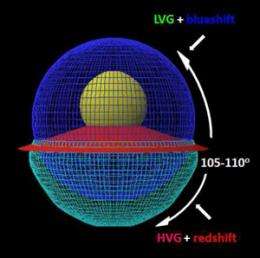
A schematic picture of the structure of a supernova Ia. The ashes of the first phases of the explosion, right after ignition (yellow), are offset with respect to the centre of the ejected material. Depending on where we view the supernova from, it will demonstrate different spectral properties.
(PhysOrg.com) -- Supernovae are gigantic stellar explosions that can be seen across the entire universe. Type Ia supernovae are a relatively homogeneous class of stellar explosions, which researchers use as 'standard candles' to observe the acceleration of the universe. It has long been known, however, that they exhibit considerable variation in their spectra and the origin of the differences has been unknown.
Now researchers, including scientists from the Niels Bohr Institute, have solved the mystery. They have shown that the supernovae are exploding asymmetrically and the difference in their appearance is simply due to the directions from which the supernovae are being observed. The results have just been published in the scientific journal, Nature.
Type Ia supernovae have played a crucial role in cosmology because they can be used to measure the distances across the universe. Even though they are not perfect ‘standard candles' (their luminosity can vary by up to 50 %), they can still be standardized based on the knowledge that the brightest supernovae fade more slowly, while the weaker fade more quickly.
There is now broad consensus that the relative homogeneity of type Ia supernovae is due to their having the same origin, namely a white dwarf in a binary system, where the two stars circle each other. A white dwarf is the type of star that our sun will become in the end of its life when it has run out of hydrogen. The white dwarf absorbs material thrown out from its companion star and when it reaches 1.4 solar masses it explodes as a supernova.
The true story, however, is more complicated. Supernovae that fade in the same way may exhibit quite different behaviour in how fast their expanding material slows down (the so-called velocity gradient). This fact has raised doubts about whether type Ia supernovae could be used as cosmological standard candles.
"With new detailed studies we have now shown that the velocity gradient is closely associated with these supernovae exploding asymmetrically", explains astrophysicist Jesper Sollerman, Dark Cosmology Centre at the Niels Bohr Institute at the University of Copenhagen.
New detailed studies by an international team including Keiichi Maeda, University of Tokyo and Giorgos Leloudas, Jesper Sollerman and Max Stritzinger from the Dark Cosmology Centre have shown that the velocity gradient is closely associated with an asymmetrical character of the explosions of these supernovae.
"What we could see was that the varying natures of the supernovae could be explained by an asymmetric explosion, where the ignition takes place away from the centre. So the different appearances of the supernovae simply depend on the point of view they are observed from", explains Giorgos Leloudas from the Dark Cosmology research group.
While there had already been indications from previous observations of type Ia supernovae that they might explode asymmetrically, this is the first time that it has been convincingly shown by observational studies probing the supernova central regions. The researchers observed the supernovae in the late stages where it is possible to see deep into their interior and like this confirm that they really explode asymmetrically.
"Besides giving us new insight into how these stars explode and solving the problem with their different appearances, the results are also good news for the use of supernovae as standard candles. If we just observe enough supernovae, the differences from the angles will even out", point out the three researchers from the Niels Bohr Institute, Giorgos Leloudas, Jesper Sollerman and Max Stritzinger.
Provided by Niels Bohr Institute
-
Astronomers simulate how white dwarf stars merge and become a supernova
Jan 07, 2010 |
not rated yet |
0
-
The origin of supernovae confirmed
Mar 19, 2009 |
not rated yet |
0
-
Chandra Reveals Origin of Key Cosmic Explosions
Feb 17, 2010 |
not rated yet |
0
-
Super Supernova: White Dwarf Star System Exceeds Mass Limit
Mar 15, 2010 |
not rated yet |
0
-
Ticking stellar time bomb identified (w/ Video)
Nov 17, 2009 |
not rated yet |
0
-
Engineers build first sub-10-nm carbon nanotube transistor
Feb 01, 2012 |
4.9 / 5 (31) |
30
-
Something old, something new: Evolution and the structural divergence of duplicate genes
Jan 31, 2012 |
4.6 / 5 (7) |
1
-
The hidden nanoworld of ice crystals: Revealing the dynamic behavior of quasi-liquid layers
Jan 30, 2012 |
5 / 5 (3) |
1
-
Stock market network reveals investor clustering
Jan 27, 2012 |
3.9 / 5 (23) |
8
-
Of microchemistry and molecules: Electronic microfluidic device synthesizes biocompatible probes
Jan 26, 2012 |
5 / 5 (1) |
0
-
Pith balls problem
1 hour ago
-
Electrostatics
1 hour ago
-
what is phase constant
1 hour ago
-
Basics In electromagnetic wave
1 hour ago
-
How to calculate theoretical initial velocity?
2 hours ago
-
Question about Gravity?
3 hours ago
- More from Physics Forums - General Physics
More news stories
Putting the squeeze on planets outside our solar system
(PhysOrg.com) -- Using high-powered lasers, scientists at Lawrence Livermore National Laboratory and collaborators discovered that molten magnesium silicate undergoes a phase change in the liquid state, abruptly ...
12 hours ago |
4.3 / 5 (7) |
0
|
Hovering not hard if you're top-heavy, researchers find
Top-heavy structures are more likely to maintain their balance while hovering in the air than are those that bear a lower center of gravity, researchers at New York University's Courant Institute of Mathematical Sciences ...
13 hours ago |
5 / 5 (1) |
1
|
SLAC, Stanford team focuses on high-energy electrons to treat cancer
Accelerator physicists at SLAC and cancer specialists from Stanford are working on a new technology that could dramatically reduce the time needed for cancer radiation treatments. The team ran an initial experiment ...
16 hours ago |
5 / 5 (2) |
0
Measurements from high-energy collisions lead to better understanding of why meson particles disappear
For several years, physicists at the Relativistic Heavy Ion Collider (RHIC) at Brookhaven National Laboratory (BNL), USA, have studied an unusual state of matter called the quarkgluon plasma, which they ...
16 hours ago |
4.5 / 5 (4) |
0
Explained: Sigma
It's a question that arises with virtually every major new finding in science or medicine: What makes a result reliable enough to be taken seriously? The answer has to do with statistical significance -- but ...
Feb 09, 2012 |
5 / 5 (16) |
53
Anonymous knocks CIA website offline (Update)
The website of the Central Intelligence Agency was inaccessible on Friday after the hacker group Anonymous claimed to have knocked it offline.
Google users warned of threat to smartphone wallets
Users of Google smartphone wallets were being warned on Friday that there is a way to crack pass codes intended to thwart thieves from going on illicit shopping sprees.
New error-correcting codes guarantee the fastest possible rate of data transmission
Error-correcting codes are one of the triumphs of the digital age. Theyre a way of encoding information so that it can be transmitted across a communication channel such as an optical fiber o ...
Humans may have helped the decline of African rainforests 3000 years ago
(PhysOrg.com) -- Large areas of rainforests in Central Africa mysteriously disappeared over three thousand years ago, to be replaced by savannas. The prevailing theory has been that the cause was a change ...
New power source discovered
(PhysOrg.com) -- Researchers at the Massachusetts Institute of Technology (MIT) and RMIT University have made a breakthrough in energy storage and power generation.
Small modular reactor design could be a 'SUPERSTAR'
(PhysOrg.com) -- Though most of today's nuclear reactors are cooled by water, we've long known that there are alternatives; in fact, the world's first nuclear-powered electricity in 1951 came from a reactor ...
Jun 30, 2010
Rank: 1.7 / 5 (6)
After all, we know, even Earth is not completely spherical - the geoid has a pear shape. It would be nice to correlate this asymmetry with direction of rotation. too.
https://www.e-edu...gram.jpg
Jun 30, 2010
Rank: 5 / 5 (6)
Its very difficult to imagine how the explosion COULD be symmetrical given those simulations. Using the principal of Occam's razor, more complex origins should be excluded without a lot more evidence that more is going on.
The observed asymmetries are huge compared with the rotational bulge of cosmic objects.
Its good to see theory confirmed by observation!
Jun 30, 2010
Rank: not rated yet
This is great news indeed. A deluge of type Ia supernovae will be available through upcoming mega-surveys like LSST. A preprint of the Nature paper has been posted over at arXiv: http://arxiv.org/...88v1.pdf
Jul 01, 2010
Rank: not rated yet
When I saw that gaff I stopped reading the article.
Jul 01, 2010
Rank: 5 / 5 (2)
I have never really trusted the idea of a standard type 1a supernova. These are the questions I have:
Luminosity with respect to rotation of the object. Meaning is it much brighter looking at the pole vs. the equator, especially if the accretion disk is from an object that does not orbit in the plane of rotation?
Luminosity with respect to location of a trigger event. This is a complex question because it isn't even know what a trigger event looks like, but if a trigger event starts at a specific location, how might it affect luminosity as shock waves travel through the star, perhaps like a shaped explosion?
Can a trigger event be initiated by a collision that could create a very lopsided luminosity event?
I have others but these are the major ones.
Jul 07, 2010
Rank: not rated yet
Now what happens is that either hydrogen burning near the surface, or Helium burning near the core causes a pressure spike and...Boom! If I'm right, the explosion will always start at the surface of the core, and the location will be near the axis between the two stars, but lagging a bit. The infall will cause occasional pressure spikes that are good triggers.
* Helium, huh? Sure, the outer layer is mostly from the donor star. There are lots of indications that novas, rather than supernovas are caused by hydrogen burning to helium or WD on neutron stars.