Count Confirms Critical Status Of Endangered Right Whale
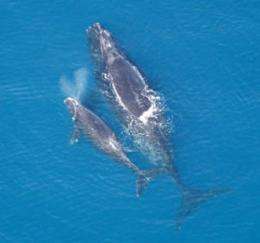
After more than a decade of monitoring the Bering Sea off the coast of Alaska, scientists have released the first count of one of the world's most endangered group of whales.
Approximately thirty right whales inhabit the eastern Pacific Ocean, they reported on Tuesday -- slightly more than previously thought. Whether enough remain to prevent these once-hunted, now-protected animals from dying out remains a mystery.
"It's a tiny number, and we don't know where this population is heading 50 or 100 years from now," said Robert Pitman, a marine ecologist at NOAA's Southwest Fisheries Science Center in La Jolla, Calif., who participated in the research. "Initially, we were surprised to find any left there at all."
Right whales were once common throughout the northern reaches of the Pacific Ocean, from Alaska to Japan. In the nineteenth century, though, commercial whalers decimated the slow-swimming species, which, according to popular legend, was named the "right" whale to kill because its blubbery carcass floated. An estimated tens of thousands of Pacific right whales were killed in the 1840s alone.
Today, four separate populations of right whales exist around the world: a larger group in the Southern hemisphere and three small groups in the North Atlantic and on either side of the Pacific Ocean.
Reliable size estimates of the tiny population remaining on the eastern side of the Pacific have been difficult to come by. Only single sightings were reported until 1996, when scientists spotted a group of four animals feeding in the eastern Bering Sea.
Subsequent scientific expeditions have monitored the area by listening to calls with acoustic devices, taking aerial photographs, and collecting tissues sample to identify individuals.
While right whales are no longer hunted, environmental groups are concerned about other potential threats -- such as shipping vessel collisions, which kill about one whale every year. Federal regulations now protect the Bering Sea from trawling ships and drilling operations.
According to the new study, published in the scientific journal Biology Letters, the photographic and genetic data tend to agree: about thirty whales live in the area.
Dave Mellinger, a whale-acoustics expert at Oregon State University's Hatfield Marine Science Center in Newport, Oregon, agreed that the new estimate is reasonable.
"If there were very many somewhere else, people would have seen them," said Mellinger.
The data includes a few causes for cautious optimism: more females than previously thought -- eight in total -- and a couple of young calves.
But whales live a long time, 70 or 80 years, so the herd could also be the aging survivors of the original population, said Phillip Clapham of the Alaska Fisheries Science Center in Seattle.
"There have been very few observations of right whale calves since in the 1960s," said Clapham. "There's pretty good evidence that the reproductive rate has been lower in the North Pacific than it has for other right whale populations."
Scientists were once more optimistic about the fate of these right whales. In 1949, the world's whaling nations signed an international agreement to protect the remnants of the right whales.
Soviet whalers continued to illegally hunt them in Pacific waters, though, killing an estimated 372 in the 1960 -- in spite of Soviet inspectors onboard.
"We'll never know for sure, but we think Soviet whalers probably got the bulk of the population with those catches," said Clapham.
Commercial whaling of any species is illegal under current international agreements, though this ban hasn't stopped illegal whale meat from surfacing in Japanese sushi bars. Last week, international talks seeking to curb illegal whaling by lifting the ban and imposing quotas fell apart.
Those who count right whales said that this legacy offers a cautionary tale for the whaling community: agreements and quotas aren't enough.
"If the deal to allow whaling to resume in some limited form occurs, it has to be accompanied by truly independent monitoring of everything from the catch to that market," said Clapham. "When the whaling countries tell you 'yes, you can trust us,' the answer is 'no, we can't.'"
Provided by Inside Science News Service


