Indonesia's last glacier will melt within years
July 1, 2010 By ROBIN McDOWELL , Associated Press Writer
Indonesia's last glacier will melt within years (AP)

Enlarge

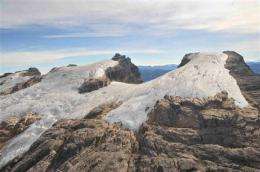
This undated photo released by Papua Project Freeport-McMoRan shows glaciers on Puncak Jaya, mountains in eastern Indonesia. "These glaciers are dying," Lonnie Thompson, one of the world's most accomplished glaciologists, said Wednesday, June 30, 2010, after wrapping up a 13-day trip to Puncak Jaya, rarely visited even by local tribesman. "Before I was thinking they had a few decades, but now I'd say we're looking at years." (AP Photo/Papua Project Freeport McMoRan)

(AP) -- Lonnie Thompson spent years preparing for his expedition to the remote, mist-shrouded mountains of eastern Indonesia, hoping to chronicle the affect of global warming on the last remaining glacier in the Pacific. He's worried he got there too late.

Even as he pitched his tent on top of Puncak Jaya, the ice was melting beneath him.

The 3-mile- (4,884-meter-) high glacier was pounded by rain every afternoon during the team's 13-day trip, something the American scientist has never encountered in three decades of drilling ice cores. He lay awake at night listening to the water gushing beneath him.

By the time they were ready to head home, ice around their sheltered campsite had melted a staggering 12 inches (30 centimeters).

"These glaciers are dying," said Thompson, one of the world's most accomplished glaciologists. "Before I was thinking they had a few decades, but now I'd say we're looking at years."

Thompson has led 57 such expeditions in 16 countries around the planet, from China to Peru.

But for him, the Papuan glaciers, because they lie along the fringe of the world's warmest ocean and could provide clues about regional weather patterns, were an unexplored "missing link."

It is this region that generates disturbances and influences climate from India's monsoons to the Amazon's droughts.

As such, it is one of the only "archives" about the story of the equatorial phenomenon, said Michael Prentice of the Indiana Geological Survey, who has long been interested in the area. It also could point to what lies ahead for billions of people in Asia.

The ice that covered much of Papua thousands of years ago is today just 1 square mile (2 square kilometers) wide and 32 yards (meters) deep. Deep crevasses crisscross the dirty ice.

Glaciers worldwide are in retreat, with major losses already seen across much of Alaska, the Alps, the Andes and numerous other ranges. What makes Puncak Jaya different, aside from its location in the Pacific, is just how little is known about it.

Research permits to work in Papua are difficult to obtain, in part because Indonesia's government is hugely sensitive to the region's long-simmering insurgency. Foreign journalists are barred and humanitarian groups are restricted.

It is also one of the most isolated corners of the sprawling archipelagic nation.

The U.S. mining company Freeport-McMoRan, operating nearby, helped airlift the team to Puncak Jaya's heights by helicopter, along with four tons of equipment - from electromechanical and thermal drill systems, to radars needed to map the underlying rock, said one of its employees, Scott Hanna.

There was a winch and cables, high-altitude camping gear and boxes to preserve ice samples, which will eventually join 70,000 yards (meters) of tropical cores being kept in cold storage in Columbus, Ohio.

There, glaciologists will help analyze the ice layer by layer through centuries past.

Flecks of dust, falling seasonally, enable them to count down the years, much like tree rings. Isotopes of oxygen, in minute air bubbles trapped in the ice, vary with temperature helping researchers understand how ancient weather shifted.

"I just hope we weren't too late," said Thompson, 62, adding that in addition to melting from the top, water likely seeped in to the base of the glacier, leaving them with limited records from a section of time.

"But still, the have horizontal layers all the way through, so I think we were able to salvage at least a little bit of the climate history," said Thompson of Ohio State University, who co-coordinated the expedition with Dwi Susanto of Columbia University.

Among other things, the team expects to find volcanic ash from past eruptions - the 1883 blast of Krakatau and Tambora in 1815 should help serve as timelines - soot from wildfires, pollen, plant debris and maybe even frozen animals.

Satellite images and aerial photos have long shown the glacier in rapid retreat.

The mountain has lost about 80 percent of its ice since 1936 - two-thirds of that since the last scientific expedition in the early 1970s.

Thompson says he thinks temperatures are rising twice as fast in high altitudes as at the earth's surface, which, if true, could have broad implications on people who depend on for water during the dry season, such as in the Himalayas.

Geoffrey Hope, a professor at Australian National University who took part in the 1971 expedition to Puncak Jaya, noted that Papua has the wettest mountain region in the world, so high precipitation levels didn't come as a great surprise.

Still, his own experience was markedly different.

"The roof of our marque tent fell in on many evenings due to the weight of the snow," he recalled, "and all water coming from the glacier would freeze by 8 p.m. each night."

More information: http://blogs.ei.columbia.edu/blog/tag/indonesia-puncak-jaya/
http://www.earth.columbia.edu/videos/watch/247

©2010 The Associated Press. All rights reserved. This material may not be published, broadcast, rewritten or redistributed.

3.4 /5 (9 votes)  

Filter


Move the slider to adjust rank threshold, so that you can hide some of the comments.


Display comments: newest first

TegiriNenashi
Jul 01, 2010

Rank: 2.6 / 5 (5)
Papua is an island, so wouldn't the local climate affected mostly by surrounding ocean? Then, wouldn't it be more reliable just to measure water temperature directly instead of inventing some goofy temperature proxies?
GSwift7
Jul 01, 2010

Rank: 2.6 / 5 (5)
Yes, and besides that, it doesn't make sense that a one degree increase in temperature has had this much of an effect. There must be other factors with a larger influence at work here, such as wind velocity, air density, relative humidity, average daily sun exposure, etc. They're so focused on temperature change that they often ignore all the other factors. All those other factors just don't fit the anti-CO2 agenda though.

Have you noticed that EVERY area where ice is melting supposedly is more sensitive to global warming than any other area of the world? First the arctic, then antarctic, now the tropics too. lol.
GSwift7
Jul 02, 2010

Rank: 1 / 5 (1)
"Thompson says he thinks temperatures are rising twice as fast in high altitudes as at the earth's surface, which, if true, could have broad implications on people who depend on glaciers for water during the dry season, such as in the Himalayas"

But the Himalayan glaciers aren't melting, and neither are the ones in Alaska.
thermodynamics
Jul 03, 2010

Rank: 3.3 / 5 (4)
GSwift7: The glaciers are melting in both Alaska and the Himalayan regions. They are just not melting as fast as the idiots in the IPCC said they were. However, they are melting according to the most recent data:

http://arctic.atm...osphere/

Of course the rates are not monotonic and progressive (being influenced by weather and ocean currents). However, if you look a little deeper you will see there are some glaciers in Alaska that are growing and some in the Himalayas that are growing but most are shrinking. Take a look at the near-real-time-data and see for yourself.
Jigga
Jul 03, 2010

Rank: 5 / 5 (2)
Effective glacier thinning

http://eoedu.bels...er-3.gif
Rank 3.4 /5 (9 votes)
Related Stories
Relevant PhysicsForums posts
  • Discrepancy between oxygen and carbon-dioxide levels
    created23 hours ago
  • where gems are found in the world
    createdFeb 09, 2012
  • Wind Waves in Reservoir ~ Wind run-up and Wind set-up
    createdFeb 08, 2012
  • Balance of oxygen in the atmosphere
    createdFeb 01, 2012
  • The case for a methanol-based economy
    createdJan 30, 2012
  • Weather in a rotating cylinder
    createdJan 25, 2012
  • More from Physics Forums - Earth

More news stories

Humans may have helped the decline of African rainforests 3000 years ago

(PhysOrg.com) -- Large areas of rainforests in Central Africa mysteriously disappeared over three thousand years ago, to be replaced by savannas. The prevailing theory has been that the cause was a change ...

Space & Earth / Environment

created 16 hours ago | popularity 4.2 / 5 (9) | comments 10 | with audio podcast report

NASA sees wide-eyed cyclone Jasmine

Cyclone Jasmine's eye has opened wider on NASA satellite imagery, as it moves through the Southern Pacific Ocean.

Space & Earth / Earth Sciences

created 4 hours ago | popularity 2 / 5 (1) | comments 1

Could Venus be shifting gear?

(PhysOrg.com) -- ESA’s Venus Express spacecraft has discovered that our cloud-covered neighbour spins a little slower than previously measured. Peering through the dense atmosphere in the infrared, the ...

Space & Earth / Space Exploration

created 12 hours ago | popularity 5 / 5 (7) | comments 7 | with audio podcast

NASA sees Giovanna reach cyclone strength, threaten Madagascar

Tropical Storm 12S built up steam and became a cyclone on February 10, 2012 as NASA's Terra satellite passed overhead. Residents of east-central Madagascar should prepare for this cyclone to make landfall ...

Space & Earth / Earth Sciences

created 4 hours ago | popularity not rated yet | comments 0

Mars Science Laboratory computer issue resolved

(PhysOrg.com) -- Engineers have found the root cause of a computer reset that occurred two months ago on NASA's Mars Science Laboratory and have determined how to correct it.

Space & Earth / Space Exploration

created 13 hours ago | popularity 4.7 / 5 (6) | comments 3 | with audio podcast


Google users warned of threat to smartphone wallets

Users of Google smartphone wallets were being warned on Friday that there is a way to crack pass codes intended to thwart thieves from going on illicit shopping sprees.

Anonymous knocks CIA website offline (Update)

The website of the Central Intelligence Agency was inaccessible on Friday after the hacker group Anonymous claimed to have knocked it offline.

Complex wiring of the nervous system may rely on a just a handful of genes and proteins

Researchers at the Salk Institute have discovered a startling feature of early brain development that helps to explain how complex neuron wiring patterns are programmed using just a handful of critical genes. ...

New error-correcting codes guarantee the fastest possible rate of data transmission

Error-correcting codes are one of the triumphs of the digital age. They’re a way of encoding information so that it can be transmitted across a communication channel — such as an optical fiber o ...

The power of estrogen -- male snakes attract other males

A new study has shown that boosting the estrogen levels of male garter snakes causes them to secrete the same pheromones that females use to attract suitors, and turned the males into just about the sexiest ...

Putting the squeeze on planets outside our solar system

(PhysOrg.com) -- Using high-powered lasers, scientists at Lawrence Livermore National Laboratory and collaborators discovered that molten magnesium silicate undergoes a phase change in the liquid state, abruptly ...