Study links low national average IQs with infectious diseases
July 1, 2010 by Lin Edwards
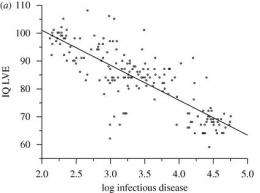
Log disability-adjusted life years owing to infectious disease and average national IQ correlate. Image credit: [i]Proceedings of the Royal Society B[/i], doi:10.1098/rspb.2010.0973
(PhysOrg.com) -- Researchers in the US have noted areas of the world with the lowest average intelligence quotient (IQ) also tend to have the highest rates of infectious diseases, and suggest the energy required to fight off the diseases may hinder brain development in children because both are metabolically costly processes.
The research is partly based on data published in 2001 and then 2002 in the book by Richard Lynn and Tatu Vanhanen, “IQ and the Wealth of Nations.” The book collected data from published literature and tabulated the average IQ of 81 nations. They also estimated the average IQ for a further 104 countries by looking at the IQ of surrounding countries. The 2006 edition of the book expanded the data to include measurements for 113 countries and estimates for another 79.
The results published in the book showed that Hong Kong had the highest average IQ of 107. The lowest IQs were found in the poorer countries, such as those in Africa, and the authors suggested the differences were at least partly due to variations in the wealth of the nations.
The new study, by Christopher Eppig, Corey Fincher, and Randy Thornhill, of the University of New Mexico in Albuqurque, suggests that lower IQs are linked to infectious diseases. They call their hypothesis the “parasite-stress hypothesis,” and propose children who contract “parasites,” which they define as including viruses and bacteria as well as parasites such as intestinal worms, spend more energy fighting off infection and therefore have less in reserve for brain development.
The scientists took the data on IQ collected in Lynn and Vanhanen’s 2006 edition of their book, and compared it to 2004 data on the number of years of healthy life lost due to poor health and infectious diseases from the World Health Organization (WHO). The WHO data included information on 28 infectious diseases, including malaria, tetanus, and hepatitis. They also looked at factors suggested by other researchers to explain the national differences in IQ, such as nutrition, education, gross domestic product, temperature, and climate.
The results of the analysis showed the infectious disease burden more closely correlated with the average IQ than the other variables both across all nations, and within each continent except South America. To test the hypothesis further they developed a statistical model that enabled them to test the effects of infectious diseases against the other suggested variables, and again infectious diseases came out in the lead, with temperature and distance from sub-Saharan Africa also explaining some of the variation.
Eppig points out the study does not suggest “that parasites are the only thing affecting the global diversity of intelligence,” but that it may be even more important than factors such as wealth and access to education. He said disease saps the body’s energy and in the early years of childhood a lot of energy is going into building the brain. “If you don’t have enough, you can’t do it properly.” If the results are right, the IQ of a nation will not be raised unless the burden of disease can be lifted, Eppig said.
The research findings are reported online in the Proceedings of the Royal Society B.
More information: Parasite prevalence and the worldwide distribution of cognitive ability, Christopher Eppig et al., Proceedings of the Royal Society B. Published online before print June 30, 2010, doi:10.1098/rspb.2010.0973
© 2010 PhysOrg.com
-
Pesticide exposure linked to lower IQ
Mar 24, 2006 |
not rated yet |
0
-
Lower IQ found in children of women who took epilepsy drug
May 03, 2007 |
not rated yet |
0
-
Low childhood IQ linked to type of dementia
Jun 26, 2008 |
not rated yet |
0
-
IQ testing for obese people is challenged
Jan 23, 2007 |
not rated yet |
0
-
Intelligent children more likely to become vegetarian
Dec 15, 2006 |
not rated yet |
0
-
Engineers build first sub-10-nm carbon nanotube transistor
Feb 01, 2012 |
4.9 / 5 (31) |
30
-
Something old, something new: Evolution and the structural divergence of duplicate genes
Jan 31, 2012 |
4.6 / 5 (7) |
1
-
The hidden nanoworld of ice crystals: Revealing the dynamic behavior of quasi-liquid layers
Jan 30, 2012 |
5 / 5 (3) |
1
-
Stock market network reveals investor clustering
Jan 27, 2012 |
3.9 / 5 (23) |
8
-
Of microchemistry and molecules: Electronic microfluidic device synthesizes biocompatible probes
Jan 26, 2012 |
5 / 5 (1) |
0
-
Classical and Quantum Mechanics via Lie algebras
Apr 15, 2011
- More from Physics Forums - Independent Research
More news stories
Complex wiring of the nervous system may rely on a just a handful of genes and proteins
Researchers at the Salk Institute have discovered a startling feature of early brain development that helps to explain how complex neuron wiring patterns are programmed using just a handful of critical genes. ...
8 hours ago |
4.9 / 5 (9) |
0
|
Both maternal and paternal age linked to autism
Older maternal and paternal age are jointly associated with having a child with autism, according to a recently published study led by researchers at The University of Texas Health Science Center at Houston (UTHealth).
Medicine & Health / Psychology & Psychiatry
12 hours ago |
4.3 / 5 (3) |
0
|
New understanding of DNA repair could eventually lead to cancer therapy
A research group in the Faculty of Medicine & Dentistry at the University of Alberta is hoping its latest discovery could one day be used to develop new therapies that target certain types of cancers.
12 hours ago |
4.8 / 5 (5) |
0
|
Curry spice component may help slow prostate tumor growth
Curcumin, an active component of the Indian curry spice turmeric, may help slow down tumor growth in castration-resistant prostate cancer patients on androgen deprivation therapy (ADT), a study from researchers ...
13 hours ago |
4.4 / 5 (8) |
0
|
Team isolates nerve cells involved in storing long term memory and gene proteins associated with them
(Medical Xpress) -- A research team in Taiwan has succeeded in isolating two nerve cells in fruit fly brains that are believed to be the major players in allowing for the formation of long term memories. Furthermore, ...
Google users warned of threat to smartphone wallets
Users of Google smartphone wallets were being warned on Friday that there is a way to crack pass codes intended to thwart thieves from going on illicit shopping sprees.
Anonymous knocks CIA website offline (Update)
The website of the Central Intelligence Agency was inaccessible on Friday after the hacker group Anonymous claimed to have knocked it offline.
New error-correcting codes guarantee the fastest possible rate of data transmission
Error-correcting codes are one of the triumphs of the digital age. Theyre a way of encoding information so that it can be transmitted across a communication channel such as an optical fiber o ...
Humans may have helped the decline of African rainforests 3000 years ago
(PhysOrg.com) -- Large areas of rainforests in Central Africa mysteriously disappeared over three thousand years ago, to be replaced by savannas. The prevailing theory has been that the cause was a change ...
New power source discovered
(PhysOrg.com) -- Researchers at the Massachusetts Institute of Technology (MIT) and RMIT University have made a breakthrough in energy storage and power generation.
The power of estrogen -- male snakes attract other males
A new study has shown that boosting the estrogen levels of male garter snakes causes them to secrete the same pheromones that females use to attract suitors, and turned the males into just about the sexiest ...
Jul 01, 2010
Rank: 1 / 5 (2)
And not Mama procreating with a dummy?
Jul 01, 2010
Rank: 2.3 / 5 (3)
Unless the very few points above the '100' line are huge populations. looks flawed to me.
Jul 01, 2010
Rank: 1 / 5 (3)
There is an organization out there, created by a small group of doctors that for nearly 15 years now, has advertised an ever increasing size of a prize pool, for ANY doctor in ANY medical profession who will simply take all the vaccinations that the world tries to foist upon ALL children in the western world.
The prize is up to over $300,000 US at this time.
They have zero takers.
Everyone (who has a brain) in the medical profession knows that what we are injecting our children with is the leading cause of their emergent stupidity and reduced intelligence, ADD, autism, etc.
Is it purposeful, or not? That is the question you need to answer for yourself.
Jul 01, 2010
Rank: 5 / 5 (1)
It couldn't have anything to do with poverty, then?
I suppose the researchers think poor people have access to excellent medical care, great hygiene, high-quality nutrition, pollution-free neighborhoods, lots of leisure time and nice sports/physical exercise facilities, and outstanding education.
Yet, despite all of those perks, the poor suckers suffer low IQs due to /INFECTIONS/? As if the higher rates of infection are not at all correlated or directly caused by the other contributing factors in the first place???
Holy circular argument, Batman!
Jul 02, 2010
Rank: 5 / 5 (1)
Any 'national IQ' is NOT comparable to any other culture's quotient! I.Q. is a DERIVED item, via TESTING; it is NOT a thing that one 'assigns a nation'... except in one single case: we can always define a nation's average IQ as 100. Period. As for 'neighboring nations', where the hell is that validated? nations emerge often by wandering peoples.. those who are DIFFERENT and want to leave .. those who are more wealthy and CAN leave. those who can read and learn that things might be better elsewhere!
It might be time for physorg to garner some scientific expertise before fostering this garbage on the community!
Jul 05, 2010
Rank: not rated yet