Russian mathematician rejects $1 million prize
July 1, 2010 By MALCOLM RITTER , AP Science Writer
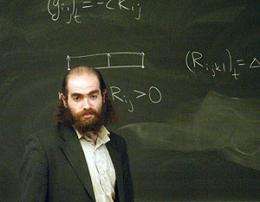
Grigory Perelman

Enlarge

Grigory Perelman

(AP) -- He said nyet to $1 million. Grigory Perelman, a reclusive Russian mathematics genius who made headlines earlier this year for not immediately embracing a lucrative math prize, has decided to decline the cash.

Perelman's decision was announced Thursday by the Clay Institute in Cambridge, Mass., which had awarded Perelman its Millennium .

The award honors his solving of the Poincare (pwan-kah-RAY) conjecture, which deals with shapes that exist in four or more dimensions.

Jim Carlson, institute president, said Perelman's decision was not a complete surprise, since he had declined some previous math prizes.

Carlson said Perelman had told him by telephone last week of his decision and gave no reason. But the Interfax news agency quoted Perelman as saying he believed the prize was unfair. Perelman told Interfax he considered his contribution to solving the Poincare conjecture no greater than that of mathematician Richard Hamilton.

"To put it short, the main reason is my disagreement with the organized mathematical community," Perelman, 43, told Interfax. "I don't like their decisions, I consider them unjust."

Attempts by The Associated Press to reach Perelman, a resident of St. Petersburg, were unsuccessful.

Carlson said institute officials will meet this fall to decide what to do with the prize money. "We have some ideas in mind," he said. "We want to consider that carefully and make the best use possible of the money for the benefit of mathematics."

More information: http://www.claymath.org

©2010 The Associated Press. All rights reserved. This material may not be published, broadcast, rewritten or redistributed.

4.9 /5 (30 votes)  

Filter


Move the slider to adjust rank threshold, so that you can hide some of the comments.


Display comments: newest first

trekgeek1
Jul 01, 2010

Rank: 4.4 / 5 (7)
Wow, that man has very strong principles. At first I think he's crazy for not taking the money, then I'm impressed because I know that I couldn't reject such a prize because of my principles.
Pete83
Jul 01, 2010

Rank: 4.3 / 5 (6)
Mathematicians usually exist way out there, they have to, to do what they do. I love this guy.
marjon
Jul 01, 2010

Rank: 4.5 / 5 (4)
He could have taken the money and donated it to whomever HE decided.
He did not have to keep it.
Bob_Kob
Jul 01, 2010

Rank: 2.5 / 5 (2)
Yeah he couldve donated to charity or whatnot.
nanotech_republika_pl
Jul 01, 2010

Rank: 3 / 5 (2)
... he could've donated it to Hamilton :-) But I bet Hamilton would not accept it from him since he is another man of strong principles.
bob_barker
Jul 01, 2010

Rank: 3.3 / 5 (4)
I thought his reasons for refusing may be due to the government collecting 50%-100% of the prize money had he accepted.
frajo
Jul 02, 2010

Rank: 3 / 5 (4)
He could have taken the money and donated it to whomever HE decided.
He did not have to keep it.
It wasn't the money what he refused. He refused to cooperate with the "organized mathematical community". Obviously he's associating it with "organized crime". Accepting the money and donating it to whomever would have constituted another kind of cooperation.

I thought his reasons for refusing may be due to the government collecting 50%-100% of the prize money had he accepted.
Could you give me a link to an official Russian web page confirming your statement?
Milou
Jul 02, 2010

Rank: 3 / 5 (1)
It not about the money it is about the unjust way the organization makes their judgment (America will never understand). His belief is as valid as any supposedly great organization's. At least this man puts his mouth where his beliefs stands. Which is a lot greater than any of our world leaders.
JJC
Jul 02, 2010

Rank: not rated yet
Generally in math and science they give prizes for "breakthrough" work to one person (or a team of 2-3), when really the work was done by at least dozens of people over many years.

I don't know about this prize in particular, but he may have a point.

That being said, he could have taken the money and used his acceptance speech to give credit to the other guy. Or he could have given the other guy half the money!
JamesThomas
Jul 02, 2010

Rank: 5 / 5 (2)
Yes, he could have done it some other way, however, it's likely that the rout he chose made the strongest statement.

I applaud him. He seems to be both a genius and a saint.
Jigga
Jul 02, 2010

Rank: 2.3 / 5 (3)
Maybe he just afraid of Petersburg mafia for killing him for that money. He's very fearful freak, who suffers with many paranoias. Sheldon from The Big Bang Theory is a big hero with compare to him.

http://english.pr...relman-0
Au-Pu
Jul 04, 2010

Rank: 5 / 5 (1)
The Clay Institute could set up a mathematics scholarship in both St Petersburg and Columbia University, one in Perelman's name and the other in Hamilton's name.
That would honour both and in their home towns.
One must admire and respect the moral integrity of Perelman.
There are too few people with that level of personal integrity.
The more Perelman types the better the world will be
paulsac
Jul 04, 2010

Rank: not rated yet
great book
Rank 4.9 /5 (30 votes)
Related Stories
Relevant PhysicsForums posts

More news stories

A frank discussion of the power law and linking correlation to causation

(PhysOrg.com) -- Michael Stumpf a mathematics professor at Imperial College in London, and Mason Porter a lecturer at Oxford have teamed together to write and publish a perspective piece in Science regarding the in ...

Other Sciences / Mathematics

created 17 hours ago | popularity 5 / 5 (3) | comments 7 | with audio podcast report

Employers feel no love for unscrupulous practice of 'service sweethearting'

A new study led by two Florida State University marketing professors finds that some frontline service employees who are rewarded for hikes in customer loyalty and satisfaction also may engage in "service ...

Other Sciences / Economics & Business

created 11 hours ago | popularity 4 / 5 (1) | comments 4

The question of life in the ancient world

There’s a general feeling that we don’t get the Greeks – ancient or modern. Many, including heads of state like Angela Merkel, visibly shake their head in exasperation, rightly or wrongly, at ...

Other Sciences / Archaeology & Fossils

created 16 hours ago | popularity 1.3 / 5 (3) | comments 4

Sonic Cradle lands spot in TED exhibition

A Simon Fraser University graduate student project that melds music, meditation and modern technology has landed a rare spot as an exhibit at TEDActive 2012 in Palm Springs, California this month.

Other Sciences / Other

created 13 hours ago | popularity not rated yet | comments 0

Chilean miners' rescue capsule on show in London

The capsule used to rescue Chilean miners trapped underground for two months goes on display Saturday at the Science Museum in London -- the first time it has been seen in Europe.

Other Sciences / Other

created 15 hours ago | popularity not rated yet | comments 0


Google users warned of threat to smartphone wallets

Users of Google smartphone wallets were being warned on Friday that there is a way to crack pass codes intended to thwart thieves from going on illicit shopping sprees.

Anonymous knocks CIA website offline (Update)

The website of the Central Intelligence Agency was inaccessible on Friday after the hacker group Anonymous claimed to have knocked it offline.

New error-correcting codes guarantee the fastest possible rate of data transmission

Error-correcting codes are one of the triumphs of the digital age. They’re a way of encoding information so that it can be transmitted across a communication channel — such as an optical fiber o ...

Humans may have helped the decline of African rainforests 3000 years ago

(PhysOrg.com) -- Large areas of rainforests in Central Africa mysteriously disappeared over three thousand years ago, to be replaced by savannas. The prevailing theory has been that the cause was a change ...

New power source discovered

(PhysOrg.com) -- Researchers at the Massachusetts Institute of Technology (MIT) and RMIT University have made a breakthrough in energy storage and power generation.

Complex wiring of the nervous system may rely on a just a handful of genes and proteins

Researchers at the Salk Institute have discovered a startling feature of early brain development that helps to explain how complex neuron wiring patterns are programmed using just a handful of critical genes. ...