Scientists Develop New Laser-Machining Techniques for Radiation Detectors
July 1, 2010
Scientists Develop New Laser-Machining  Techniques for Radiation Detectors

Enlarge

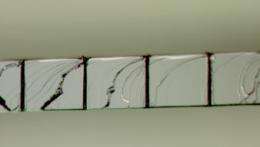
Optical micrograph (cross-section) of ∼ 10μm wide laser-machined holes in an Indium Phosphide (InP) substrate which is 450 μm thick.

(PhysOrg.com) -- Scientists at the Naval Research Laboratory have developed new laser-machining techniques for radiation detectors. "The new detectors will enable the next generation of space-based high-energy radiation astronomical research and might also be used for homeland security applications," explains Dr. Bernard Phlips, who heads the NRL team.

The Radiation Detection Section in NRL's Space Science Division is developing novel radiation detectors based on hole- or trench-arrays in semiconductors. These types of detectors are often called three-dimensional (3-D) detectors. A widely spaced hole-array is desirable in that it allows lateral depletion and charge collection. This decreases the device thickness and depletion voltage and consequently reduces material quality requirements and cost of the detector material. The radiation detectors that will be produced with these new NRL-developed techniques will have a smaller size and substantially lower weight and than current state-of-the-art devices.

The NRL team developed novel ways to laser-micromachine hole-arrays in a variety of semiconductors, including silicon (Si), Cadmium Telluride (CdTe) and Indium Phosphide (InP). Their reproducible new fabrication methodology is the critical process step for 3-D hole-arrays detector development. The resulting laser-machined holes have a much higher aspect ratio (diameter to depth ratio) than holes achieved with standard fabrication techniques. For example, laser-micromachined hole-arrays into silicon that have been developed at NRL have aspect ratios up to 100:1, while traditional techniques allow a maximum of only 40:1.

NRL's laser-micromachining hole-arrays work is being performed at NRL's Institute for Nanoscience (NSI), which has just installed a new Oxford Laser E-Series micro-machining system that is making this work possible. Dr. Marc Christophersen, from NRL's High-Energy Space Environment Branch, who developed the novel laser-machining techniques, is the NSI custodian for the Oxford micromachining system. In addition to performing his own research on the system, Christophersen is responsible for user training, tool maintenance, and the initial tool start-up.

Provided by Naval Research Laboratory (news : web)

3.5 /5 (4 votes)  

Rank 3.5 /5 (4 votes)
Related Stories
Relevant PhysicsForums posts
  • Infinity by Particles
    created1 hour ago
  • what does negative resistivity mean
    created2 hours ago
  • Calculating Electrostatic force between parallel plates
    created3 hours ago
  • Strength of induced magnetic field inside an inductor
    created6 hours ago
  • increasing time of daylight
    created7 hours ago
  • Light & Sight
    created8 hours ago
  • More from Physics Forums - General Physics

More news stories

Putting the squeeze on planets outside our solar system

(PhysOrg.com) -- Using high-powered lasers, scientists at Lawrence Livermore National Laboratory and collaborators discovered that molten magnesium silicate undergoes a phase change in the liquid state, abruptly ...

Physics / Condensed Matter

created 7 hours ago | popularity 4.8 / 5 (4) | comments 0 | with audio podcast

Hovering not hard if you're top-heavy, researchers find

Top-heavy structures are more likely to maintain their balance while hovering in the air than are those that bear a lower center of gravity, researchers at New York University's Courant Institute of Mathematical Sciences ...

Physics / General Physics

created 8 hours ago | popularity 5 / 5 (1) | comments 1 | with audio podcast

SLAC, Stanford team focuses on high-energy electrons to treat cancer

Accelerator physicists at SLAC and cancer specialists from Stanford are working on a new technology that could dramatically reduce the time needed for cancer radiation treatments. The team ran an initial experiment ...

Physics / General Physics

created 11 hours ago | popularity 5 / 5 (1) | comments 0

Measurements from high-energy collisions lead to better understanding of why meson particles disappear

For several years, physicists at the Relativistic Heavy Ion Collider (RHIC) at Brookhaven National Laboratory (BNL), USA, have studied an unusual state of matter called the quark–gluon plasma, which they ...

Physics / General Physics

created 11 hours ago | popularity 5 / 5 (1) | comments 0

Explained: Sigma

It's a question that arises with virtually every major new finding in science or medicine: What makes a result reliable enough to be taken seriously? The answer has to do with statistical significance -- but ...

Physics / General Physics

created Feb 09, 2012 | popularity 5 / 5 (16) | comments 48


Google users warned of threat to smartphone wallets

Users of Google smartphone wallets were being warned on Friday that there is a way to crack pass codes intended to thwart thieves from going on illicit shopping sprees.

Anonymous knocks CIA website offline (Update)

The website of the Central Intelligence Agency was inaccessible on Friday after the hacker group Anonymous claimed to have knocked it offline.

Complex wiring of the nervous system may rely on a just a handful of genes and proteins

Researchers at the Salk Institute have discovered a startling feature of early brain development that helps to explain how complex neuron wiring patterns are programmed using just a handful of critical genes. ...

New error-correcting codes guarantee the fastest possible rate of data transmission

Error-correcting codes are one of the triumphs of the digital age. They’re a way of encoding information so that it can be transmitted across a communication channel — such as an optical fiber o ...

The power of estrogen -- male snakes attract other males

A new study has shown that boosting the estrogen levels of male garter snakes causes them to secrete the same pheromones that females use to attract suitors, and turned the males into just about the sexiest ...

NASA sees wide-eyed cyclone Jasmine

Cyclone Jasmine's eye has opened wider on NASA satellite imagery, as it moves through the Southern Pacific Ocean.