As world first, Finland makes broadband service basic right
July 1, 2010
Finland became the first country in the world to make access to a broadband service a basic right

Enlarge

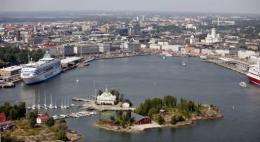
An aerial view of the port in Helsinki. Finland on Thursday became the first country in the world to make access to a broadband service a basic right, ensuring that a high-speed Internet connection is available to all Finns, a government official said.

Finland on Thursday became the first country in the world to make access to a broadband service a basic right, ensuring that a high-speed Internet connection is available to all Finns, a government official said.

"Today the universal service obligation concerning Internet access of one Megabit per second (Mbit/s) has entered into force," Olli-Pekka Rantala of the unit at the ministry of transport and communications said.

"It is our understanding that we have become the first in the world to have made broadband a basic right," he added.

The tech-savvy Nordic country amended its communications market act last year to make sufficient Internet access a universal service, such as the telephone and postal services.

It was later determined by the ministry of communications "that what is meant by sufficient Internet access ... is one Megabit per second." Rantala said.

Finnish Communications Minister Suvi Linden called the new mandatory regulation "one of the government's most significant achievements in regional policy."

"I'm proud of it," she said in a statement. "I hope that people will make use of the opportunity and turn to in the area they live."

From July 1, service providers in Finland are thus obligated to provide a one Mbit/s connection to all Finnish households, regardless of their location.

The Finnish Communications Regulatory Authority (FICORA) was in charge of designating universal service providers for areas where a high speed connection was not previously available.

The service obligation does not apply to summer residences, FICORA said on its website.

It added the price of an Internet connection provided by a universal service provider "must be reasonable," but that the provider could take into consideration "the costs incurred from the production of the service."

The Finnish government has also launched a project to connect all Finns to the Internet with fast fibre-optic or cable networks by 2015.

"The objective of the project is that nearly all (more than 99 percent of the) permanent places of residence and places of business and public administration are no further than two kilometres from a 100 Mbit/s fibre-optic cable network," FICORA said.

(c) 2010 AFP

4.4 /5 (14 votes)  

Filter


Move the slider to adjust rank threshold, so that you can hide some of the comments.


Display comments: newest first

alq131
Jul 01, 2010

Rank: 1 / 5 (7)
So, if I were a Finn, would my rights be violated when a cable is cut? Would the government be responsible for restoring my "rights".

Is the "right" to have a computer to actually connect the next right that will be guaranteed? Then how about the "right" to have power for that computer...and the "right" to have a/c to keep that PC operating at optimum temp...Where does it end? Oh, it doesn't...it's socialism.
Dhanne
Jul 01, 2010

Rank: 5 / 5 (5)
Well, I'm a Finn and I'm very proud of our new basic right... even though most of our internet connections are nowdays a lot faster than one megabit per second.

Cutting cables? If you are that confused as you seem, alq131, I prefer you sometimes come to visit here in Finland. ;)
Quantum_Conundrum
Jul 01, 2010

Rank: 5 / 5 (7)
What is it with people who don't comprehend that governments have ALWAYS been involved in the establishment of infrastructures, of which internet is becoming a basic component in modern civilization?

Internet is no longer a "luxury," but is practically required to do business and even get a job and live a "normal" life now; much like roads, bridges, water and sewer are required for "normal" modern life.

I don't know what the deal is with people being opposed to government's being involved in energy and infrastructure. Throughout the history of civilizations, the governments were usually the only entities with the resources to accomplish this.

People who are poor or who live in isolated communities should not be further punished because their parents were farmers or laborers and they weren't born in a city, and now they are "left behind" technologically with no real hope of "catching up" barring some extraordinary alignment.

Every nation should pass a similar law, IMO.
Starblade_Enkai
Jul 01, 2010

Rank: 2 / 5 (4)
The issue here is that the 'infrastructure' argument is basically a guarantee at someone else's expense.

Quantum Conundrum and Dhanne, please don't evangelize, IE don't try to import your morals onto entire countries. If some countries don't think internet is a right then that's just their choice.
Daein
Jul 01, 2010

Rank: not rated yet
When you make a "right" for "all" that costs money you're not making a right at all. You're essentially passing a law that requires everyone to get broadband. In the end they are probably paying more for it to be called a "right" rather than it being an outright law. Since they have to pay the government for it in their taxes rather than just getting it directly and we all know how efficient the government is with other people's money.
ricardo_sandoval
Jul 01, 2010

Rank: not rated yet
In discussions about what should or should not be "a right" I rarely see the actual costs of the service.

It would not bother me to pay 20 dollars a month for 1Mbit/s to myself and everybody else that really can't afford it (but that is just me).

The combination:

a) Need big initial investments.
b) Are very desirable.

Usually means that after the companies recoup their investment (some times over) they can still maintain high prices. Meaning that there is a disconnection between the price they can charge and the actual cost of providing the service.

Rewarding entrepreneurship, hard work, creativity or talent is one thing, holding the population hostage for no good reason is another.
ricardo_sandoval
Jul 02, 2010

Rank: not rated yet
Governments are perhaps better understood as just another type of company (see my comment above), in any case it is our job to look for some kind of fairness.

I am all for more power to individuals and less power to big whatever. Meaning big whatever’s should be closely watched by us simple individuals because they can and many times do abuse their power.

Democracy like it should be I guess.
nita
Jul 02, 2010

Rank: not rated yet
When I read the article about Finland instigating a nationwide broadband policy, I felt both envious and hopeful--hopeful that perhaps one day the US would offer such a boon. Since I live in rural area that is "dead" to receiving either cell phone service or any access to broadband, I subscribe to a satellite service that costs a whopping 50 plus tax dollars for a sl000000 connection in order to get anything faster than a dial up connection for internet. I agree with the person who wrote the Quantum Conundrum comments.
maxcypher
Jul 02, 2010

Rank: not rated yet
I'm an American, so I suppose I should be staunchly capitalist and anti-gov't, but I can't help thinking that these socialist countries treat their populations much more gracefully than the US probably ever will. Also, I looked up Finland's stats and -- in spite of their high tax rate -- the Finns seem to enjoy a wonderful economic standard. I wonder if they need anymore math teachers...
OsR
Jul 02, 2010

Rank: not rated yet
The government does not simply create new internet connections, by declaring them as "rights". It froces the local operators to build them, even in very remote woods and skerries without electricity. Mosty all finns have already access to internet. These unused connections are paid by other customers by higher fees and lower quality.

These connections would end up costing hundreds of thousand of euros, so it would be cheaper to just buy them a fine apartments from Helsinki city center(and the housing bubble has not even bursted yet!).

The finnish government is now also changing the old TV licence fee as to all inclusive "Media"(includingin Internet) licence fee, as nobody watches anymore the reruns shows from Finnish national TV stations. It's very conviniet to first force operators to build connections for everyone and then take charge from them.
Rank 4.4 /5 (14 votes)
Related Stories
Relevant PhysicsForums posts
  • Force free body diagram problem on gym equipment
    created1 hour ago
  • Empirical data regarding shower heads and water
    created9 hours ago
  • feed hold button on CNC lathe
    createdFeb 09, 2012
  • RFAC in Fortran
    createdFeb 09, 2012
  • dynamics 2/32
    createdFeb 08, 2012
  • dynamics
    createdFeb 08, 2012
  • More from Physics Forums - General Engineering

More news stories

Netflix light on flicks as viewers soak up TV shows

Like most fresh faces that arrive in Hollywood, Netflix wanted to be a movie star. But now it's learning what many in Tinseltown have known for decades: Movies are sexy, but the real money is in television.

Technology / Business

created 6 minutes ago | popularity not rated yet | comments 0

Sony's Hirai refuses to abandon dire TV business

Struggling Japanese entertainment giant Sony will not abandon its cash-bleeding television business, its incoming CEO says, but he acknowledges tough decisions lie ahead including over redundancies.

Technology / Business

created 36 minutes ago | popularity not rated yet | comments 0

New error-correcting codes guarantee the fastest possible rate of data transmission

Error-correcting codes are one of the triumphs of the digital age. They’re a way of encoding information so that it can be transmitted across a communication channel — such as an optical fiber o ...

Technology / Computer Sciences

created 3 hours ago | popularity 5 / 5 (3) | comments 2 | with audio podcast

Small modular reactor design could be a 'SUPERSTAR'

(PhysOrg.com) -- Though most of today's nuclear reactors are cooled by water, we've long known that there are alternatives; in fact, the world's first nuclear-powered electricity in 1951 came from a reactor ...

Technology / Energy & Green Tech

created 2 hours ago | popularity 5 / 5 (4) | comments 9 | with audio podcast

Advanced power-grid model finds low-cost, low-carbon future in West

(PhysOrg.com) -- The least expensive way for the Western U.S. to reduce greenhouse gas emissions enough to help prevent the worst consequences of global warming is to replace coal with renewable and other ...

Technology / Energy & Green Tech

created 2 hours ago | popularity 5 / 5 (1) | comments 3 | with audio podcast


Experts reveal how plants don't get sunburn

(PhysOrg.com) -- Experts at the University of Glasgow have discovered how plants survive the harmful rays of the sun.

Fool's gold may prove an unlikely alternative to overexploited catalytic materials

Catalytic materials, which lower the energy barriers for chemical reactions, are used in everything from the commercial production of chemicals to catalytic converters in car engines. However, with current catalytic materials ...

Curry spice component may help slow prostate tumor growth

Curcumin, an active component of the Indian curry spice turmeric, may help slow down tumor growth in castration-resistant prostate cancer patients on androgen deprivation therapy (ADT), a study from researchers ...

Unpicking HIV’s invisibility cloak

Drug researchers hunting for alternative ways to treat human immunodeficiency virus (HIV) infections may soon have a novel target—its camouflage coat. HIV hides inside a cloak unusually rich in a sugar ...

What lies beneath: Mapping hidden nanostructures

The ability to diagnose and predict the properties of materials is vital, particularly in the expanding field of nanotechnology. Electron and atom-probe microscopy can categorize atoms in thin sheets of material, ...

To avoid early labor and delivery, weight and diet changes not the answer

One of the strongest known risk factors for spontaneous or unexpected preterm birth – any birth that occurs before the 37th week of pregnancy, most often without a known cause – is already having had one. For women ...