Print your own lasers, lights and TV screens
July 1, 2010
Print your own lasers, lights and TV screens

Enlarge

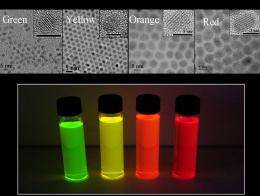
Four different colours of quantum dots (photo: Raffaella Signorini, Padova University)

Imagine printing your own room lighting, lasers, or solar cells from inks you buy at the local newsagent. Jacek Jasieniak and his colleagues at CSIRO, the University of Melbourne and the University of Padua in Italy, have moved a step closer to such a future, by developing liquid inks based on quantum dots that can be used to print devices.

Imagine printing your own room lighting, lasers, or from inks you buy at the local newsagent. Jacek Jasieniak and his colleagues at CSIRO, the University of Melbourne and the University of Padua in Italy, have moved a step closer to such a future, by developing liquid inks based on quantum dots that can be used to print devices.

The first , invented 50 years ago in May 1960, was described as a solution looking for a problem. Today dozens of lasers are built into our computers, cars and homes. Soon, thanks to Jacek’s work, we may have millions of tiny lasers working in our homes lighting our rooms and even acting as pixels in printable TV screens. The lasers could also be used as components in optical computers, electronics, sensors, as cheap laser pointers in a range of colours or even fashion accessories.
Print your own lasers, lights and TV screens
Enlarge

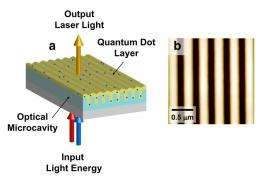
A schematic of a quantum dot lasing device (photo: Raffaella Signorini, Padova University)

Jacek’s work is being presented for the first time in public through Fresh Science, a communication boot camp for early-career scientists held at the Melbourne Museum. Jacek was one of 16 winners from across Australia.

“Creating cheaper lasers relies heavily on progress in ,” Jacek says. “At present, lasers are manufactured using expensive materials and production techniques. To make them more cost effective, we have focused on developing materials that are cheap, function well as lasers, and can be printed. Quantum dots meet all these requirements.”

Quantum dots are made of grown as nanometre-sized crystals, around a millionth of a millimetre in diameter. The laser colour they produce can be selectively tuned by varying their size. To build a laser using quantum dots, you need to place them within a structure known as an . This structure acts to amplify the light that is produced by the quantum dots to produce the laser.

“Conventional lasers use large optical cavities which make them impossible to use for printable lasers. To develop true nanometre-sized lasers we have employed a special type of optical cavity that consists of a repeating nano-structured pattern on the surface of the material onto which the are printed. A major benefit of this nano-structured optical cavity is that it can be produced during the printing process by controlled indentation or scratching of the material’s surface,” Jacek says.
Print your own lasers, lights and TV screens
Enlarge

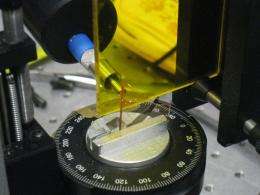
A prototype quantum lasing device (photo: Raffaella Signorini, Padova University)

“The tiny lasers generated using such an approach are highly efficient and can be adapted for numerous applications.”

In addition to lasers, this research has significant implications for many other future technologies which use liquid inks to develop printable components. One highly promising example is the production of thin-film solar cells, a research area that Jacek is also currently involved in at CSIRO.

Source: Fresh Science

4.8 /5 (29 votes)  

Filter


Move the slider to adjust rank threshold, so that you can hide some of the comments.


Display comments: newest first

HealingMindN
Jul 01, 2010

Rank: 3 / 5 (2)
I want to print out a video greeting card and business cards with moving ads. Can I print piezo speakers too? What about a video tattoo?
jtdrexel
Jul 02, 2010

Rank: 5 / 5 (2)
I want to print out a video greeting card and business cards with moving ads. Can I print piezo speakers too? What about a video tattoo?


Dream On :-)
Quarl
Jul 02, 2010

Rank: 2 / 5 (1)
I want to print out a video greeting card and business cards with moving ads. Can I print piezo speakers too? What about a video tattoo?


Well, if you print a thin-film solar cell on your back and then print leads to an unobtrusively located printed control circuit which has printed leads to the tattoo...:-)
Jimbaloid
Jul 02, 2010

Rank: 5 / 5 (4)
I already have a laser printer ;-)
Nartoon
Jul 03, 2010

Rank: 3 / 5 (1)
The beginning of the light Sabre.
Hunnter
Jul 04, 2010

Rank: 5 / 5 (1)
Oh boy, i can't wait to read the morning newspaper, only to be blinded by a laser ad, quite literally this time.

But seriously, amazing work. Quantum dots get more amazing every time i hear about them.
Rank 4.8 /5 (29 votes)
Related Stories
Relevant PhysicsForums posts
  • How physicists handle the idea of Free Will?
    created2 hours ago
  • Orbital Decay Question
    created3 hours ago
  • Pure energy
    created8 hours ago
  • How to remove the magnetic property for screw driver?
    created11 hours ago
  • How to magnetize a concrete wall?
    created15 hours ago
  • Upward speed of an object in water
    created16 hours ago
  • More from Physics Forums - General Physics

More news stories

Borexino Collaboration succeeds in spotting pep neutrinos emitted from the sun

(PhysOrg.com) -- To learn more about how the sun works, scientists study particles that are emitted from it into space due to thermonuclear reactions that occur inside; by applying known physics principles, ...

Physics / General Physics

created 6 hours ago | popularity 5 / 5 (4) | comments 0 | with audio podcast report

Physics research suggests new pathways for cancer progression

Observing that certain cancer cells may exhibit greater flexibility than normal cells, some scientists believe that this capability promotes rapid tumor growth. Now computer simulations developed by Boston University Biomedical ...

Physics / General Physics

created 3 hours ago | popularity 5 / 5 (1) | comments 0

Explained: Sigma

It's a question that arises with virtually every major new finding in science or medicine: What makes a result reliable enough to be taken seriously? The answer has to do with statistical significance -- but ...

Physics / General Physics

created 6 hours ago | popularity 5 / 5 (6) | comments 6

Quantum physicist explains $100K offer for proof scaled-up quantum computing is impossible

(PhysOrg.com) -- MIT researcher Scott Aaronson has certainly riled the physics community with his offer this past Friday, of $100,000 to anyone who can prove that scaled-up quantum computing is impossible. ...

Physics / Quantum Physics

created Feb 08, 2012 | popularity 4 / 5 (10) | comments 30 | with audio podcast weblog

Physicists build highly efficient 'no-waste' laser

A team of University of California, San Diego researchers has built the smallest room-temperature nanolaser to date, as well as an even more startling device: a highly efficient, "thresholdless" laser that ...

Physics / General Physics

created Feb 08, 2012 | popularity 5 / 5 (17) | comments 5 | with audio podcast


FDA-approved drug rapidly clears amyloid from the brain, reverses Alzheimer's symptoms in mice

Neuroscientists at Case Western Reserve University School of Medicine have made a dramatic breakthrough in their efforts to find a cure for Alzheimer's disease. The researchers' findings, published in the journal Science, show t ...

Ocean microbe communities changing, but long-term environmental impact is unclear

As oceans warm due to climate change, water layers will mix less and affect the microbes and plankton that pump carbon out of the atmosphere – but researchers say it's still unclear whether these processes ...

Researchers create 3-D laser maps that show how earthquake changes landscape

Geologists have a new tool to study how earthquakes change the landscape down to a few inches, and it's giving them insight into how earthquake faults behave. In the Feb. 10 issue of the journal Science, a team ...

Cell death unleashes full force of human antiviral system

A scientific team led by researchers at the University of Geneva (UNIGE) and the Charite Berlin Medical University has made a completely unprecedented discovery showing how much our immune system is provoked into action when ...

Secrets of immune response illuminated in new study

When disease-causing invaders like bacteria infect a human host, cells of various types swing into action, coordinating their activities to address the threat.

Nanotube therapy takes aim at breast cancer stem cells

Wake Forest Baptist Medical Center researchers have again proven that injecting multiwalled carbon nanotubes (MWCNTs) into tumors and heating them with a quick, 30-second laser treatment can kill them.