HIRO III lets you feel what you see on screen (w/ Video)
July 2, 2010 by Lin Edwards report
HIRO III lets you feel what you see on screen (w/ Video)

Enlarge

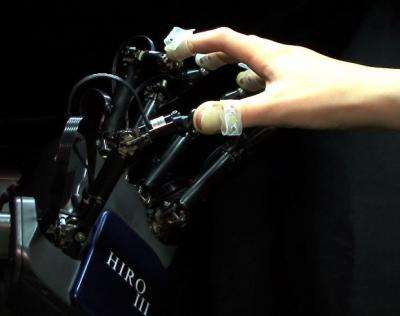
(PhysOrg.com) -- Researchers in Japan are developing a new touch screen system, the HIRO III, that incorporates a robot hand that could offer a new way of simulating the touching of virtual objects and receiving feedback from them.

Scientists from Gifu University’s Kawasaki and Mouri Laboratory at Gifu in central Japan, say the HIRO III is a "haptic interface robot,” which can transmit realistic sensations of touch to a user’s . The uses a 3D display to provide the .

This video is not supported by your browser at this time.

The robot is an arm and hand with five fingers to which the user’s own fingers are strapped. The robotic fingers give the user tactile sensations simulating the textures of surfaces, size of virtual objects and a sense of weight. The system is integrated with a three-dimensional display that includes an image of the user’s hand. The hand on the screen appears to be in the same position as the user’s own hand, which could make the experience seem very realistic.

Each robotic fingertip has fifteen degrees of movement and the arm has six, which allows it to operate in a relatively large space under the screen. The robot’s movements are controlled by fifteen motors running simultaneously.

The device could be used in applications such as controlling robotic arms in factory work, and for simulating procedures for medical diagnosis training. At the moment it is still at the experimental stage and the researchers are concentrating on its potential use in teaching medical students how to carry out tactile screening for .

© 2010 PhysOrg.com

4.6 /5 (10 votes)  

Filter


Move the slider to adjust rank threshold, so that you can hide some of the comments.


Display comments: newest first

powerup1
Jul 02, 2010

Rank: 3 / 5 (2)
it can the user an accurate simulation of what it feels like to touch a breast...now that is something to think about. :-D
Aloken
Jul 02, 2010

Rank: not rated yet
I can assure you it doesn't feel like a mettalic robot hand.
Newbeak
Jul 02, 2010

Rank: 3 / 5 (2)
The porn industry will be the first to jump on this,just like they did with other cutting-edge tech..
Jigga
Jul 02, 2010

Rank: not rated yet
Such robotic gloves could be used during protein & medical research. They would enable scientists to touch the molecule models and to investigate their optimal spatial configuration and or reactivity in hands. This approach is based on the insight, for human is much easier to find spatial conformation or tension by using of visual and haptic feedback - whereas for computer it's very computationally intensive job because of high degree of freedom in motion of complex molecules.
trekgeek1
Jul 02, 2010

Rank: 5 / 5 (1)
I'm more impressed with the robotic hands degree of freedom. That hand could be part of an awesome robot if we could just get the programming down.
CouchP
Jul 02, 2010

Rank: not rated yet
Like...bags of sand....
eurekalogic
Jul 06, 2010

Rank: not rated yet
I agree with trekgeek and would like to add that this can become a fully two way system robot to human like a robotic Avatar. Great for hazardous locations and even take away the need for space walks. I also loved the magnetic junctions for great emergency speed launch and disconnect. Well thought out. ALmost makes me wonder if the CHI medicine inspired the design.
antialias_physorg
Jul 11, 2010

Rank: not rated yet
I've worked with haptic devices (in medical contexts). You can get these to feel very 'real' -
from soft tissue to hard bony surfaces to viscous fluids everything is possible.

Very useful during laproscopic surgery because surgeons work by feel as much as they do by sight. Keyhole surgeries were notable in that this haptic feedback was missing which posed real problems.

And yes: with a five fingered apparatus(like the one shown) you could get a very real feel of a virtual breast. If the model is good and you closed your eyes you would not feel the difference.
Rank 4.6 /5 (10 votes)
Related Stories
Relevant PhysicsForums posts
  • Calling function with no input argument
    created3 hours ago
  • Force free body diagram problem on gym equipment
    created4 hours ago
  • Empirical data regarding shower heads and water
    created12 hours ago
  • feed hold button on CNC lathe
    createdFeb 09, 2012
  • RFAC in Fortran
    createdFeb 09, 2012
  • dynamics 2/32
    createdFeb 08, 2012
  • More from Physics Forums - General Engineering

More news stories

Review: Netflix and Hulu's new scripted originals

Within just over a week, Netflix and Hulu are both debuting their first stabs at original scripted programming.

Technology / Business

created 1 hour ago | popularity not rated yet | comments 0

India probes Google over 'forex transactions'

Indian authorities are probing whether online giant Google broke domestic foreign-exchange transactions rules while shifting funds abroad, the Press Trust of India reported on Friday.

Technology / Internet

created 46 minutes ago | popularity not rated yet | comments 0

Germany freezes signing of disputed Internet pact

Germany on Friday halted the signing of a controversial international accord billed as a way to beat online piracy that has sparked angry protests, saying it needed more time to consider it.

Technology / Internet

created 57 minutes ago | popularity not rated yet | comments 0

Expat French get Internet vote for first time

French citizens will for the first time this year be able to vote in a parliamentary election over the Internet, an experiment that could be extended to other elections if successful.

Technology / Internet

created 7 minutes ago | popularity not rated yet | comments 0

New error-correcting codes guarantee the fastest possible rate of data transmission

Error-correcting codes are one of the triumphs of the digital age. They’re a way of encoding information so that it can be transmitted across a communication channel — such as an optical fiber o ...

Technology / Computer Sciences

created 6 hours ago | popularity 5 / 5 (3) | comments 2 | with audio podcast


Hovering not hard if you're top-heavy, researchers find

Top-heavy structures are more likely to maintain their balance while hovering in the air than are those that bear a lower center of gravity, researchers at New York University's Courant Institute of Mathematical Sciences ...

Grass to gas: Researchers' genome map speeds biofuel development

Researchers at the University of Georgia have taken a major step in the ongoing effort to find sources of cleaner, renewable energy by mapping the genomes of two originator cells of Miscanthus x giganteus, a large perenn ...

Putting the squeeze on planets outside our solar system

(PhysOrg.com) -- Using high-powered lasers, scientists at Lawrence Livermore National Laboratory and collaborators discovered that molten magnesium silicate undergoes a phase change in the liquid state, abruptly ...

Researchers develop new method for creating tissue engineering scaffolds

Researchers at Northwestern University have developed a new method for creating scaffolds for tissue engineering applications, providing an alternative that is more flexible and less time-intensive than current technology.

Molecular profiling reveals differences between primary and recurrent ovarian cancers

There is a need to analyze tumor specimens at the time of ovarian cancer recurrence, according to a new study published in Molecular Cancer Therapeutics. Researchers used a diagnostic technology called molecular profiling to examine ...

C-sections linked to breathing problems in preterm infants

Research conducted at Yale School of Medicine shows that a cesarean (C-section) delivery, which was thought to be harmless, is associated with breathing problems in preterm babies who are small for gestational age.