Wallabies and bats harbor 'fossil' genes from the most deadly family of human viruses
July 2, 2010
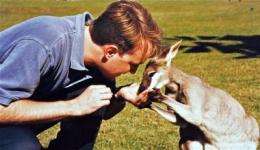
Research by Derek Taylor has shown that modern marsupials harbor a "fossil" copy of a gene that codes for filoviruses, which cause Ebola and Marburg hemorrhagic fevers and are the most lethal viruses known to humans. Credit: University at Buffalo
Modern marsupials may be popular animals at the zoo and in children's books, but new findings by University at Buffalo biologists reveal that they harbor a "fossil" copy of a gene that codes for filoviruses, which cause Ebola and Marburg hemorrhagic fevers and are the most lethal viruses known to humans.
Published this week in the online journal BMC Evolutionary Biology, the paper ("Filoviruses are ancient and integrated into mammalian genomes") demonstrates for the first time that mammals have harbored filoviruses for at least tens of millions of years, in contrast to the existing estimate of a few thousand.
It suggests that these species, which maintain a filovirus infection without negative health consequences, could have selectively maintained these so-called "fossil" genes as a genetic defense.
The work has important implications for the development of potential human vaccines, as well as for the modeling of disease outbreaks and the discovery of emerging diseases, including new filoviruses.
"This paper identifies the first captured 'fossil' copies of filovirus-like genes in mammalian genomes," says Derek J. Taylor, PhD, associate professor of biological sciences in the UB College of Arts and Sciences and co-author. "Our results confirm for the first time that several groups of mammals, including groups such as marsupials that never colonized Africa, have had an association with filoviruses."
The UB co-authors say that if the rarely captured genes represent antiviral defenses or genomic scars from persistent infections, then the work opens up new possibilities for identifying reservoir species for filoviruses, which harbor the virus but remain asymptomatic.
"The reservoir for filovirus has remained a huge mystery," says Jeremy A. Bruenn, PhD, UB professor of biological sciences and co-author. "We need to identify it because once a filovirus hits humans, it can be deadly."
When the UB researchers studied samples from the fur of a wallaby at the Buffalo Zoo and a brown bat caught on the UB campus, they found that the genomes of both animals as well as some other small mammals contain "fossil" copies of the gene for these deadly viruses, and thus could be candidate reservoir species for them.
"Who knew that the bats in the attic as well as modern marsupials harbored fossil gene copies of the group of viruses that is most lethal to humans," asks Taylor.
The research also demonstrates a new mechanism by which different species of mammals can acquire genes, through non-retroviral integrated RNA viruses, which the UB scientists had previously identified in eukaryotes but was unknown in mammals.
The UB scientists note that it is well-known that RNA retroviruses, like HIV-AIDS, can be integrated into mammal genomes.
"But because filoviruses infect only the cytoplasm of cells and not the nucleus and because they have no means of making DNA copies that might be integrated into the genome -- as retroviruses do -- it was never thought gene transfer could occur between non-retroviral RNA viruses and hosts," says Bruenn. "This paper shows that it does and it may prove to be a far more general phenomenon than is currently known."
The research also reveals that existing estimates that filoviruses originated in mammals a few thousand years ago were way off the mark.
"Our findings demonstrate that filoviruses are, at a minimum, between 10 million and 24 million years old, and probably much older," says Taylor. "Instead of having evolved during the rise of agriculture, they more likely evolved during the rise of mammals."
-
Ebola and Marburg viruses may be much older than thought
Jun 28, 2010 |
not rated yet |
0
-
Researchers Unravel Mystery of How Ebola and Marburg Kill
Oct 19, 2006 |
not rated yet |
0
-
HIV's ancestors 'plagued first mammals'
Sep 18, 2009 |
not rated yet |
0
-
Scientists detect presence of marburg virus in african fruit bats
Aug 22, 2007 |
not rated yet |
0
-
Gene neighbors may have taken turns battling retroviruses
Dec 21, 2007 |
not rated yet |
0
-
Engineers build first sub-10-nm carbon nanotube transistor
Feb 01, 2012 |
4.9 / 5 (31) |
30
-
Something old, something new: Evolution and the structural divergence of duplicate genes
Jan 31, 2012 |
4.6 / 5 (7) |
1
-
The hidden nanoworld of ice crystals: Revealing the dynamic behavior of quasi-liquid layers
Jan 30, 2012 |
5 / 5 (3) |
1
-
Stock market network reveals investor clustering
Jan 27, 2012 |
3.9 / 5 (23) |
8
-
Of microchemistry and molecules: Electronic microfluidic device synthesizes biocompatible probes
Jan 26, 2012 |
5 / 5 (1) |
0
-
Stem cell question.
1 hour ago
-
Protease cleavage
7 hours ago
-
Pertubance in a model
14 hours ago
-
Cancer drugs and Alzheimer's, Oh my!
22 hours ago
-
Squishing cells
23 hours ago
-
Any books/articles for evolutionary stable strategy models in humans?
Feb 09, 2012
- More from Physics Forums - Biology
More news stories
The power of estrogen -- male snakes attract other males
A new study has shown that boosting the estrogen levels of male garter snakes causes them to secrete the same pheromones that females use to attract suitors, and turned the males into just about the sexiest ...
12 hours ago |
4.8 / 5 (5) |
0
|
Grass to gas: Researchers' genome map speeds biofuel development
Researchers at the University of Georgia have taken a major step in the ongoing effort to find sources of cleaner, renewable energy by mapping the genomes of two originator cells of Miscanthus x giganteus, a large perenn ...
9 hours ago |
3.8 / 5 (5) |
0
|
Experts reveal how plants don't get sunburn
(PhysOrg.com) -- Experts at the University of Glasgow have discovered how plants survive the harmful rays of the sun.
12 hours ago |
4.7 / 5 (3) |
0
|
Miami battling invasion of giant African snails
No one knows how they got there. But an invasion of African giant snails has southern Florida in a panic over potential crop damage, disease and general yuckiness surrounding the slimy gastropods.
16 hours ago |
4 / 5 (1) |
4
Protein libraries in a snap
(PhysOrg.com) -- A Rice University undergraduate will depart with not only a degree but also a possible patent for his invention of an efficient way to create protein libraries, an important component of biomolecular ...
15 hours ago |
4.8 / 5 (4) |
0
|
Google users warned of threat to smartphone wallets
Users of Google smartphone wallets were being warned on Friday that there is a way to crack pass codes intended to thwart thieves from going on illicit shopping sprees.
Anonymous knocks CIA website offline (Update)
The website of the Central Intelligence Agency was inaccessible on Friday after the hacker group Anonymous claimed to have knocked it offline.
Complex wiring of the nervous system may rely on a just a handful of genes and proteins
Researchers at the Salk Institute have discovered a startling feature of early brain development that helps to explain how complex neuron wiring patterns are programmed using just a handful of critical genes. ...
New error-correcting codes guarantee the fastest possible rate of data transmission
Error-correcting codes are one of the triumphs of the digital age. Theyre a way of encoding information so that it can be transmitted across a communication channel such as an optical fiber o ...
Humans may have helped the decline of African rainforests 3000 years ago
(PhysOrg.com) -- Large areas of rainforests in Central Africa mysteriously disappeared over three thousand years ago, to be replaced by savannas. The prevailing theory has been that the cause was a change ...
Putting the squeeze on planets outside our solar system
(PhysOrg.com) -- Using high-powered lasers, scientists at Lawrence Livermore National Laboratory and collaborators discovered that molten magnesium silicate undergoes a phase change in the liquid state, abruptly ...