Why you should never arm wrestle a saber-toothed tiger
July 3, 2010
Why you should never arm wrestle a saber-toothed tiger

Enlarge

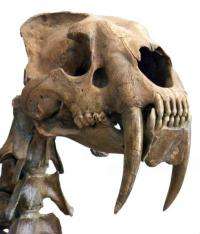
Saber-toothed cats may be best known for their supersized canines, but they also had exceptionally strong forelimbs for pinning prey before delivering the fatal bite, says a new study in the journal PLoS ONE. Credit: Wikimedia Commons

Saber-toothed cats may be best known for their supersized canines, but they also had exceptionally strong forelimbs for pinning prey before delivering the fatal bite, says a new study in the journal PLoS ONE.

Commonly called the "saber-toothed tiger," the extinct cat Smilodon fatalis roamed North and South America until 10,000 years ago, preying on large mammals such as bison, camels, and mammoths. Telltale clues from bones and teeth suggest they relied on their forelimbs as well as their fangs to catch and kill their prey.

The size and shape of sabertooth canines made them more vulnerable to fracture than cats living today, said author Julie Meachen-Samuels, a at the National Center in Durham, NC.

"Cats living today have canines that are round in cross-section, so they can withstand forces in all directions. If the prey is struggling it doesn't matter which way it's pulling — their teeth are unlikely to break," she explained.

In contrast, the elongated canines of saber-toothed cats were oval in cross-section, which made them more vulnerable to breaking than their conical-toothed cousins. "Many scientists infer that saber-toothed cats killed prey differently from other cats because their teeth were thinner side-to-side," said Meachen-Samuels.

Despite their vulnerable canines, prominent muscle attachment scars on sabertooth limb bones suggest the cat was powerfully built. Saber-toothed cats may have used their muscular arms to immobilize prey and protect their teeth from fracture, she explained.

To estimate how strong sabertooth forelimbs were relative to other cats, the researchers used x-rays to measure the cross-sectional dimensions of the upper arm and leg bones of fossils recovered from the La Brea Tar Pits in Los Angeles. They also measured the limb bones of 28 cat species living today — ranging in size from the 6-pound margay to the 600-pound tiger — as well as the extinct American lion, the largest conical-toothed cat that ever lived.

The researchers used their cross-sectional measurements to estimate strength and rigidity for each species. When they plotted rigidity against length for the 30 species in their study, species with longer limbs generally had stronger bones. But the data for the saber-toothed cat fell well outside the normal range —while their leg bones scaled to size, their arm bones were exceptionally thick for their length.

"When I looked at the arm bones, Smilodon fatalis was way out in left field," said Meachen-Samuels.
Why you should never arm wrestle a saber-toothed tiger

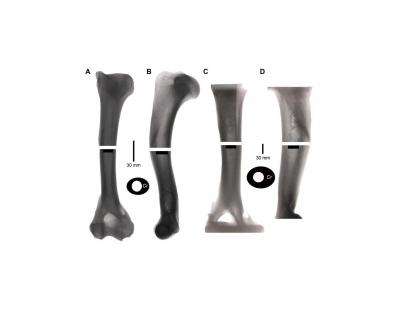
These X-ray images show cross-sectional dimensions of the upper arm bone of a jaguar (A and B) compared to a saber-toothed cat (C and D). Credit: Photo by Julie Meachen-Samuels

Sabertooth arm bones were not only larger in diameter than other cats, they also had thicker cortical bone, the dense outer layer that makes bones strong and stiff. Thicker cortical bone is consistent with the idea that sabertooth forelimbs were under greater stress than would be expected for cats their size, Meachen-Samuels explained. Just like weight-bearing exercise remodels our bones and improves bone density over time, the repeated strain of grappling with prey may have resulted in thicker and stronger arm bones in saber-toothed cats.

"As muscles pull on bones, bones respond by getting stronger," said Meachen-Samuels. "Because saber-toothed cats had thicker arm bones we think they must have used their forelimbs more than other cats did."

"The findings give us new information about how strong their forelimbs were and how they were built," she added. "This is the first study to look inside sabertooth arm bones to see exactly how much stress and strain they could handle."

The findings will be published online in the June 30 issue of PLoS ONE.

More information: Meachen-Samuels, J. and B. VanValkenburgh (2010). "Radiographs reveal exceptional forelimb strength in the saber-toothed cat, Smilodon fatalis." PLoS ONE.

Provided by National Evolutionary Synthesis Center (NESCent)

3.3 /5 (13 votes)  

Filter


Move the slider to adjust rank threshold, so that you can hide some of the comments.


Display comments: newest first

trekgeek1
Jul 04, 2010

Rank: not rated yet
Plus, they cheat.
cmn
Jul 04, 2010

Rank: not rated yet
Plus, they're f'n saber-toothed tigers.
Rank 3.3 /5 (13 votes)
Relevant PhysicsForums posts
  • Pertubance in a model
    created2 hours ago
  • Cancer drugs and Alzheimer's, Oh my!
    created10 hours ago
  • Squishing cells
    created11 hours ago
  • Any books/articles for evolutionary stable strategy models in humans?
    created22 hours ago
  • Science behind the bore feeling?
    createdFeb 09, 2012
  • Homo Sapien vs. Chimpanzee - Divergence Timeline
    createdFeb 09, 2012
  • More from Physics Forums - Biology

More news stories

Chilean miners' rescue capsule on show in London

The capsule used to rescue Chilean miners trapped underground for two months goes on display Saturday at the Science Museum in London -- the first time it has been seen in Europe.

Other Sciences / Other

created 47 minutes ago | popularity not rated yet | comments 0

A frank discussion of the power law and linking correlation to causation

(PhysOrg.com) -- Michael Stumpf a mathematics professor at Imperial College in London, and Mason Porter a lecturer at Oxford have teamed together to write and publish a perspective piece in Science regarding the in ...

Other Sciences / Mathematics

created 2 hours ago | popularity 5 / 5 (1) | comments 1 | with audio podcast report

The question of life in the ancient world

There’s a general feeling that we don’t get the Greeks – ancient or modern. Many, including heads of state like Angela Merkel, visibly shake their head in exasperation, rightly or wrongly, at ...

Other Sciences / Archaeology & Fossils

created 1 hour ago | popularity not rated yet | comments 2

US workers are 'giving away the store,' costing firms billions

Nearly 70 percent of the nation's service employees give away free goods and services – from hamburgers to cable TV – costing companies billions of dollars a year, according to a groundbreaking study.

Other Sciences / Economics & Business

created 19 hours ago | popularity 4.5 / 5 (2) | comments 9

Storm warning: Financial tsunami heading this way

In today's global village, national coffers are more interconnected than ever before. And as the current economic crisis has proven, a downturn in one country can travel in a wave across the globe, like a financial tsunami. ...

Other Sciences / Economics & Business

created 20 hours ago | popularity 3 / 5 (2) | comments 7


The power of estrogen -- male snakes attract other males

A new study has shown that boosting the estrogen levels of male garter snakes causes them to secrete the same pheromones that females use to attract suitors, and turned the males into just about the sexiest ...

Could Venus be shifting gear?

(PhysOrg.com) -- ESA’s Venus Express spacecraft has discovered that our cloud-covered neighbour spins a little slower than previously measured. Peering through the dense atmosphere in the infrared, the ...

Experts reveal how plants don't get sunburn

(PhysOrg.com) -- Experts at the University of Glasgow have discovered how plants survive the harmful rays of the sun.

Team isolates nerve cells involved in storing long term memory and gene proteins associated with them

(Medical Xpress) -- A research team in Taiwan has succeeded in isolating two nerve cells in fruit fly brains that are believed to be the major players in allowing for the formation of long term memories. Furthermore, ...

Fool's gold may prove an unlikely alternative to overexploited catalytic materials

Catalytic materials, which lower the energy barriers for chemical reactions, are used in everything from the commercial production of chemicals to catalytic converters in car engines. However, with current catalytic materials ...

Measurements from high-energy collisions lead to better understanding of why meson particles disappear

For several years, physicists at the Relativistic Heavy Ion Collider (RHIC) at Brookhaven National Laboratory (BNL), USA, have studied an unusual state of matter called the quark–gluon plasma, which they ...