Japanese probe yields insights into Moon's inner life
July 4, 2010
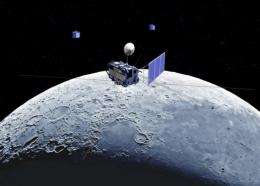
An illustration of the lunar observation satellite Kaguya

Enlarge

This illustration, released by the Japan Exploration Agency (JAXA) in 2007, shows a lunar observation satellite Kaguya. Japanese astronomers on Sunday said they had found traces of a mineral that adds an important piece of knowledge to the puzzle of the Moon's geological past.

Japanese astronomers on Sunday said they had found traces of a mineral that adds an important piece of knowledge to the puzzle of the Moon's geological past.

Using a instrument-laden probe, Kaguya, which was placed in orbit around the Moon in 2007, the team found abundant signatures of the mineral in concentric rings in three big crater regions.

The mineral, called olivine, is deemed to be a telltale of mantle, the deep inner layer of iron- and magnesium-rich rock that lies beneath the Moon's crust.

A leading theory is that the Moon was created about 4.5 billion years ago after the "Big Whack" -- it was ripped from Earth after our planet suffered a gigantic collision from some space object.

As the material coalesced into a ball, its surface gradually cooled, forming a crust made of a light-coloured aluminous mineral, feldspar, which floated in a dense, molten liquid.

Kaguya's data add a chapter to this "lunar magma ocean" hypothesis.

It suggests that after the crust had formed, there was some massive overturn in the fiery liquid beneath. Olivine-rich mantle was brought from deep within the lunar bowels to within the base of the crust.

At the craters sampled by the probe -- the South Pole-Aitken, Imbrium and Moscoviense impact basins -- the Moon's crust is very thin, and the olivine mantle may have been exposed by asteroids that smashed into the , the paper suggests.

The Moon's crust is believed to be far thicker than Earth's, averaging around 70 kilometres (45 miles) in depth, although the thickness varies significantly.

The structure and origins of the Moon's have been fiercely debated by astro-geologists.

The famous rocks brought back by the Apollo missions shed no light on the question, as they were all from the lunar crust. As a result, pointers to the existence of the were, for decades, either sketchy or indirect.

The study, published online by the journal Nature , is headed by Satoru Yamamoto of the National Institute for Environmental Studies in Tsukuba.

(c) 2010 AFP

4.1 /5 (14 votes)  

Filter


Move the slider to adjust rank threshold, so that you can hide some of the comments.


Display comments: newest first

omatumr
Jul 04, 2010

Rank: 2.5 / 5 (2)
Lunar olivine may contain evidence of the Moon's origin - as a fragment from Earth or as a separate body.

With kind regards,
Oliver K. Manuel
Rank 4.1 /5 (14 votes)
Related Stories
Relevant PhysicsForums posts
  • Scale of the Universe
    created10 hours ago
  • Titan's lack of impact craters
    createdFeb 09, 2012
  • Real pictures of black hole eating a star?
    createdFeb 08, 2012
  • Hypothetical way to travel faster than light, but not technically exceed lightspeed
    createdFeb 06, 2012
  • How do scientists monitor the Sun's activity?
    createdFeb 05, 2012
  • Search patterns in observational studies
    createdFeb 05, 2012
  • More from Physics Forums - General Astronomy

More news stories

Humans may have helped the decline of African rainforests 3000 years ago

(PhysOrg.com) -- Large areas of rainforests in Central Africa mysteriously disappeared over three thousand years ago, to be replaced by savannas. The prevailing theory has been that the cause was a change ...

Space & Earth / Environment

created 21 hours ago | popularity 4.3 / 5 (12) | comments 12 | with audio podcast report

Could Venus be shifting gear?

(PhysOrg.com) -- ESA’s Venus Express spacecraft has discovered that our cloud-covered neighbour spins a little slower than previously measured. Peering through the dense atmosphere in the infrared, the ...

Space & Earth / Space Exploration

created 17 hours ago | popularity 5 / 5 (7) | comments 7 | with audio podcast

NASA budget will axe Mars deal with Europe: scientists

US President Barack Obama's budget proposal to be submitted next week for 2013 will cut NASA's budget by 20 percent and eliminate a major partnership with Europe on Mars exploration, scientists said Thursday.

Space & Earth / Space Exploration

created 20 hours ago | popularity 5 / 5 (2) | comments 18

Two new moons for Jupiter

Advances in technology have lead to the discovery of new planets outside of our Solar System, and now even new moons in our own backyard.

Space & Earth / Space Exploration

created 17 hours ago | popularity 4 / 5 (1) | comments 7

Mars Science Laboratory computer issue resolved

(PhysOrg.com) -- Engineers have found the root cause of a computer reset that occurred two months ago on NASA's Mars Science Laboratory and have determined how to correct it.

Space & Earth / Space Exploration

created 18 hours ago | popularity 4.7 / 5 (6) | comments 3 | with audio podcast


Anonymous knocks CIA website offline (Update)

The website of the Central Intelligence Agency was inaccessible on Friday after the hacker group Anonymous claimed to have knocked it offline.

New error-correcting codes guarantee the fastest possible rate of data transmission

Error-correcting codes are one of the triumphs of the digital age. They’re a way of encoding information so that it can be transmitted across a communication channel — such as an optical fiber o ...

Google users warned of threat to smartphone wallets

Users of Google smartphone wallets were being warned on Friday that there is a way to crack pass codes intended to thwart thieves from going on illicit shopping sprees.

New power source discovered

(PhysOrg.com) -- Researchers at the Massachusetts Institute of Technology (MIT) and RMIT University have made a breakthrough in energy storage and power generation.

The power of estrogen -- male snakes attract other males

A new study has shown that boosting the estrogen levels of male garter snakes causes them to secrete the same pheromones that females use to attract suitors, and turned the males into just about the sexiest ...

Small modular reactor design could be a 'SUPERSTAR'

(PhysOrg.com) -- Though most of today's nuclear reactors are cooled by water, we've long known that there are alternatives; in fact, the world's first nuclear-powered electricity in 1951 came from a reactor ...