Japanese lab finds 'minute particles' in asteroid pod
July 5, 2010
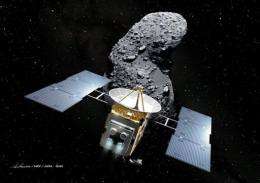
An artist's impression of Japan's space probe "Hayabusa" (Falcon) and an asteroid, called Itokawa in space

Enlarge

An artist's impression of Japan's space probe "Hayabusa" (Falcon) and an asteroid, called Itokawa in space. When Hayabusa was launched in 2003, the canister was open, meaning it may contain materials that originated on Earth, a JAXA spokesman said.

Japan's space agency said Monday it has found "minute particles" of what it hopes is asteroid dust in the capsule of the space probe Hayabusa which returned to Earth last month.

Scientists hope any dust samples from the potato-shaped asteroid Itokawa could help reveal secrets about the origins of the solar system.

"We have started the opening process of the sample container of Hayabusa since June 24, 2010 and confirmed there are minute particles," the Japan Aerospace Exploration Agency (JAXA) said.

But the agency added it remained unclear whether the particles are contaminants from Earth or come from Itokawa, which the space probe landed on during its multi-billion-kilometre (mile) journey.

It is expected to take months to get the final results of the analysis.

Hayabusa project manager Junichiro Kawaguchi said scientists believed materials from Earth were among the particles found in the pod.

"But it's important that it wasn't empty... I'm glad that there is the possibility" that some are from the asteroid, Kawaguchi told a press briefing.

Researchers have not fully opened the capsule yet but have found more than 10 specks visible to the naked eye, said another JAXA scientist, Toshifumi Mukai.

Mukai conceded these particles may not have come from the asteroid.

"I have a feeling that they are not cosmic dust," he said, adding that it was also possible that they were from deep space.

Separately, an electron microscope found two more minute particles, estimated to be slightly bigger than 10 microns each, scientists said. One micron is one-millionth of a metre.

When Hayabusa was launched in 2003, the canister was open, meaning it may contain materials that originated on Earth, a JAXA spokesman said.

Technical problems plagued the journey of Hayabusa, which at one stage spun out of control and lost contact with JAXA for seven weeks, delaying the mission for three years until the asteroid and Earth re-aligned.

When it finally latched onto the Itokawa asteroid, a pellet-firing system designed to stir up dust malfunctioned, leaving it unclear how much material the probe was able to gather.

After a seven-year space odyssey, the heatproof pod was fired back to Earth by the Hayabusa probe in June.

Researchers at JAXA's Sagamihara Campus near Tokyo, have been opening the multi-layered canister in cooperation with US space agency NASA.

(c) 2010 AFP


Rank 5 /5 (11 votes)
Related Stories
Relevant PhysicsForums posts
  • Titan's lack of impact craters
    createdFeb 09, 2012
  • Real pictures of black hole eating a star?
    createdFeb 08, 2012
  • Hypothetical way to travel faster than light, but not technically exceed lightspeed
    createdFeb 06, 2012
  • How do scientists monitor the Sun's activity?
    createdFeb 05, 2012
  • Search patterns in observational studies
    createdFeb 05, 2012
  • Derivation of Pogson's law
    createdFeb 03, 2012
  • More from Physics Forums - General Astronomy

More news stories

Humans may have helped the decline of African rainforests 3000 years ago

(PhysOrg.com) -- Large areas of rainforests in Central Africa mysteriously disappeared over three thousand years ago, to be replaced by savannas. The prevailing theory has been that the cause was a change ...

Space & Earth / Environment

created 9 hours ago | popularity 5 / 5 (3) | comments 8 | with audio podcast report

Could Venus be shifting gear?

(PhysOrg.com) -- ESA’s Venus Express spacecraft has discovered that our cloud-covered neighbour spins a little slower than previously measured. Peering through the dense atmosphere in the infrared, the ...

Space & Earth / Space Exploration

created 5 hours ago | popularity 5 / 5 (5) | comments 7 | with audio podcast

Mars Science Laboratory computer issue resolved

(PhysOrg.com) -- Engineers have found the root cause of a computer reset that occurred two months ago on NASA's Mars Science Laboratory and have determined how to correct it.

Space & Earth / Space Exploration

created 6 hours ago | popularity 5 / 5 (5) | comments 3 | with audio podcast

Clam fields found at deep, low-temperature Mariana vents

(PhysOrg.com) -- Scientists have marveled at the unusual life forms thriving at high temperature hydrothermal vents of the deep ocean.

Space & Earth / Earth Sciences

created 6 hours ago | popularity not rated yet | comments 0 | with audio podcast

Two new moons for Jupiter

Advances in technology have lead to the discovery of new planets outside of our Solar System, and now even new moons in our own backyard.

Space & Earth / Space Exploration

created 5 hours ago | popularity not rated yet | comments 2


Human cognitive performance suffers following natural disasters, researchers find

Not surprisingly, victims of a natural disaster can experience stress and anxiety, but a new study indicates that it might also cause them to make more errors - some serious - in their daily lives. In their upcoming Human Fa ...

"Twisted Metal" gamers get shot at real gunplay

Fans of "Twisted Metal" will get to welcome a long-awaited sequel of the car-battle videogame with a real-world bang by blasting an ice cream truck to bits with a machine gun.

Putting the squeeze on planets outside our solar system

(PhysOrg.com) -- Using high-powered lasers, scientists at Lawrence Livermore National Laboratory and collaborators discovered that molten magnesium silicate undergoes a phase change in the liquid state, abruptly ...

The power of estrogen -- male snakes attract other males

A new study has shown that boosting the estrogen levels of male garter snakes causes them to secrete the same pheromones that females use to attract suitors, and turned the males into just about the sexiest ...

Both maternal and paternal age linked to autism

Older maternal and paternal age are jointly associated with having a child with autism, according to a recently published study led by researchers at The University of Texas Health Science Center at Houston (UTHealth).

New error-correcting codes guarantee the fastest possible rate of data transmission

Error-correcting codes are one of the triumphs of the digital age. They’re a way of encoding information so that it can be transmitted across a communication channel — such as an optical fiber o ...